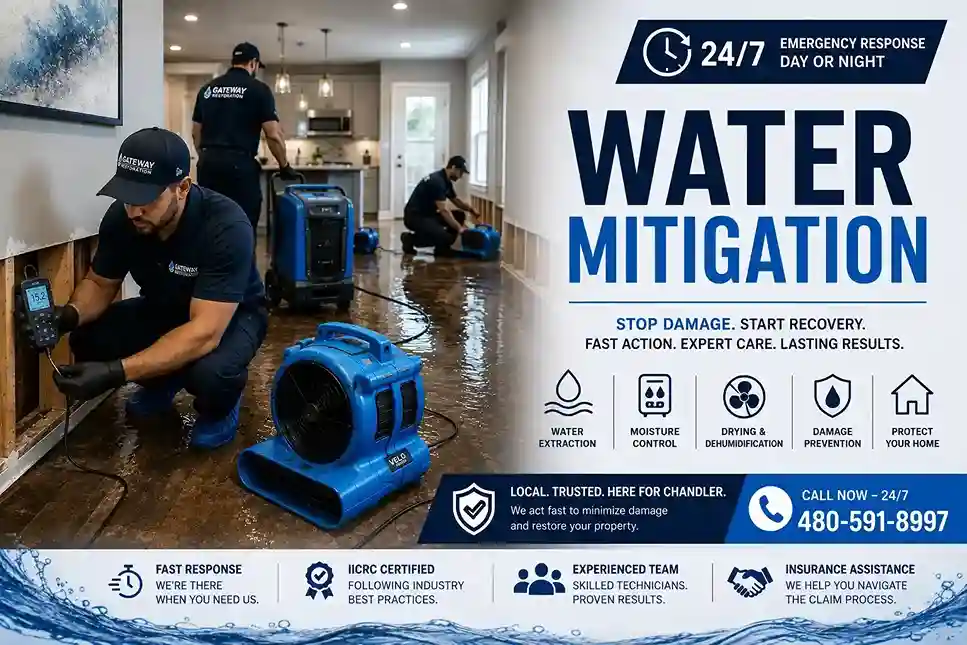
Water damage becomes more expensive every hour it remains untreated. Gateway Restoration provides emergency water mitigation services designed to stop ongoing damage, stabilize affected materials, reduce moisture levels, protect structural components, and prepare your property for successful restoration.
Gateway Restoration is the crew that arrives immediately after a water loss to stop the damage from spreading. Below, we break down exactly what mitigation involves, how it differs from restoration, and why acting fast in Chandler's climate matters more than most homeowners realize.
Water mitigation is the set of emergency actions taken immediately after a water loss to prevent the damage from becoming more severe. It's not repair work — it's damage control. The goal is to stop what's happening now, stabilize the property, and set the stage for a successful restoration.
A technician evaluates the source, scope, and severity of the water loss the moment they arrive.
We locate and stop the source, whether it's a burst pipe, slab leak, or storm intrusion.
Standing water is removed quickly using truck-mounted and portable extraction equipment.
Wet flooring, drywall, and framing are stabilized to slow further absorption and warping.
Air movers and dehumidifiers begin pulling moisture out of the structure and the air.
Every reading, photo, and action is logged to support your insurance claim from day one.
Together, these actions are designed to reduce the severity of the loss before repairs ever begin — which is exactly why mitigation, not restoration, is the first call you should make.
These two terms get used interchangeably, but they describe two very different phases of recovery. Understanding the difference helps you know what to expect — and when — after a water loss.
Mitigation always happens first. Restoration only begins once moisture readings confirm the structure is stable and dry. Skipping or rushing mitigation is one of the most common reasons restoration projects run over budget. For a deeper comparison, see our guide on water mitigation vs. restoration.
Chandler homes and businesses face a specific set of water loss scenarios shaped by local construction, plumbing, and climate. Each one requires mitigation to begin immediately.
Common in Chandler's slab-on-grade homes, where a hidden leak beneath the foundation can saturate flooring before it's ever noticed. Learn more.
Hard water and aging galvanized plumbing throughout the East Valley raise the risk of sudden pipe failure. Learn more.
A failed tank can release dozens of gallons in minutes, often in a garage or utility closet that spreads to adjoining rooms. Learn more.
Washing machines, dishwashers, and refrigerator lines are frequent sources of gradual and sudden leaks in Chandler homes. Learn more.
Arizona's heavy air conditioning use means condensate line failures are a common, often hidden, source of attic and ceiling damage. Learn more.
Monsoon winds and driving rain can force water beneath roofing materials, especially on older Chandler homes.
Fast, intense monsoon storms overwhelm roofs, gutters, and yard grading across the Chandler area every summer.
A broken irrigation line near the foundation can saturate soil and push moisture into the slab over time. Learn more.
Contaminated water from a sewer backup requires immediate mitigation under Category 3 protocols.
Restaurants, offices, and retail spaces throughout Chandler face unique mitigation needs to protect operations and inventory.
Every mitigation job follows a consistent, IICRC-based process. Here's exactly what happens once our crew arrives at your Chandler property.
We assess the full scope of the loss, identify affected rooms and materials, and determine the safest, fastest path to stabilization.
We locate and stop the source of the water, whether that means shutting off a valve, capping a line, or coordinating with a plumber.
Every loss is classified before further work begins:
Standing water is removed using truck-mounted and portable extraction equipment, pulling far more volume than shop-vacs. See our extraction process.
Thermal imaging and moisture meters locate hidden pockets of water inside walls, under flooring, and behind cabinetry. Learn how it works.
Wet materials are stabilized to slow further absorption, warping, and swelling while drying equipment is deployed.
Commercial air movers and dehumidifiers are placed according to IICRC calculations based on room size, humidity, and material type. See structural drying and dehumidification services.
We return daily to track drying progress and adjust equipment placement until moisture readings confirm the structure is stable.
Every moisture reading, photo, and piece of equipment used is logged to support your insurance claim from day one.
Once the property is confirmed dry, we hand off a clear scope of work for the repair and rebuild phase.
Chandler's climate and construction create conditions where delayed mitigation causes damage to escalate faster than in many other parts of the country.
High indoor temperatures accelerate mold colonization, often within 24 to 48 hours of water exposure.
Intense, fast-moving rain between June and September can overwhelm roofs and grading in minutes.
Homes near washes and low-lying streets face sudden water intrusion during monsoon season.
Water can become trapped behind exterior stucco long before a stain ever appears indoors.
Most Chandler homes sit on concrete slabs, where leaks travel underneath flooring undetected.
Condensate line failures are a frequent, overlooked source of attic and ceiling moisture.
Every hour of delay increases repair costs, extends drying times, raises mold risk, and increases the likelihood that materials will need to be replaced instead of saved.
Fast intervention is often the single biggest factor in what can be saved versus what has to be replaced. Materials that are treated within the first few hours have a significantly higher survival rate.
Can often be dried in place if extraction begins before delamination sets in.
Tile itself is water-resistant, but subfloor and grout require fast moisture control.
Base cabinets can frequently be dried and saved rather than removed.
Minor drywall wicking can be dried; extensive saturation may still require replacement.
Wood framing can typically be preserved with fast, thorough drying.
Furniture, electronics, and documents often have a strong chance of recovery when treated quickly.
We provide mitigation for single-family homes, condos, apartments, and townhomes throughout the Chandler area. A kitchen slab leak in Ocotillo, a washing machine overflow in Fulton Ranch, or a monsoon-driven roof leak near Sun Lakes all call for the same fast, structured response — stop the source, extract, stabilize, and monitor until the home is verified dry. See our residential restoration services.
Business downtime is often more costly than the water damage itself. We provide commercial mitigation for office buildings, retail spaces, warehouses, restaurants, healthcare facilities, schools, HOAs, and property management portfolios across Chandler and the East Valley, with a focus on keeping operations running wherever possible. See our commercial restoration services.
Mitigation decisions aren't guesswork — they're driven by data collected throughout the job.
Reveals temperature differences that indicate hidden moisture behind walls and ceilings.
Measure moisture content directly inside drywall, subfloor, and framing materials.
Track ambient humidity levels to confirm drying equipment is working effectively.
Ongoing tracking ensures the drying environment stays on target throughout the job.
Creates a visual record of affected areas to guide equipment placement and verify progress.
Every reading is logged and time-stamped as part of your insurance record.
Thorough documentation protects both you and your insurance company by proving the mitigation work was necessary, timely, and effective.
Daily readings that track the drying process from start to finish.
A record of every air mover and dehumidifier deployed, and for how long.
Formal classification of the water type, which affects coverage and protocol.
Before, during, and after photos of every affected area.
Ongoing updates so you and your adjuster always know where the job stands.
Reports formatted the way Chandler-area adjusters expect to see them.
Learn more about whether insurance covers water damage in Arizona.
We provide water mitigation throughout Chandler and the greater East Valley, including these neighborhoods and communities.
Crews positioned near Chandler dispatch immediately, day or night.
Commercial-grade extraction, drying, and moisture-detection tools on every job.
We know Chandler's soil, plumbing, and monsoon patterns firsthand.
Clear updates at every stage, with no surprises along the way.
Every decision is backed by data, not guesswork.
We work directly with you and your insurance adjuster from day one.
Water mitigation is the emergency stabilization phase that happens after a water loss, focused on stopping the source, extracting water, controlling humidity, and preventing additional damage before restoration and repairs begin.
Mitigation stops and stabilizes the damage, while restoration rebuilds and repairs the property. Mitigation always happens first, and restoration follows once the structure is confirmed dry.
Mitigation should begin within hours of discovering water damage. Materials absorb moisture quickly, and in Arizona's warm indoor environments, mold risk increases significantly after the first 24 to 48 hours.
Most policies cover mitigation when the water loss is sudden and accidental, such as a burst pipe or appliance failure. Damage from long-term neglect is typically excluded. Read more in our Arizona insurance coverage guide.
Yes. Rapid extraction, humidity control, and structural drying during mitigation are the primary defenses against mold developing in wet materials.
Most mitigation stabilization takes one to three days, depending on the water category, affected square footage, and how long the property sat wet before crews arrived.
Slab leaks, burst pipes, water heater failures, appliance leaks, HVAC condensate leaks, roof leaks, monsoon flooding, irrigation failures, and sewer backups all require immediate mitigation.
Often, yes, if mitigation begins quickly. Hardwood, tile, and other flooring materials have a much higher chance of survival when extraction and drying start within the first few hours.
Yes. We provide commercial water mitigation for office buildings, retail spaces, warehouses, restaurants, healthcare facilities, schools, HOAs, and property management portfolios throughout the Chandler area.
Once moisture readings confirm the structure is stable and dry, the property moves into the restoration phase, where repairs, rebuild, and replacement of damaged materials take place.
17817 S McQueen Rd, Chandler, AZ 85286