 Gateway Restoration
How Fast Does Mold Grow After Water Damage in Chandler, AZ?
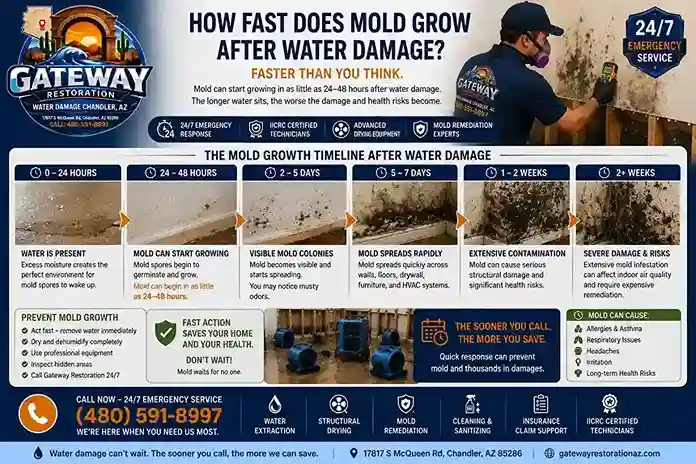
Water damage in the last 24 hours? Don't wait to find out if mold has started.
📞 Call (480) 591-8997 NowMost homeowners assume mold takes weeks, even months, to show up after a flood, a burst pipe, or a leaking water heater. That assumption is one of the most expensive mistakes a Chandler homeowner can make. Mold doesn't wait for you to notice a stain or smell an odor — it activates on a biological timeline that starts the moment building materials get wet, and in Arizona's warm indoor environments, that timeline moves faster than most people expect. This guide walks through exactly what happens hour by hour after water damage, why Chandler's climate creates unique mold risk despite its dry reputation, where mold hides first, and what actually stops it before it becomes a remediation project.
The Mold Growth Timeline: What Happens Hour by Hour
Mold growth isn't instantaneous, but it isn't slow either. It follows a fairly predictable biological progression once building materials become wet enough to support spore activation. Here's what that timeline typically looks like in a residential setting.
| Time After Water Damage | What Happens |
|---|---|
| 0–24 Hours | Moisture saturation begins |
| 24–48 Hours | Mold spores activate |
| 48–72 Hours | Visible colonies may start |
| 3–7 Days | Rapid growth phase |
| 1–2 Weeks | Structural contamination risk |
| 1 Month+ | Major remediation often required |
0–24 Hours: Moisture Saturation Begins
In the first day after a leak, burst pipe, or flood, water is being absorbed into porous materials — drywall paper, wood framing, carpet padding, and cabinetry. The surface may look wet or may already appear dry to the eye, but moisture is wicking upward and inward well past what's visible. This is the window where extraction and drying have the highest chance of preventing mold altogether.
24–48 Hours: Mold Spores Activate
Mold spores are present in virtually every home, resting dormant in dust and on surfaces. Once a material's moisture content rises into the right range and stays there, dormant spores begin to germinate. This is the critical window referenced throughout this article — the point where "wet" starts becoming "actively growing."
48–72 Hours: Visible Colonies May Start
By the second or third day, early colonies can become visible as faint discoloration, especially on paper-faced drywall, grout lines, or the underside of carpet. In hidden cavities — behind baseboards, under cabinets, inside wall voids — growth may already be established even though nothing is visible from the room.
3–7 Days: Rapid Growth Phase
This is when mold colonies expand aggressively if moisture hasn't been removed. Colonies spread across contiguous wet surfaces, and spore counts in the surrounding air begin to rise measurably. Odor often becomes noticeable during this window even before visible growth is obvious.
1–2 Weeks: Structural Contamination Risk
Left untreated for one to two weeks, mold can move from surface growth into porous structural materials — wood framing, subfloor, and insulation — where simple surface cleaning is no longer sufficient. This is typically the point where remediation, rather than simple drying, becomes the only realistic path forward.
1 Month+: Major Remediation Often Required
After a month of unresolved moisture, colonization is usually extensive enough that affected materials need to be removed and replaced rather than treated in place. Odor, air quality complaints, and visible damage are common by this stage, and remediation costs rise substantially compared to early intervention.
Why Mold Grows So Quickly After Water Damage
Mold isn't unpredictable — it's opportunistic. It needs four specific ingredients to establish and grow, and a flooded or leaking home provides all four simultaneously, which is exactly why the timeline above moves as fast as it does.
Moisture
This is the single most important factor. Mold requires sustained elevated moisture content in a material, not just brief dampness. Water damage delivers exactly that — saturated materials that stay wet for hours or days rather than minutes.
Organic Material
Mold feeds on organic material, and homes are full of it. Drywall paper facing, wood framing, carpet backing, cardboard storage boxes, and household dust are all food sources sitting inside nearly every wall cavity and closet.
Warm Temperatures
Most mold species thrive between roughly 60°F and 80°F — squarely within the range of a typical indoor Chandler home, even during air-conditioned summer months. There's rarely a temperature barrier protecting an Arizona home the way there might be in a colder climate.
Time
Given the first three ingredients, time is what turns dormant spores into an active colony. That's the one variable a homeowner can actually control — and it's the reason speed of response matters more than almost any other factor in preventing mold after water damage.
Does Mold Grow Faster in Chandler, Arizona?
Arizona's reputation as a dry climate leads many homeowners to assume mold isn't a serious local risk. In practice, several Chandler-specific conditions create pockets of elevated humidity that can make indoor mold growth just as fast, or faster, than in more traditionally humid regions.
Monsoon Season Humidity
From July through September, Chandler's monsoon season brings a sharp spike in outdoor humidity alongside intense, fast-moving storms. Homes that experience roof leaks, window intrusion, or flooding during this period are dealing with wet materials in an already humid indoor environment, which accelerates every stage of the mold timeline.
Post-Storm Indoor Humidity
Even homes that don't take on direct water damage often see indoor relative humidity climb for days after a monsoon event, as saturated air infiltrates through doors, attic vents, and building envelope gaps. That ambient humidity alone can be enough to sustain mold growth in areas with residual dampness from an unrelated, older leak.
Stucco Construction
Stucco exteriors, standard on most Chandler homes, can trap moisture behind the coating when water finds a path in through cracks, flashing failures, or window penetrations. Because stucco doesn't show staining the way interior drywall does, trapped wall-cavity moisture can go unnoticed for extended periods.
Attic Heat
Chandler attics regularly exceed 130°F in summer, and while extreme heat isn't ideal for most mold species, it does accelerate material breakdown and creates dramatic temperature and moisture swings once a roof leak introduces water into that environment, particularly around HVAC ductwork and insulation.
HVAC Condensation
Because Chandler homes rely on air conditioning nearly year-round, HVAC systems generate a constant stream of condensate. A clogged condensate line or a failed drain pan is one of the most common, and most overlooked, sources of ongoing indoor moisture — often in an attic or closet where no one is looking regularly.
Energy-Efficient Modern Homes
Newer, tightly sealed Chandler homes are excellent at keeping conditioned air in, but that same airtightness can trap moisture indoors longer after a leak, since natural air exchange with the drier outdoor environment is reduced compared to older, leakier construction.
Where Mold Usually Appears First After Water Damage
Mold rarely starts where you can see it. It starts where moisture lingers longest and airflow is weakest — which is almost always somewhere hidden from daily view.
Behind Drywall
Wall cavities trap moisture against the back side of drywall, where paper facing provides an ideal food source and airflow is minimal.
Under Flooring
Subfloor and the underside of tile, laminate, or hardwood can stay damp long after the surface feels dry to the touch.
Inside Cabinets
Toe kicks and cabinet interiors near sinks, dishwashers, or water heaters trap humidity in an enclosed, poorly ventilated space.
Beneath Baseboards
Baseboards sit directly against the wall-floor joint, one of the most common places for wicked moisture to collect unnoticed.
Inside Wall Cavities
Insulation and framing inside the wall stay wet far longer than the visible drywall surface, with almost no natural airflow to help drying.
Behind Bathroom Vanities
Supply line and drain connections under vanities create a chronically humid micro-environment even from small, slow leaks.
Under Carpet Padding
Padding holds water like a sponge, keeping the subfloor beneath it wet long after the carpet surface appears dry.
HVAC Systems
Ductwork, drain pans, and coil compartments provide dark, often damp conditions that can harbor growth largely out of sight.
Homeowners typically miss these locations for one simple reason: nothing looks wrong from the room. Surfaces can appear completely dry while the material directly behind or beneath them is still saturated — which is exactly why professional moisture detection matters so much in the first 48 hours.
Not sure if moisture is trapped somewhere you can't see? We can check.
📞 Request a Moisture CheckWhat Water Damage Situations Cause Mold the Fastest?
Not all water events carry the same mold risk. The source, the water category, and how long it goes undetected all affect how quickly the timeline above plays out.
- Burst Pipes — Clean water, but often high volume released quickly into wall cavities and flooring, creating widespread saturation fast.
- Water Heater Leaks — Frequently undetected overnight or while homeowners are away, giving mold a head start before anyone calls for help.
- Roof Leaks — Often slow and intermittent, meaning materials cycle between wet and dry for weeks, a pattern that can actually accelerate colonization in the affected zone.
- AC Condensate Overflows — Chronic, low-volume leaks in attics or closets that go unnoticed for long stretches, ideal conditions for sustained mold growth.
- Washing Machine Failures — Sudden, often significant water volume into laundry rooms and adjoining spaces.
- Dishwasher Leaks — Slow leaks under cabinetry that mimic the vanity scenario above, often going unnoticed for weeks.
- Slab Leaks — Continuous moisture wicking up through flooring, creating a persistent, hard-to-fully-dry source of humidity.
- Monsoon Flooding — Large-volume intrusion combined with already elevated outdoor and indoor humidity, a high-risk combination.
- Sewage Backups — Contaminated water carrying its own biological load, requiring immediate professional response regardless of mold timeline.
The Hidden Mold Problem Most Homeowners Never See
The most dangerous mold scenarios aren't the ones with a visible stain on the ceiling — they're the ones where everything looks fine. Concealed moisture inside wall cavities, under flooring systems, in attic insulation, or within crawl spaces can sustain active mold growth for weeks while the visible surfaces in the room show no sign of a problem at all. This is why "it looks dry" is not the same thing as "it is dry," and why moisture readings, not visual inspection alone, are the standard restoration professionals rely on.
Warning Signs Mold May Already Be Growing
Musty Odors
An earthy, damp smell is often the earliest detectable sign, sometimes appearing before any visible growth.
Discoloration
Dark spotting, staining, or a greenish-black tint on drywall, grout, or wood surfaces.
Warped Materials
Bowing, buckling, or swelling in flooring, cabinetry, or drywall indicates sustained moisture exposure.
Peeling Paint
Paint bubbling or peeling from a wall can signal moisture pushing through from behind the surface.
Increased Humidity
A room that consistently feels muggier than the rest of the house may have an unresolved moisture source.
Persistent Dampness
Surfaces that stay cool or damp to the touch well after a leak was supposedly addressed.
Allergic Reactions
Unexplained sneezing, coughing, or irritation that improves when away from the home can point to elevated spore exposure.
HVAC Odors
A musty smell specifically when the air conditioner runs often points to moisture inside the ductwork or coil compartment.
How Professionals Detect Mold Before It Becomes Visible
Restoration professionals don't wait for mold to become visible to confirm a problem — they measure the conditions that predict it. Gateway Restoration uses several detection methods together to build an accurate picture of hidden moisture before it becomes an active colony.
- Thermal Imaging — Infrared cameras reveal temperature differences in walls and floors that indicate trapped moisture, without any demolition.
- Moisture Mapping — A systematic, documented survey of moisture levels across every affected surface, establishing the true boundary of water intrusion.
- Hygrometers — Measure relative humidity in the air of a room to identify whether ambient conditions are supporting mold growth.
- Moisture Meters — Pin and pinless meters read moisture content directly inside materials like drywall, wood, and subfloor.
- Infrared Cameras — Used alongside thermal imaging to pinpoint specific problem zones for targeted investigation.
- Air Sampling — When elevated mold activity is suspected, air samples can quantify spore concentrations compared to a baseline outdoor sample.
- Surface Testing — Swab or tape-lift samples confirm whether visible discoloration is actually microbial growth.
These tools let us find and dry hidden moisture before it ever reaches the point of visible, established colonization — which is the entire goal of an early response.
Why Drying Is More Important Than Mold Removal
This is one of the most important concepts in water damage restoration: preventing mold is dramatically easier, faster, and less expensive than remediating it once it has established. The comparison below illustrates why speed matters so much.
Immediate Drying
Typically completed in three to five days with commercial air movers and dehumidifiers. Materials are often saved. Minimal disruption to the household, and cost is generally limited to extraction and drying equipment time.
Mold Remediation Weeks Later
Often requires containment barriers, removal of contaminated materials, air scrubbing, and post-remediation verification testing. Cost, timeline, and disruption all increase substantially compared to early drying.
The math is simple: every day of delay shifts a job from a drying problem to a demolition-and-rebuild problem. That's why our process, from the moment we're called, is built around stopping moisture before mold has the chance to establish, not cleaning it up after it has.
What Happens If Mold Is Allowed to Grow?
- Drywall Damage — Contaminated drywall typically must be cut out and replaced rather than cleaned.
- Cabinet Damage — Particleboard cabinet components swell, delaminate, and become a growth medium themselves.
- Flooring Damage — Subfloor and flooring materials can require full replacement rather than repair.
- Insulation Damage — Wet, contaminated insulation loses effectiveness and must be removed and replaced.
- Odor Problems — Persistent musty odor can linger in a home long after visible mold is removed if the source isn't fully addressed.
- Structural Concerns — Extended moisture exposure can compromise the strength of wood framing over time.
- Reduced Property Value — A documented mold history can affect resale value and complicate future insurance coverage.
Black Mold: What Homeowners Need to Know
Few topics generate more anxiety than "black mold," and much of what circulates online is exaggerated or inaccurate. Here are the facts, stated plainly. Stachybotrys chartarum, the species most commonly referred to as black mold, requires sustained, high moisture conditions to grow — generally more prolonged saturation than many other common indoor mold species need. Its presence is not something a homeowner can reliably determine by color alone, since several mold species can appear dark in color. Professional testing is the only reliable way to identify the specific species present when that information matters for remediation planning. Importantly, the standard of care in restoration is the same regardless of species: all mold growth should be addressed professionally, because the health and structural risks of unresolved moisture exist independent of which species happens to be present.
How to Stop Mold Growth After Water Damage
- Stop the Water Source. Shut off the supply line, main valve, or appliance causing the leak before anything else.
- Call a Restoration Professional. Call (480) 591-8997 as soon as the source is controlled — every hour matters more than most homeowners realize.
- Remove Standing Water. Extraction equipment removes far more volume and moisture than household tools like mops or shop-vacs can manage.
- Begin Drying Immediately. Commercial air movers and dehumidifiers are placed based on room size, humidity, and material type to accelerate evaporation safely.
- Monitor Moisture Levels. Daily readings track drying progress objectively rather than relying on how a surface looks or feels.
- Verify Dryness. Materials are only considered dry once moisture meter readings return to a normal baseline, not simply when they appear dry.
- Apply Antimicrobial Treatments. Where appropriate, antimicrobial treatments add a layer of protection against growth during the drying window.
Real Chandler Water Damage Scenarios and Mold Timelines
Water Heater Leak in Ocotillo
A garage water heater fails overnight and goes unnoticed until morning — roughly 8 to 10 hours of saturation. With same-day extraction and drying, mold risk stays low; without it, spore activation can begin within the following 24 to 48 hours.
Monsoon Flood in Sun Lakes
Storm water enters through a roofline during an intense July system. Combined with elevated outdoor humidity, hidden moisture in the attic and ceiling cavity can support growth in as little as 48 hours if not professionally dried.
AC Leak in Cooper Commons
A clogged condensate line drips slowly into an attic space for an estimated one to two weeks before discovery — well past the window where simple drying alone resolves the issue, often requiring remediation of affected insulation.
Roof Leak in Clemente Ranch
An intermittent leak wets and partially dries a ceiling cavity across several storms over a month, a cycling pattern that can actually accelerate colonization compared to a single saturation event.
Burst Pipe in Downtown Chandler
A supply line fails while the homeowner is at work, releasing water for several hours before discovery. Same-day professional extraction and drying keeps the timeline inside the low-risk window.
Mold Prevention Tips for Chandler Homeowners
- HVAC Maintenance. Schedule regular servicing and keep condensate lines clear, especially before summer cooling season.
- Condensate Drain Inspections. Check attic drain pans and lines periodically for clogs or slow drips.
- Roof Inspections. Inspect roofing and flashing before monsoon season each year, particularly around penetrations and valleys.
- Plumbing Checks. Periodically inspect supply lines, shutoff valves, and fittings under sinks and behind appliances.
- Humidity Monitoring. A simple hygrometer can flag a room running persistently higher than the rest of the home.
- Monsoon Preparation. Clear gutters, check grading around the foundation, and confirm door and window seals before storm season arrives.
When Should You Call a Mold Remediation Professional?
- Visible Mold of any size, since surface appearance doesn't reflect how far growth extends behind the material.
- Musty Odors without an obvious visible source.
- Hidden Moisture confirmed by a moisture meter, thermal scan, or persistent humidity reading.
- Flood Events, given the volume and speed of saturation involved.
- Sewage Backups, which require professional handling regardless of visible mold.
- Long-Term Leaks that went unnoticed for more than 48 hours.
- Failed DIY Drying, where fans and dehumidifiers from a hardware store haven't resolved lingering dampness or odor.
Any of these apply to your home right now? Let's take a look before it spreads further.
📞 Call (480) 591-8997The IICRC Standard Behind Our Process
Every step described in this article — extraction timing, drying equipment placement, moisture verification, and antimicrobial application — follows the IICRC S500 Standard for Professional Water Damage Restoration, the industry benchmark used to classify water damage and guide the drying process. That standard exists precisely because the mold timeline is predictable: it defines water categories based on contamination level, sets expectations for drying duration based on material type and humidity, and requires documented moisture readings rather than visual judgment calls before a job is considered complete. When a restoration company tells you a space is "dry," that claim should be backed by a number on a moisture meter, not a guess based on how a surface feels. This is the same rigor we bring to every water heater leak, monsoon flood, or slab leak job across Chandler, and it's the reason our drying timelines and mold-prevention outcomes are consistent rather than left to chance.
Why Chandler Homeowners Trust Gateway Restoration
We're a locally based restoration company, not a national call center routing your job to whoever's available. Our crews respond quickly throughout Chandler neighborhoods including Ocotillo, Sun Lakes, Cooper Commons, Fox Crossing, and Downtown Chandler, using moisture mapping and thermal imaging to find hidden water before it becomes a mold problem. When drying alone isn't enough, we handle mold prevention and full mold remediation in-house, backed by IICRC S500 drying standards and documentation built for your insurance claim from day one. We've seen firsthand how a fast response to a garage water heater leak in Ocotillo or an attic AC condensate drip in Cooper Commons can mean the difference between a two-day drying job and a multi-week remediation project — which is why our dispatch process is built around minutes, not days.
Related Services
Frequently Asked Questions
How soon can mold start growing after water damage?
Mold spores can begin activating within 24 to 48 hours of sustained moisture exposure, with visible colonies sometimes appearing as early as 48 to 72 hours in favorable conditions.
Can mold grow in less than 24 hours?
True colonization is unlikely in under 24 hours, but the moisture saturation that sets the stage for growth begins immediately, which is why fast extraction in the first day matters so much.
Will fans stop mold growth?
Household fans move air across a surface but can't reach moisture trapped inside drywall, cabinetry, or subfloor the way commercial air movers and dehumidifiers can, so they're rarely sufficient on their own after significant water damage.
How do I know if mold is growing behind walls?
Musty odor, unexplained humidity, or discoloration near baseboards can all be indicators. Moisture meters and thermal imaging are the most reliable way to confirm what's happening inside the wall cavity without demolition.
Does homeowners insurance cover mold?
Coverage typically depends on the cause. Mold resulting from a sudden, accidental event like a burst pipe is often covered, while mold from long-term neglect or an unresolved leak is typically excluded. Documentation of the timeline matters for your claim.
Can mold grow under tile flooring?
Yes. While tile itself doesn't support growth, the subfloor, adhesive layer, and grout lines beneath and around it can stay wet long enough to support mold, especially after a slab leak or prolonged standing water.
What does mold smell like?
Most mold produces a musty, earthy odor, sometimes described as similar to wet cardboard or damp soil. A persistent version of this smell, especially in one area of a home, is a common early warning sign.
Is black mold more dangerous than other mold?
All mold growth should be treated seriously and addressed professionally. Species identification through testing can inform remediation planning, but the recommended response — stop the moisture, remove the growth, verify dryness — is consistent regardless of which species is present.
Can mold come back after remediation?
Mold returns when the underlying moisture source wasn't fully resolved. Proper remediation includes identifying and correcting the source, not just removing visible growth, which is why moisture verification is a required final step in our process.
How can I prevent mold after water damage?
Call a restoration professional immediately, remove standing water quickly, begin structural drying without delay, and confirm dryness with moisture readings rather than assuming a surface that looks dry is actually dry.
Every Hour Matters After Water Damage
If your Chandler home has experienced water damage, mold prevention starts immediately after water intrusion, not days later. The faster drying begins, the greater the chance of avoiding costly mold remediation.
Gateway Restoration
17817 S McQueen Rd, Chandler, AZ 85286
24/7 Emergency Water Damage & Mold Response Throughout Chandler and the East Valley