 Gateway Restoration
Gateway Restoration
Gateway Restoration
Chandler homeowners face a specific set of water damage risks — monsoon flooding, water heater failures, slab leaks, appliance leaks, AC condensation problems, burst pipes, and hidden moisture that can sit undetected for weeks. This blog is a free, ongoing resource built by our restoration team to help you understand what's happening in your home, what to do first, and when professional help matters most — whether or not you're ready to call us today.
Need immediate help? Call Gateway Restoration at (480) 591-8997 for 24/7 emergency water damage restoration in Chandler and the East Valley.
These three guides answer the questions Chandler homeowners ask us most — before, during, and after a water damage event.
A realistic breakdown of what to expect at each stage — water extraction, structural drying, repairs, and the insurance documentation that runs alongside the work — so you know what a normal timeline looks like for your specific loss.
Read the guide →Mold timelines in Arizona's warm indoor environments, how Chandler's humidity and monsoon moisture change the equation, and the prevention strategies that actually make a difference in the first 48 hours.
Read the guide →Hidden leaks rarely announce themselves. Learn the early warning signs — from musty odors to subtle discoloration — and the moisture detection methods professionals use to find what's hiding behind your walls and floors.
Read the guide →When water damage is actively happening, the first hour matters more than any other. These resources walk you through exactly what to do — and what to avoid — while help is on the way.
A step-by-step first-hour checklist: safety steps, stopping the water source, documenting damage for insurance, and what to do while waiting for a restoration crew to arrive.
Read the guide →What Category 1, Category 2, and Category 3 water actually mean, why the distinction changes the entire restoration approach, and how classification affects your safety and your claim.
Read the guide →Structural drying is one of the most misunderstood parts of restoration. Homeowners often assume a wet carpet or a few fans mean the job is done — but real drying follows measurable science, not guesswork, and moisture that isn't detected doesn't just disappear on its own.
An inside look at IICRC drying standards, the science of moisture removal from framing, drywall, and subfloor, and why proper equipment placement matters more than the number of fans in a room.
Read the guide →How thermal imaging and moisture meters work together to find hidden water inside walls and under flooring — and why documented readings give your insurance adjuster objective proof, not just an opinion.
Read the guide →The cheapest water damage restoration job is the one that never happens. These guides cover the maintenance habits that catch problems before they become emergencies.
A practical preventive maintenance schedule for Chandler homes, including seasonal inspections and monsoon preparation steps that catch small problems before they become expensive ones.
Read the guide →An honest look at when drywall can be dried and salvaged versus when it needs to be removed, how water category affects the decision, and the mold concerns that drive replacement calls.
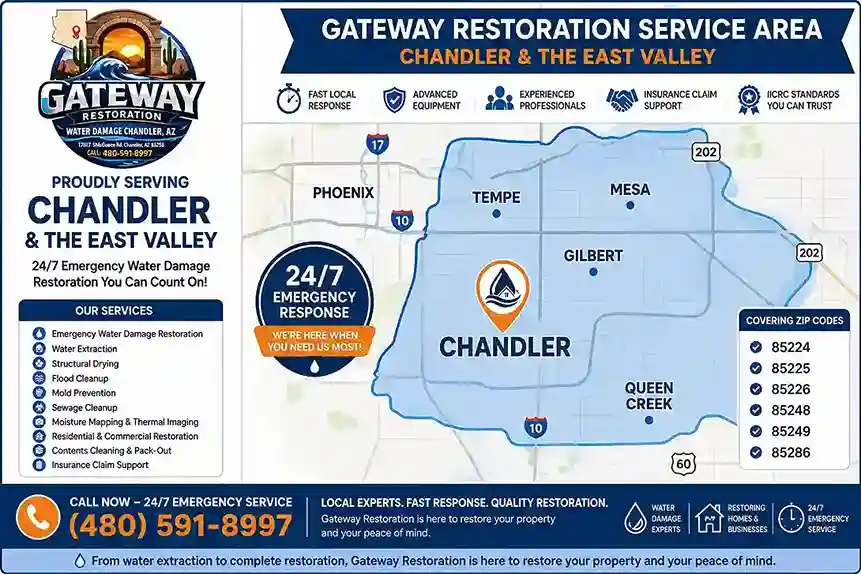
Read the guide →Water damage in the East Valley doesn't look like water damage in wetter climates. Our technicians respond to the same recurring set of causes across Chandler, Gilbert, Mesa, Tempe, Queen Creek, and Phoenix, shaped by our specific weather, soil, and construction patterns.
Monsoon season, running from July through September, is the single biggest driver of storm-related water damage calls in Chandler. These storms move in fast, dropping intense rainfall in a short window that overwhelms roofs, gutters, and yard grading before most homeowners even realize water has breached the structure. Flash flooding compounds the risk in neighborhoods near washes and low-lying streets, where fast-moving stormwater can push against exterior walls and foundations within minutes of a storm starting.
Much of the East Valley, including Chandler, Gilbert, and Mesa, is built on slab foundations, a construction style that creates a specific vulnerability: when a slab leak develops, water has nowhere to go but up into flooring and framing, often for weeks before a homeowner notices a warm spot on the floor or a spike in the water bill. Combined with Chandler's hard, caliche-heavy soil that drains poorly, slab leaks are one of the most common sources of undetected water damage we respond to across the region.
Water heater failures are another leading cause, particularly in homes with aging units approaching or past their expected service life. A failed tank in a garage or closet can release dozens of gallons before it's discovered, often soaking stored belongings, drywall, and flooring in the process. Arizona's climate also means AC condensation issues are a uniquely regional risk: with air conditioning running for most of the year, condensate drain lines that clog or fail can slowly leak into ceilings and walls, especially in attics above bedrooms and hallways.
Appliance leaks from washing machines, dishwashers, refrigerators, and water softeners remain one of the most common causes of residential water damage claims we see throughout Chandler, Gilbert, Mesa, Tempe, Queen Creek, and Phoenix. And across nearly every cause listed here, the common thread is hidden moisture — water that travels behind walls, under flooring, or above ceilings long before it becomes visible. This is exactly why moisture mapping and thermal imaging matter: they let a trained technician find and document water that a visual inspection alone would miss, protecting both the structure and your insurance claim.
July–September storms bring fast-moving rain that overwhelms roofs and drainage in minutes.
Fast-moving stormwater threatens homes near washes and low-lying streets.
Common East Valley construction means slab leaks travel upward, often undetected for weeks.
Aging infrastructure raises the risk of sudden tank failures in garages and closets.
Heavy summer AC use makes condensate line failures a common, often hidden risk.
Water often travels behind walls and under floors — exactly why moisture mapping matters.
Understanding the basics of water damage restoration before you need it puts you in a stronger position when an emergency does happen.
That's the purpose of this blog: to give Chandler homeowners, property managers, business owners, HOAs, and insurance claim stakeholders a trustworthy, free resource — whether you're preparing before a storm or standing in a wet hallway right now.
Stop the water source if it's safe to do so, cut power to any affected outlets, document the damage with photos, and call a restoration company. Avoid relying on household fans alone — they can't reach moisture trapped inside walls, baseboards, or subfloor.
In Arizona's warm indoor environments, mold spores can begin colonizing damp materials within 24 to 48 hours of water exposure. This is why immediate extraction and drying are so important, rather than waiting to see if an area dries on its own.
Minor, surface-level moisture from a small spill can sometimes be managed with fans and towels. But once water has reached flooring, drywall, or framing, DIY drying rarely reaches trapped moisture the way commercial equipment does, and incomplete drying is the leading cause of hidden mold.
Most residential structural drying takes three to five days with commercial air movers and dehumidifiers running continuously. Larger losses, Category 3 water, or dense materials like tile and concrete slab can extend that timeline.
Moisture mapping uses thermal imaging and moisture meters to locate hidden water inside walls, ceilings, and under flooring that isn't visible during a standard walkthrough, with readings logged for insurance documentation.
No. Water is classified into Category 1 (clean), Category 2 (gray water with some contamination), and Category 3 (grossly contaminated, such as sewage). Classification determines the safety protocols and restoration approach used.
It depends on the water category and how long the drywall stayed wet. Clean water exposure for a short period is often salvageable with proper drying, while contaminated water or prolonged saturation typically requires removal and replacement.
The most common causes we see are water heater failures, slab leaks, appliance leaks, monsoon storm intrusion, AC condensate overflows, and burst pipes, often compounded by Chandler's slab foundations and poor-draining soil.
Most homeowners policies cover sudden, accidental damage such as a burst pipe or storm intrusion. Damage from long-term neglect or a gradual, unaddressed leak is typically excluded. Documentation supports your claim either way.
As soon as you discover standing water, saturated materials, or signs of a hidden leak. The first few hours after discovery are the most important window for limiting damage and preventing mold growth.
Every guide on this blog connects back to hands-on restoration work. Explore the service pages below for the specific help you need.
Whether you're researching ahead of monsoon season or standing in an active emergency right now, Gateway Restoration delivers fast response, professional water extraction, structural drying, moisture mapping, and mold prevention throughout Chandler and the East Valley.
24/7 Emergency Water Damage Restoration Throughout Chandler and the East Valley