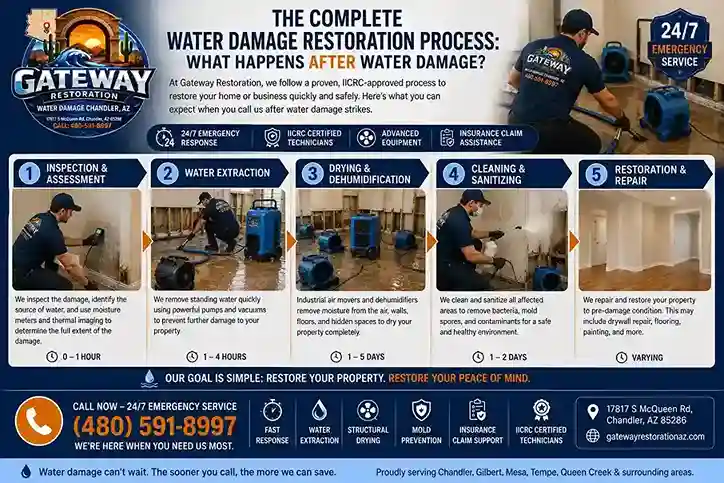
Most property owners have no real idea what happens after they make that first phone call to a restoration company. One moment there's water on the floor and a sense of panic, and the next, a crew of technicians is moving equipment, taking readings, and talking about categories, psychrometrics, and dry standard. It can feel like a black box at the exact moment you need clarity most.
This guide walks through the entire water damage restoration process from start to finish, step by step: emergency response, inspection, water extraction, structural drying, moisture monitoring, cleaning, repairs, and final restoration. Understanding what's supposed to happen, and why each step exists, helps you know what to expect, evaluate whether your restoration company is doing the job correctly, and understand why every hour matters after water intrusion begins. Professional restoration in the United States follows industry standards established by the IICRC, most notably the ANSI/IICRC S500 Standard for Professional Water Damage Restoration, which is the framework referenced throughout this article.
What's In This Guide
- Why Immediate Action Matters
- Step 1: Emergency Contact & Rapid Response
- Step 2: Inspection & Damage Assessment
- Step 3: Water Category Classification
- Step 4: Water Extraction
- Step 5: Material Evaluation & Demolition
- Step 6: Structural Drying & Dehumidification
- Step 7: Daily Moisture Monitoring
- Step 8: Cleaning, Sanitizing & Mold Prevention
- Step 9: Restoration & Reconstruction
- How Long Does It Take?
- What Determines Cost?
- Common Homeowner Mistakes
- How This Works in Chandler, AZ
- Frequently Asked Questions
Why Immediate Action Matters After Water Damage
Water damage is not static. The longer water sits, the more it spreads, absorbs into materials, and creates conditions for secondary damage like mold and structural deterioration. Restoration professionals think in terms of a damage timeline, because the appropriate response, and the ultimate cost, changes significantly depending on how quickly action is taken.
Minutes
Water begins spreading across floors and wicking into baseboards, carpet, and the base of drywall.
Hours
Drywall begins absorbing moisture and swelling; wood flooring starts to warp; furniture finishes can bleed.
24 Hours
Hidden moisture spreads into wall cavities and subfloor; conditions become favorable for mold growth to begin.
48 Hours
Mold growth can become active; drywall, insulation, and porous materials increasingly need to be replaced rather than dried.
Several Days
Untreated moisture can begin compromising structural components, framing, and subflooring, turning a mitigation job into a reconstruction project.
Every one of these stages increases the scope, and the cost, of the eventual restoration. A loss that could have been mitigated with extraction and drying alone within the first 24 hours can turn into a demolition and rebuild project if it sits untreated for a week. This is the core reason emergency water damage restoration and 24 hour response exist as dedicated services rather than a next-business-day appointment.
Emergency Contact and Rapid Response
The process begins the moment you call. A trained dispatcher gathers key information: the water source if known, which rooms are affected, whether the water is still actively flowing, and any immediate safety concerns like electrical exposure. This information allows the right crew and equipment to be dispatched before they even arrive on site.
Restoration companies operate 24/7 because water damage doesn't wait for business hours, and neither does its spread. On arrival, expect technicians to first address safety, confirming the water source is controlled, checking for electrical hazards, and assessing whether any areas are unsafe to enter. From there, they move directly into inspection and begin extraction where standing water is present.
As a homeowner, you should expect clear communication about what's happening, realistic timing on when crews will arrive, and documentation (typically photos) starting from the very first visit.
Inspection and Damage Assessment
Before any water is extracted or equipment is set up, technicians conduct a thorough inspection to understand the full scope of the loss. This step determines the entire restoration plan that follows, so it's not something that gets rushed.
The inspection evaluates:
- The water source and whether it has been fully stopped
- The extent of visible and hidden damage throughout the property
- Safety hazards, including electrical and structural concerns
- Structural elements that may be affected, including framing and subfloor
- How far moisture has migrated beyond the visibly wet area
This is where moisture mapping and thermal imaging come in. Infrared cameras scan walls, ceilings, and floors for temperature anomalies that suggest hidden moisture, while moisture meters confirm actual readings at each flagged location. Every reading, along with photographic documentation, becomes part of the record used both to build the drying plan and to support your insurance claim.
Step 3: Water Category Classification
Not all water damage is treated the same way. The IICRC classifies water intrusion into three categories based on contamination level, and the category determines cleaning procedures, safety precautions, and which materials can be dried versus which must be removed.
Category 1 Water
Category 1 is water from a clean source that poses no substantial health risk. Common examples include broken supply lines, water heater leaks, and sink overflows from a clean water source. Category 1 water can often be dried in place if addressed quickly, before it has time to degrade or pick up contaminants from the materials it contacts.
Category 2 Water
Category 2, often called "gray water," contains a significant degree of contamination and can cause discomfort or illness if contacted or consumed. This includes discharge from washing machines, dishwasher leaks, and other appliance-related failures. Category 2 water requires more caution in handling and cleaning than Category 1.
Category 3 Water
Category 3 is grossly contaminated water containing harmful bacteria, pathogens, and toxins. Sewage, flood water, storm surge, and groundwater intrusion all fall into this category. Category 3 water requires specialized safety equipment, strict containment, and typically the removal of any porous materials it contacted, since they cannot be safely cleaned. For losses involving sewage or contaminated flooding, our water mitigation team follows enhanced safety protocols specific to this category.
Water can also change category over time. Clean Category 1 water left standing for more than 48 hours can degrade into Category 2 as it picks up contaminants from carpet, flooring, and building materials, another reason speed matters throughout this process.
Water Extraction
Removing standing water is the single highest priority once the source is controlled and the inspection is complete, because every hour water remains in contact with building materials increases how deep it absorbs and how far it spreads. Water extraction uses several types of equipment depending on the volume and location of water:
- Truck-mounted extractors for high-volume extraction with maximum suction power
- Portable extraction units for areas trucks can't reach or smaller-scale losses
- Submersible pumps for standing water several inches deep or more
- Weighted extraction tools that press into carpet and padding to pull out trapped water
- Carpet extraction wands designed specifically for soft flooring
- Hard-surface extraction tools for tile, wood, and vinyl flooring
Thorough extraction dramatically reduces the drying time needed in the next phase. Every gallon of water physically removed is moisture that dehumidifiers and air movers don't have to evaporate and pull out of the air later, which is why extraction and drying, while related, are treated as distinct steps with distinct goals.
Material Evaluation and Demolition
Once standing water is extracted, technicians evaluate which materials can be dried in place and which need to be removed. This decision balances cost, restoration time, and the practical reality that some materials simply cannot be fully dried or cleaned once saturated.
Often can be saved
Hardwood flooring (with fast response), structural framing, tile flooring, and concrete can typically be dried in place using targeted equipment rather than removed.
Often requires removal
Wet insulation, severely swollen or delaminated drywall, contaminated materials, and any porous materials affected by Category 3 water generally cannot be salvaged.
This is the "dry in place versus removal" decision that shapes the rest of the project. Drying in place is always preferable when it's a viable option, since it avoids the cost and disruption of demolition and reconstruction. But materials that have absorbed contamination, or that have been wet long enough to begin breaking down structurally, need to come out rather than risk mold growth or structural failure later.
Structural Drying and Dehumidification
This is where the real science of restoration happens, and it's also the step most homeowners misunderstand. Structural drying is not simply placing a few fans in a room and waiting. It's a controlled, monitored process built around psychrometrics, the science of how air holds and releases moisture at different temperatures and humidity levels.
Professional drying uses several types of equipment working together:
- Air movers create controlled airflow across wet surfaces, speeding evaporation by continuously replacing the humid air layer that forms against damp materials
- LGR (low-grain refrigerant) dehumidifiers pull large volumes of moisture out of the air even in already-dry ambient conditions, which is especially useful in Arizona's climate
- Refrigerant dehumidifiers cool air to condense and remove moisture, standard equipment for most residential drying setups
In plain terms: air movers evaporate moisture out of wet materials and into the air, and dehumidifiers pull that moisture back out of the air so it doesn't just resettle somewhere else. Without proper dehumidification running alongside air movers, you're just relocating moisture around a closed room rather than actually removing it from the building. Technicians calculate airflow and dehumidification capacity based on the size of the affected area, the materials involved, and ambient humidity, then adjust daily based on readings. Our dehumidification services cover this equipment and process in more depth.
Most residential water losses reach dry standard in three to five days with equipment properly placed and monitored. More severe losses, involving multiple rooms, dense materials like hardwood or concrete, or Category 3 contamination, can take a week or longer.
Daily Moisture Monitoring
Structural drying isn't a "set it and walk away" process. Technicians return daily to take moisture readings at each documented location, log the results, and compare them against dry, unaffected reference points in the same material type. This ongoing moisture log becomes both a drying roadmap and part of the insurance documentation package.
Based on daily readings, equipment is adjusted: air movers repositioned, dehumidifiers added or removed, and drying goals updated. This is also when technicians catch materials that aren't drying as expected, which can indicate a material needs removal after all, or that a hidden moisture source is still active.
A material is only considered at "dry standard" once its moisture content consistently matches the dry reference readings for that material type, not simply when it looks or feels dry to the touch. Verification testing at the end of the drying phase confirms this before equipment is pulled and the project moves forward.
Cleaning, Sanitizing, and Mold Prevention
Once materials reach dry standard, attention turns to cleaning, sanitizing, and eliminating conditions that could support future mold growth. This includes antimicrobial treatments applied to affected surfaces and framing, odor removal treatments for any lingering moisture smell, and HEPA air scrubbing to capture fine particulates stirred up during the drying and demolition process.
Surface cleaning addresses walls, flooring, and fixtures, while content cleaning covers furniture, belongings, and other items affected by the water event. Mold prevention isn't a separate afterthought tacked onto the end of the job, it begins the moment extraction starts, because every hour of delay in drying is additional risk. Where mold has already developed before restoration began, our mold remediation team handles it as a dedicated phase of the project.
Restoration and Reconstruction
Everything up to this point is technically "mitigation," the work of stopping damage from getting worse. Restoration is the separate phase that returns the property to its pre-loss condition. This is an important distinction: mitigation focuses on drying and preventing further loss, while restoration is about rebuilding and repairing what was removed or damaged.
Depending on the scope of the loss, restoration and reconstruction work can include:
- Drywall replacement and finishing
- Painting affected walls and ceilings
- Cabinet replacement in kitchens and bathrooms
- Flooring installation, including hardwood, tile, and carpet
- Trim, baseboard, and finish carpentry work
- Final repairs to restore the space's appearance and function
- Full rebuild projects for severe or long-neglected losses
Some restoration companies handle mitigation only and hand reconstruction off to a general contractor. A full-service provider that manages both phases can offer a more seamless experience, since the same team that documented the damage understands exactly what needs to be rebuilt and can coordinate the transition without gaps in communication.
How Long Does the Water Damage Restoration Process Take?
Timelines vary significantly based on the size and severity of the loss, but most residential water damage projects follow a general pattern:
| Phase | Typical Timeframe |
|---|---|
| Emergency Response | Hours (often within 1–2 hours of the call) |
| Inspection | Same day as response |
| Extraction | Hours, same day |
| Structural Drying | 3–7 days |
| Cleaning & Sanitizing | 1–3 days |
| Repairs | Days to several weeks |
| Large Rebuilds | Weeks to several months |
Several factors affect where a given project falls in these ranges: the water category, the total square footage affected, how many building materials absorbed moisture, how quickly the loss was reported, and whether mold developed before restoration began. A quickly reported Category 1 leak in a single room might be fully mitigated in under a week, while a Category 3 loss across multiple rooms with reconstruction needs can take months from first call to final walkthrough.
What Determines the Cost of Water Damage Restoration?
Water damage restoration costs vary widely because every loss is different, but the same core factors consistently drive cost up or down:
- Water category — Category 3 losses require more safety precautions and material removal, raising cost
- Affected area size — More square footage means more extraction, drying equipment, and monitoring time
- Material types — Hardwood, tile, and specialty flooring often cost more to dry or replace than standard materials
- Equipment needs — Larger or more severe losses require more air movers and dehumidifiers running longer
- Drying duration — Extended drying timelines increase equipment rental and monitoring costs
- Mold contamination — Existing mold growth adds a full remediation phase to the project
- Contents restoration — Cleaning or replacing furniture and belongings affected by the water
- Reconstruction scope — Drywall, flooring, cabinetry, and finish work add to the total project cost
As a general educational range, straightforward Category 1 mitigation in a single room often falls in the low thousands of dollars, while multi-room losses with reconstruction can run into the tens of thousands. An accurate figure for your specific situation requires an in-person inspection, since so much depends on the water category, materials, and scope discovered during assessment.
Common Mistakes Homeowners Make After Water Damage
Waiting too long to call
Every hour of delay increases how deep and far moisture spreads, directly increasing restoration scope and cost.
Using household fans only
Consumer fans move air but don't remove moisture from it, which can prolong drying and even push moisture deeper into materials.
Ignoring hidden moisture
Assuming a space is dry because the surface looks dry overlooks moisture trapped in wall cavities, subfloor, and insulation.
Skipping moisture testing
Without meter readings, there's no objective way to confirm materials have actually reached dry standard.
Removing equipment too early
Pulling drying equipment before verification testing risks leaving trapped moisture that can lead to mold weeks later.
Failing to document damage
Photos, moisture logs, and inspection reports are what support an insurance claim; without them, claims are harder to substantiate.
Waiting for insurance approval before mitigation
Most policies require reasonable steps to prevent further damage. Delaying mitigation while waiting on approval can worsen the loss and complicate the claim.
How Water Damage Restoration Works in Chandler, Arizona
Restoration principles are universal, but local conditions shape how a project actually plays out here in Chandler. Several factors specific to the East Valley influence both the source of water damage and the drying strategy used to address it.
- Monsoon season brings sudden, wind-driven storms each summer that push water past rooflines, windows, and stucco seams, often causing intrusion that seems minor at first but tracks deep into wall cavities.
- Flash flooding during heavy monsoon storms can overwhelm drainage around homes not built for sustained heavy rainfall, leading to Category 3 concerns near ground level.
- Caliche soil drains poorly and holds water against foundations longer than typical soil, increasing the risk of moisture intrusion at the slab edge.
- Slab foundations, standard in most Chandler homes, mean plumbing leaks travel laterally under flooring rather than draining into a basement, often spreading further than expected before detection.
- AC condensate leaks are common given how heavily air conditioning runs through Arizona summers, and a clogged line can slowly soak attic insulation and ceiling drywall for weeks.
- Water heater failures are one of the most frequent Category 1 losses we respond to throughout the year.
- Roof leaks from monsoon wind damage or aging roofing materials can track along framing before ever showing a ceiling stain.
- Summer humidity spikes during monsoon season change drying calculations, since ambient humidity affects how quickly dehumidifiers can pull moisture from the air.
Because of Arizona's typically dry climate for most of the year, dehumidification equipment can often work efficiently once monsoon humidity passes, but technicians still account for seasonal humidity swings when calculating drying timelines and equipment placement for every Chandler restoration project.
Gateway Restoration is based at 17817 S McQueen Rd in Chandler and responds throughout the East Valley, including Gilbert, Mesa, Tempe, Queen Creek, and Phoenix. Every step of this process, from the first phone call to the final walkthrough, follows ANSI/IICRC S500 guidelines and is documented for insurance purposes.
Frequently Asked Questions
What is the first step in water damage restoration?
The first step is emergency contact and rapid response. A restoration company gathers details about the water source and affected areas over the phone, then dispatches technicians to begin inspection, safety checks, and water extraction, often within an hour of the call.
How long does drying take?
Most residential water losses take three to five days to fully dry with professional equipment in place. Severe losses involving multiple rooms, Category 3 water, or extensive material saturation can take a week or longer.
Can wet drywall be saved?
Sometimes. Drywall affected by clean water and dried quickly with professional equipment can often be dried in place. Drywall that's been saturated for an extended period, exposed to contaminated water, or shows signs of swelling and delamination typically needs to be removed.
What equipment is used?
Restoration technicians use truck-mounted and portable extraction units, air movers, low-grain refrigerant (LGR) and refrigerant dehumidifiers, air scrubbers with HEPA filtration, moisture meters, and thermal imaging cameras throughout the process.
How fast can mold grow?
Mold can begin developing on wet materials within 24 to 48 hours under the right warmth and moisture conditions. This is a primary reason why fast extraction and professional drying are prioritized immediately after water damage occurs.
Does insurance cover restoration?
Coverage depends on the cause of the water damage. Sudden, accidental events like burst pipes or appliance failures are commonly covered, while damage tied to long-term neglect or unresolved maintenance issues is often excluded. Documentation from the restoration company supports the claim either way.
What is structural drying?
Structural drying is the science-based process of removing moisture from a building's structure and materials using controlled airflow, dehumidification, and humidity monitoring, rather than simply placing fans in a room and waiting.
What is moisture mapping?
Moisture mapping is the process of documenting wet and dry areas throughout a property using moisture meters and thermal imaging, creating a record that guides drying equipment placement and verifies when materials have reached dry standard.
How do technicians know when materials are dry?
Technicians compare daily moisture meter readings against dry, unaffected reference points in the same material type. When readings from the affected area match the dry standard consistently, the material is considered dry and equipment can be removed.
Can hardwood floors be saved?
Hardwood floors can often be saved if water is extracted quickly and specialized drying mats or systems are used to dry the wood from both the surface and subfloor. Floors exposed to water for extended periods or already cupping and buckling may require replacement.
What is Category 3 water?
Category 3 water is grossly contaminated water, such as sewage backups, floodwater, or storm surge, that contains harmful bacteria and pathogens. It requires specialized safety precautions, containment, and typically the removal of any porous materials it contacted.
Do I need professional restoration?
For anything beyond a very small, immediately mopped-up spill, professional restoration is strongly recommended. Hidden moisture, structural drying requirements, and mold risk are difficult to manage with household equipment alone, and professional documentation also supports insurance claims.
Summary: The Complete Process, Start to Finish
Water damage restoration is a sequential, evidence-driven process: emergency response and rapid dispatch, thorough inspection and water category classification, aggressive extraction, careful evaluation of what can be saved, scientific structural drying backed by daily monitoring, cleaning and mold prevention, and finally full restoration and reconstruction. Each step exists because skipping it creates risk, either of incomplete drying, hidden mold, or a weaker insurance claim.
The single biggest factor within your control is speed. Fast action, professional drying backed by real science rather than guesswork, thorough documentation, proactive mold prevention, and complete restoration are what separate a contained, well-managed water loss from a project that spirals into months of reconstruction.