 Gateway Restoration
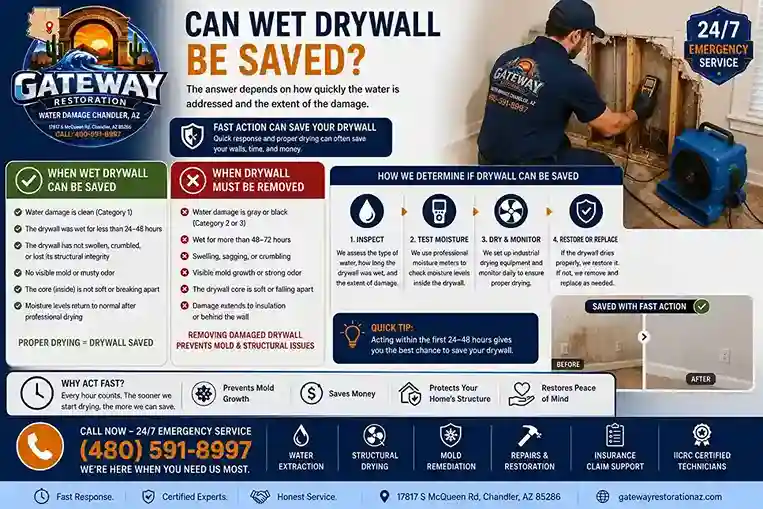
Sometimes wet drywall can be successfully dried and restored, but not always. The answer depends on how long it has been wet, the category of water involved, how saturated the drywall became, and whether mold growth has already started. If you're standing in front of a damp or stained wall right now, call Gateway Restoration at (480) 591-8997 before deciding what to tear out — timing changes everything.
The Short Answer: Sometimes Yes, Sometimes No
Drywall is a porous building material made from a gypsum core sandwiched between layers of paper facing. That porosity is exactly what makes it useful for holding paint, texture, and screws — and exactly what makes it vulnerable to water. Water doesn't sit on the surface of drywall the way it does on tile or vinyl. It moves into the material almost immediately, wicking upward and outward from the point of contact.
Three factors drive whether a restoration professional recommends drying drywall in place or removing it entirely: how long the material has been wet, what category of water caused the damage, and how far the moisture has traveled into the wall cavity, insulation, and framing behind it. Homeowners often assume any wet wall is a lost cause, and restoration companies sometimes reinforce that assumption because full replacement is a bigger job. The truth is more nuanced, and getting it right saves money without cutting corners on safety.
Professionals use a structured decision-making process rather than a visual guess: assess the water source and category, take moisture readings at multiple points, evaluate how long the material has been exposed, and only then decide whether drying in place is realistic or removal is the safer, more cost-effective path.
How Drywall Responds to Water Damage
Understanding what actually happens inside a wet wall helps explain why timing matters so much more than most homeowners expect.
Gypsum Core
The core of standard drywall is made of gypsum, a soft mineral that behaves almost like a sponge once it's exposed to moisture. Gypsum absorbs water readily and, when saturated, begins to lose the structural rigidity that keeps a wall panel flat and firm. This is why heavily wet drywall develops a soft, spongy feel — the internal mineral structure is physically breaking down, not just getting damp on the surface.
Paper Facing
The front and back paper layers bonded to the gypsum core are, functionally, cardboard. Paper is an excellent food source for mold and one of the fastest materials in a home to show mold growth once conditions are right. It also loses its bond to the gypsum core when saturated, which is part of what causes bubbling paint and peeling texture on the visible surface of a damaged wall.
Moisture Absorption
Drywall absorbs water at a measurable rate depending on how it's exposed. Direct contact with standing water, such as drywall sitting in an inch of floodwater along a baseboard, saturates far faster than drywall exposed to airborne humidity from a slow leak. Absorption isn't limited to the point of contact — it continues as long as a moisture source is present.
Capillary Action
Water doesn't stay where it lands. Capillary action pulls moisture upward through the gypsum core, which is why water damage from a leak at the baseboard often shows staining a foot or more above the actual source. This upward wicking is one of the most misunderstood aspects of drywall damage — homeowners frequently underestimate how far up a wall moisture has traveled because the visible staining lags behind the actual saturation.
Structural Weakening
As the gypsum core absorbs more water, its ability to hold screws, support texture, and stay rigid declines. In advanced cases, saturated drywall will sag under its own weight or crumble when lightly pressed. This structural weakening is a key marker professionals look for when deciding that a section is beyond saving, regardless of how long it's been wet.
When Wet Drywall Can Usually Be Saved
The strongest candidates for saving wet drywall share a few characteristics. First, the water source is Category 1 — clean water from a supply line, not water that has picked up contaminants. Second, the response was fast, meaning drying equipment was in place within the first day. Third, saturation is limited to the lower portion of the wall rather than extending through the full panel. Fourth, moisture readings taken with a meter fall within a range that responds to air movement and dehumidification rather than staying stubbornly high day after day.
Common examples where drywall is frequently saved include:
- Supply line leaks — a slow drip from a braided supply line under a sink, caught within a day of starting
- Refrigerator line leaks — a cracked ice maker line that wets the base of an adjacent wall but is shut off quickly
- Water heater leaks caught early — a small leak from a fitting or tank seam identified before it saturates a large wall area
- Small plumbing leaks — a pinhole leak in a wall-mounted pipe discovered soon after it starts, before water has time to travel far
In each of these scenarios, speed is the deciding factor. The same leak, left unaddressed for a week instead of a day, moves from "likely salvageable" to "likely needs removal" — not because the water itself changed, but because time allowed it to spread further and allowed conditions for mold to develop.
When Drywall Usually Must Be Removed
Removal isn't a default recommendation; it's a response to specific conditions that make drying in place unsafe, ineffective, or more expensive than replacement in the long run. The most common reasons drywall must come out include:
- Category 2 water (gray water) — water from sources like a washing machine overflow or dishwasher leak that may carry some contaminants
- Category 3 water (black water) — sewage backups, flood water from outside the home, or water that has been standing long enough to become contaminated
- Sewage backup — drywall exposed to sewage is treated as a contamination hazard, not just a moisture issue, and is removed regardless of how it looks or reads on a moisture meter
- Flood water — water intrusion from outside the home often carries soil, debris, and bacteria that make drying in place inappropriate
- Long-term saturation — drywall wet for more than roughly 48 to 72 hours has usually passed the point where drying restores it to a safe, structurally sound condition
- Visible mold growth — once mold is visibly established on or behind the drywall, remediation protocols call for removal rather than in-place drying
- Structural breakdown — sagging, crumbling, or soft-to-the-touch drywall has already lost the integrity needed to remain part of the wall assembly
- Delamination — when the paper facing separates from the gypsum core, the panel's structural bond is compromised beyond what drying can repair
Attempting to dry drywall that falls into these categories doesn't just risk a poor outcome — in the case of contaminated water, it can leave contamination trapped inside the wall cavity, creating a health concern that outweighs any cost savings from avoiding replacement.
Water Damage Categories and Their Impact on Drywall
The IICRC — the Institute of Inspection, Cleaning and Restoration Certification — defines three categories of water based on contamination level, and this classification drives nearly every decision a restoration professional makes about drywall.
| Category | Source | Drywall Usually Salvageable? |
|---|---|---|
| Category 1 | Clean Water | Often Yes |
| Category 2 | Gray Water | Sometimes |
| Category 3 | Black Water | Usually No |
Category 1 water comes from a clean source, such as a supply line, water heater, or appliance fill line, and hasn't come into contact with contaminants. Drywall exposed to Category 1 water and dried promptly has the best odds of being saved.
Category 2 water, often called gray water, contains some level of contamination — think dishwasher discharge, washing machine overflow, or water that has picked up contaminants from flooring or building materials on its way to the wall. Category 2 drywall damage is evaluated case by case; sometimes it's salvageable with more aggressive drying and antimicrobial treatment, and sometimes it isn't.
Category 3 water, or black water, includes sewage backups, water from outside the home carrying soil and debris, and any water that has been standing long enough to become grossly contaminated. Drywall exposed to Category 3 water is treated as a health and safety issue, not just a drying challenge, and is almost always removed.
How Long Can Drywall Stay Wet Before Mold Starts Growing?
Mold growth timelines aren't guesswork — they follow a fairly predictable progression once moisture, warmth, and an organic food source like drywall paper are present together.
First 24 hours: Drywall is wet but mold has not yet had time to establish. This is the highest-probability window for successfully drying material in place.
24–48 hours: Conditions become favorable for mold spores, which are present in virtually all indoor air, to begin germinating on damp paper facing. This is why restoration professionals treat the 48-hour mark as a meaningful threshold.
48–72 hours: Visible mold growth frequently becomes detectable at this stage, particularly in warm, humid conditions. Odor often develops around this point as well.
One week: Mold colonies are typically well established if moisture hasn't been addressed, and structural weakening of the gypsum core is usually noticeable.
One month: Left unaddressed for this long, drywall is essentially guaranteed to require removal, and mold growth may have spread beyond the original point of water intrusion into surrounding materials.
Chandler's climate adds a layer of complexity to this timeline. Indoor humidity spikes during monsoon season, combined with air conditioning systems that cycle warm, moist air through wall cavities, can accelerate mold conditions compared to drier times of year — which is part of why professional drying equipment, not just open windows or a box fan, matters so much here.
Signs Your Drywall May Be Salvageable
Homeowners can often get a preliminary read on their situation by looking — and feeling — for a few key indicators, though professional moisture testing is always the final word.
- Slight dampness — the wall feels cool or faintly damp but not saturated or dripping
- No warping — the panel remains flat, with no visible bowing or waviness
- No soft spots — pressing gently doesn't produce a spongy or yielding feel
- No odor — there's no musty smell, which is often the earliest sign of developing mold
- No discoloration — the surface hasn't developed brown, yellow, or gray staining
- Low moisture readings — a moisture meter shows readings close to the dry standard for the material
Professional moisture testing matters because several of these signs can be misleading on their own. Drywall can look completely normal on the painted surface while the back side and the insulation behind it remain significantly wet — which is exactly why thermal imaging and moisture meters are standard tools in a proper inspection rather than a visual check alone.
Signs Drywall Is Beyond Saving
On the other end of the spectrum, certain signs reliably indicate that drying in place isn't a realistic option.
- Soft drywall — the panel yields noticeably when pressed, indicating the gypsum core has broken down
- Sagging drywall — the panel is visibly drooping or pulling away from the framing
- Crumbling texture — pieces of the surface flake or crumble away with minimal contact
- Staining — dark rings, brown discoloration, or tide lines that indicate repeated or prolonged saturation
- Mold growth — any visible mold on the surface, which typically indicates more extensive growth behind the panel
- Musty odors — a persistent damp, earthy smell even after the surface appears dry
- Delamination — the paper facing separating or peeling away from the gypsum core
- Structural instability — the panel no longer holds its shape or securely supports fixtures and trim
If more than one of these signs is present, replacement is almost always the safer and, ultimately, more cost-effective decision compared to attempting to dry and salvage the material.
How Professionals Determine Whether Drywall Can Be Saved
Restoration decisions shouldn't be based on how a wall looks or how long it's been since the water event started — they should be based on data collected directly from the material.
- Moisture meters — penetrating and non-penetrating meters measure actual moisture content within the gypsum core, providing an objective baseline reading
- Thermal imaging — infrared cameras detect temperature differences caused by evaporating moisture, revealing wet areas hidden behind painted or textured surfaces
- Moisture mapping — readings are logged at multiple points across the affected wall to establish the boundary of the damage and track drying progress over time
- Hygrometers — ambient humidity readings in the room help determine whether conditions support effective evaporation or are working against the drying effort
- Drying goals — a target moisture level, based on the specific material and an unaffected reference reading, defines when the drywall is officially considered dry
- Daily monitoring — moisture readings are checked and logged daily throughout the drying process to confirm progress and catch any areas that aren't responding
This data-driven approach removes guesswork from a decision that has real financial and health implications. A wall that "looks fine" but reads high on a moisture meter is treated differently than one that looks stained but reads within an acceptable range near the drying goal.
The Drywall Drying Process Explained
When drywall is a viable candidate for drying in place, the process follows a consistent, documented sequence.
- Inspection — the affected area is assessed, the water source identified, and the water category determined
- Moisture mapping — baseline readings are taken across the wall and surrounding materials to define the full extent of the damage
- Water extraction — any standing water on the floor or trapped against the base of the wall is removed before drying equipment is placed
- Air movement — air movers are positioned to accelerate evaporation from the drywall surface and, where accessible, the wall cavity
- Dehumidification — commercial dehumidifiers pull moisture out of the ambient air so the wall can continue releasing water efficiently rather than reaching equilibrium with a humid room
- Daily monitoring — technicians return daily to take new moisture readings, adjust equipment, and track progress against the drying goal
- Final verification — once readings across the affected area meet the drying standard, the process is documented as complete and the space is cleared for repairs or repainting
Realistic drying timelines for drywall typically fall between two and five days for moderate saturation, with more heavily wet walls or those with wet insulation behind them taking longer. Rushing this process, or stopping equipment early because the surface feels dry, is one of the most common reasons drywall problems resurface weeks later.
Why Chandler Homes Present Unique Drywall Challenges
Local building patterns and climate conditions shape how drywall damage happens and how it should be handled in the Chandler area specifically.
- Monsoon season — sudden, heavy rainfall events can drive water intrusion through roof penetrations, windows, and exterior walls faster than typical drainage systems can manage
- Sudden humidity spikes — monsoon storms can push indoor humidity levels up rapidly, working against natural drying even in unaffected rooms
- Stucco construction — common throughout Chandler, stucco exteriors can trap moisture against sheathing and interior drywall if water finds a path behind the finish
- Slab foundations — without a crawlspace, moisture from plumbing leaks under a slab can wick up into base plates and lower drywall sections before it's noticed
- HVAC condensation leaks — air handlers located in attics or closets throughout Chandler homes can leak condensate onto ceiling and wall drywall, often slowly and out of sight
- Water heater failures — water heaters located in interior closets adjacent to living space can leak directly into nearby drywall before a failure is discovered
- Hard water plumbing systems — mineral buildup in Chandler's water supply contributes to fitting and valve failures that lead to slow, hidden leaks over time
- Flash flood events — periodic flash flooding in low-lying areas can introduce contaminated Category 3 water into homes, changing the drywall salvage calculation entirely
These local factors are part of why a generic national drying guideline doesn't always apply cleanly to a Chandler home — climate, construction methods, and seasonal weather patterns all influence how fast a wall dries and how much risk delay actually carries.
What Happens If Wet Drywall Is Left Alone?
Day 1: Drywall is saturated but structurally intact. This is the window with the highest chance of a full save if drying begins immediately.
Day 3: Mold conditions are favorable and may already be developing behind the surface, even if nothing is visible yet. Odor may begin to appear.
Day 7: Mold growth is often visible or detectable by smell at this point, and the gypsum core has typically begun to lose structural integrity in the wettest areas.
Day 30: Structural weakening is usually significant, mold has likely spread beyond the original wet area, and indoor air quality concerns become a legitimate consideration for occupants of the home.
Day 90: Hidden moisture may have migrated into framing, insulation, and adjacent materials well beyond the original wall section, turning what could have been a single-panel repair into a larger reconstruction project.
This progression is exactly why "it's just a small wet spot" is one of the riskiest assumptions a homeowner can make. The visible portion of the damage rarely represents the full extent of what's happening inside the wall.
Can You Dry Wet Drywall Yourself?
For very minor, quickly caught situations — a small splash from a supply line that's shut off within minutes — basic fans and a consumer dehumidifier can sometimes handle the job. But DIY drying has real limitations that are worth understanding honestly.
- Fans — household fans move air but lack the volume and directional control of commercial air movers designed specifically for structural drying
- Shop vacuums — useful for removing standing water on the floor, but they don't address moisture that has already been absorbed into the drywall itself
- Consumer dehumidifiers — smaller and less powerful than commercial units, they can struggle to keep pace with the moisture load from anything beyond a minor leak
- DIY mistakes — closing off the room to "contain" the leak, using too few fans, or stopping equipment as soon as the surface feels dry are common errors that leave hidden moisture behind
- Hidden moisture problems — without a moisture meter, there's no reliable way to confirm the wall cavity, insulation, and framing behind the drywall are actually dry, even when the surface looks fine
None of this means homeowners should feel powerless while waiting for help — quick action with fans and a wet vacuum in the first hour genuinely helps. It simply means that verifying the job is truly finished requires equipment and measurement tools most households don't have on hand.
Does Insurance Pay for Drywall Replacement?
Coverage for drywall replacement generally follows the same logic insurers apply to water damage overall. Sudden, accidental events are the events policies are designed to respond to:
- Burst pipes — a pipe that fails suddenly and without warning
- Water heater failures — a tank or fitting that fails unexpectedly
- Appliance leaks — a washing machine hose or dishwasher connection that fails suddenly
On the other hand, common exclusions include long-term neglect and maintenance issues — a slow leak that was visible or detectable for weeks or months before it was addressed is more likely to be treated as a maintenance failure rather than a covered loss.
It's important to note that Gateway Restoration is not an insurance company and does not provide insurance coverage or make coverage determinations. Our role is to assist homeowners with thorough documentation — moisture readings, photos, and a clear record of the failure point and timeline — and to provide the restoration services needed once a claim is underway. Coverage decisions are always made by your insurance carrier based on your specific policy language.
Real Chandler Water Damage Examples
The following examples illustrate how the same general principles play out differently depending on the water source, response time, and category involved.
Water Heater Leak in Ocotillo
What happened: A water heater fitting failed overnight in a closet adjacent to a hallway, sending clean water into the base of the surrounding wall. Whether drywall was saved: Yes, the lower two feet of drywall were dried in place. Why: The leak was Category 1 clean water, discovered the following morning, and drying equipment was placed within hours, keeping saturation and exposure time low.
AC Leak in Sun Lakes
What happened: A clogged condensate drain caused an attic air handler to leak into the ceiling drywall of a bedroom over several weeks. Whether drywall was saved: No, the affected ceiling section was removed. Why: The slow, ongoing nature of the leak meant the drywall had been wet intermittently for an extended period, with visible sagging and early mold growth by the time it was discovered.
Appliance Leak in Cooper Commons
What happened: A dishwasher supply line loosened gradually, leaking water into the base of an adjacent kitchen wall over a day or two before it was noticed. Whether drywall was saved: Partially — the lower section was replaced, the upper section was dried and kept in place. Why: Saturation was concentrated at the base of the wall; moisture readings higher up the wall were low enough to dry successfully, while the base showed early softening that warranted removal.
Monsoon Water Intrusion in Clemente Ranch
What happened: Heavy monsoon rainfall found a path through a roof penetration, saturating drywall in an upstairs bedroom over the course of a storm. Whether drywall was saved: No, the affected section was removed. Why: The water carried debris and had soaked the drywall and insulation extensively before the leak source was identified and sealed, pushing moisture readings well beyond a range that responds to drying.
Burst Pipe in Downtown Chandler
What happened: A supply pipe inside an interior wall burst while the homeowners were away for a weekend, saturating a section of hallway drywall for roughly 48 hours before discovery. Whether drywall was saved: No, though a portion of adjacent, less-saturated drywall was successfully dried. Why: The extended exposure time at the point of the burst pushed that section past the salvage threshold, while surrounding drywall with lower moisture readings responded well to drying equipment.
Repair vs. Replace: Cost Comparison
| Approach | Typical Scope | General Cost Range |
|---|---|---|
| Drywall Drying (in place) | Extraction, air movers, dehumidification, monitoring | $400–$1,500 per affected room |
| Selective Removal | Cutting out and replacing a lower section only | $800–$2,500 per affected room |
| Full Wall Replacement | Full panel removal, disposal, new drywall, texture, paint | $1,500–$4,000 per affected room |
| Mold Remediation | Containment, removal, antimicrobial treatment | $1,500–$6,000+ depending on extent |
| Full Reconstruction | Framing, insulation, drywall, finishes across multiple rooms | $5,000–$20,000+ |
These ranges illustrate a consistent pattern: the earlier moisture is identified and addressed, the smaller and less expensive the intervention required. A same-day response that allows drywall to be dried in place is almost always the lowest-cost outcome, while delays that allow mold to establish or moisture to spread into framing and insulation push costs toward the higher end of full reconstruction.
How to Increase the Chances of Saving Wet Drywall
- Stop the water source — shut off the supply line, appliance, or main water valve as quickly as possible
- Call quickly — the first 24 hours matter more than any other single factor in whether drywall can be saved
- Remove standing water — clear any pooled water near the base of the wall to reduce ongoing capillary absorption
- Improve airflow — open the room if it's safe to do so and position fans to move air across the affected surface
- Avoid delays — postponing an inspection, even by a day or two, meaningfully reduces the odds of a full save
- Schedule a professional inspection — moisture meters and thermal imaging provide the objective data needed to make a confident save-or-replace decision
Why Chandler Homeowners Trust Gateway Restoration
Gateway Restoration approaches every wet drywall situation with the same structured, data-driven process: thorough water extraction, professional structural drying, precise moisture mapping, and thermal imaging to confirm nothing is missed behind the surface. Where mold prevention is a concern, we address it proactively rather than waiting for a problem to develop. Throughout the process, we provide the documentation homeowners need to support their insurance claim, backed by genuine local experience serving neighborhoods throughout Downtown Chandler, Ocotillo, Sun Lakes, Cooper Commons, Fox Crossing, and Clemente Ranch.
Frequently Asked Questions
Can drywall dry out on its own?
In some cases, lightly damp drywall exposed to clean water and good airflow can dry on its own within a day or two. However, without commercial dehumidification and moisture verification, homeowners can't confirm the wall cavity and insulation behind the drywall are actually dry, which is why professional drying is recommended for anything beyond a very minor, quickly addressed splash.
How long does it take wet drywall to dry?
With commercial air movers and dehumidifiers running continuously, lightly to moderately wet drywall typically dries within two to four days. Heavily saturated drywall, or drywall with wet insulation behind it, can take five to seven days or longer to reach acceptable moisture levels.
Does wet drywall always need to be replaced?
No. Drywall exposed to clean water and dried quickly, typically within 24 to 48 hours, can often be saved. Drywall exposed to contaminated water, saturated for an extended period, or showing mold, sagging, or delamination usually needs to be removed and replaced.
Can mold grow behind drywall?
Yes, and it's one of the biggest risks with wet drywall. The back side of drywall and the wall cavity behind it stay damp and dark far longer than the visible surface, creating ideal conditions for mold growth that can go undetected until it spreads through to the painted surface or produces a musty odor.
How do professionals test drywall moisture?
Restoration professionals use penetrating and non-penetrating moisture meters to measure moisture content directly in the gypsum core, along with thermal imaging cameras to spot temperature differences that indicate hidden moisture behind walls before it becomes visible.
What does water-damaged drywall look like?
Early signs include darkened patches, slight softness to the touch, and a subtle change in texture. As damage progresses, drywall can show visible staining, bubbling paint, sagging, or a soft, spongy feel that indicates the gypsum core has broken down.
Is stained drywall automatically ruined?
Not automatically. A stain shows that water was present, but the drywall's structural integrity depends on how saturated it became and for how long. Lightly stained drywall with a firm, intact surface and acceptable moisture readings can sometimes be dried, primed, and repainted rather than replaced.
Can insulation behind drywall be saved?
It depends on the insulation type. Fiberglass batt insulation that becomes saturated typically loses its effectiveness and needs replacement, since it doesn't dry evenly and can hold moisture against the back of the drywall. Rigid foam insulation can sometimes be dried and reused if caught early.
Does insurance cover drywall replacement?
Many homeowners policies cover drywall damage caused by sudden, accidental water events such as a burst pipe or water heater failure. Damage from long-term leaks or neglected maintenance is commonly excluded. Gateway Restoration is not an insurance company and does not determine coverage, but we help document damage for your claim.
What should I do immediately after drywall gets wet?
Stop the water source if possible, remove any standing water nearby, increase airflow with fans if it's safe to do so, avoid touching or pressing on the wet drywall, and call a restoration professional promptly so drying can begin before mold has a chance to develop.
The Bottom Line
Wet drywall is not automatically ruined, but every hour matters. The sooner moisture is identified and professionally dried, the greater the chance of saving materials, preventing mold growth, and avoiding costly reconstruction. What separates a simple, low-cost repair from a full-room reconstruction is rarely the water itself — it's how quickly the response begins and how accurately the drying decision is made.
Not Sure If Your Drywall Can Be Saved?
Gateway Restoration
17817 S McQueen Rd, Chandler, AZ 85286
📞 (480) 591-8997
24/7 Emergency Water Damage Restoration, Structural Drying & Moisture Inspection Services Throughout Chandler and the East Valley