Most water damage restoration projects in Chandler take 3 to 14 days for mitigation and structural drying, while full reconstruction can take several weeks depending on the extent of damage, the materials involved, insurance approvals, and whether mold is present. Here's exactly what happens, day by day, and why the process can't be rushed.
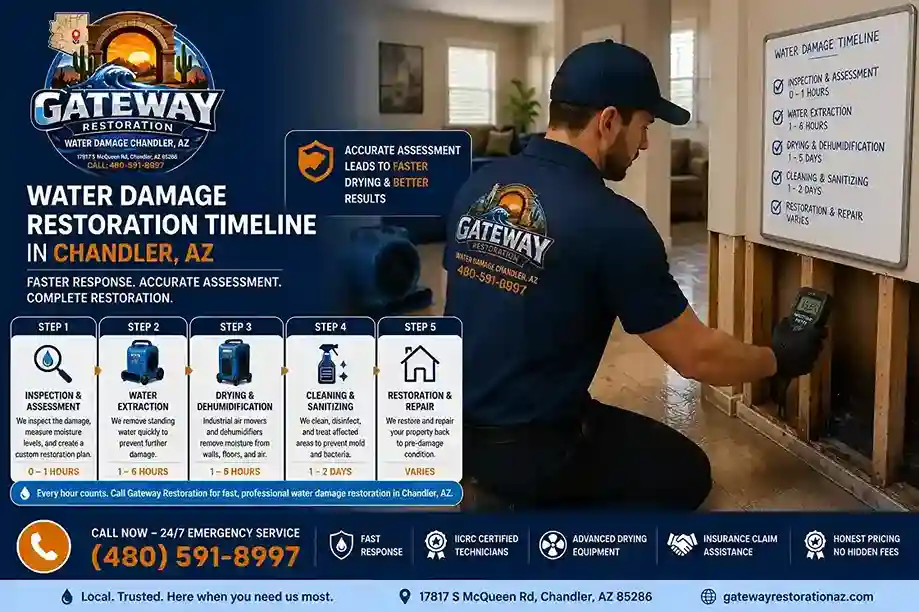
Every water damage job in Chandler moves through the same core stages, though the number of days spent in each stage depends on the water category, the square footage affected, and how quickly mitigation begins. Here's the overview before we break down each stage in detail.
| Stage | Typical Duration |
|---|---|
| Emergency response | 1–4 hours |
| Inspection | Same day |
| Water extraction | 1 day |
| Structural drying | 3–5 days |
| Monitoring | Daily throughout drying |
| Material removal | 1–3 days |
| Reconstruction | Several days to weeks |
| Final inspection | 1 day |
Notice that drying is the longest single stage in the mitigation phase — and it's also the stage homeowners most often misunderstand. A floor can look and feel dry within hours of extraction, while the drywall, baseboards, and subfloor beneath it are still holding significant moisture. Reconstruction can't safely begin until every affected material reaches a verified dry standard, which is why rushing this stage almost always costs more time in the long run, not less.
The first day of a water damage restoration project sets the trajectory for everything that follows. It's also the day that matters most: every hour water sits untreated increases the volume absorbed into porous materials and raises the odds that a Category 1 loss deteriorates toward Category 2 or 3 water.
When you call (480) 591-8997, our Chandler-based crews are dispatched immediately, day or night. Emergency response typically means a technician on-site within one to four hours, depending on the time of day and current call volume across the East Valley.
Before any equipment is placed, technicians classify the loss using industry-standard water categories. Category 1 water comes from a clean source such as a supply line, with no contamination risk. Category 2 water, often called gray water, carries some contamination — a washing machine overflow or dishwasher leak, for example. Category 3 water is grossly contaminated, such as sewage backups or flood water, and requires full protective protocols. This classification determines every decision that follows, from PPE requirements to which materials can be dried in place versus removed.
Technicians use thermal imaging cameras to identify temperature differences that reveal hidden moisture behind walls, under flooring, and inside ceiling cavities — areas that look completely unaffected to the naked eye. Moisture meters then confirm exact readings, and every wet area gets logged into a moisture map that becomes the baseline for tracking drying progress over the following days.
Once the inspection is complete, truck-mounted extraction equipment removes standing water. This is typically a same-day process for residential losses, and it's the step that determines how much flooring and subfloor can realistically be saved rather than replaced. Air movers and dehumidifiers are then positioned according to the drying plan, not spread evenly across the room as an afterthought.
Once standing water is gone, the project enters structural drying — the stage where most of a restoration project's calendar time is actually spent. Commercial air movers accelerate evaporation from walls, floors, and framing, while dehumidifiers pull that moisture out of the surrounding air before it resettles somewhere else.
Equipment placement isn't guesswork. It follows psychrometric calculations based on room size, humidity, temperature, and material type — the same relationships between air and moisture that govern how quickly a material can actually release the water trapped inside it.
Surfaces dry to the touch long before the materials beneath them do. Drywall, framing lumber, subfloor, and cabinetry can hold significant moisture for days after a room looks and feels normal. Reconstruction that starts before this hidden moisture is gone traps water behind new drywall and paint, setting up exactly the conditions mold needs to establish.
Air movers alone don't dry a structure — they move air across a wet surface, which pulls moisture out of the material and raises the humidity in the room. Without a dehumidifier actively removing that moisture from the air, it simply resettles onto nearby surfaces. More fans without balanced dehumidification can actually slow a job down, not speed it up, which is why every drying plan pairs equipment ratios deliberately rather than maximizing fan count.
Drying is confirmed with numbers, not appearance. Technicians take daily moisture readings with calibrated meters and compare them against an unaffected reference reading from the same structure. Once every affected material's moisture content matches that baseline, drying is complete — typically within three to five days for a standard residential loss, though larger losses, Category 3 water, or dense materials like tile and concrete slab can extend that timeline.
Chandler's desert climate and local construction methods shape every drying plan differently than they would in a humid coastal market. Some of these factors help; others complicate the job.
Chandler's naturally low ambient humidity supports faster evaporation rates than restoration projects in humid climates, when equipment is managed correctly.
Between July and September, sudden humidity spikes from monsoon storms can slow drying if outdoor moisture isn't factored into the plan.
Stucco exteriors, common throughout Chandler, can trap wall cavity moisture behind a surface that looks completely unaffected.
Tile itself dries fast, but water trapped beneath it and in the substrate can take longer to fully release than carpet or laminate.
Most Chandler homes sit on concrete slab, which dries far more slowly than a raised foundation and needs a different equipment strategy.
Chandler's dense caliche layer doesn't drain well, so water from a slab leak has nowhere to go but up — extending drying time near foundations.
The water category involved in your loss is the single biggest factor in how long restoration takes. Here's how each category typically plays out in Chandler homes.
Clean water from a source like a supply line, water heater, or refrigerator line failure. No contamination risk, which allows drying to begin immediately without additional protective protocols.
Typical timeline: 3–5 daysGray water carrying some contamination, such as a washing machine overflow or dishwasher leak. Requires more careful material assessment and, in some cases, removal of porous materials.
Typical timeline: 4–7 daysGrossly contaminated water — sewage backups, flood water, or water that has sat long enough to grow bacteria. Requires full PPE, aggressive removal of affected porous materials, and thorough sanitization.
Typical timeline: 1–3+ weeksContamination level, not just water volume, drives most of the timeline difference between categories. Category 3 losses require more materials to be removed rather than dried in place, and often involve additional clearance testing before rebuild can begin — both of which extend the overall project.
Even a straightforward Category 1 loss can run longer than expected when one of these factors comes into play.
Waiting on adjuster inspections or supplemental approvals can pause reconstruction even after drying is complete.
Moisture discovered inside wall cavities or beneath flooring after initial assessment extends the drying phase.
Mold found during drying requires containment and remediation before reconstruction can start.
Custom or special-order cabinetry can take weeks to fabricate and install, well beyond the drying timeline.
Salvaging hardwood requires slow, controlled drying — rushing it risks permanent cupping or gapping.
Specialty or imported tile with long lead times can delay the reconstruction phase independent of drying.
Some Chandler communities require HOA sign-off on exterior or structural repairs before work can begin.
Structural or electrical repairs may require city permits, adding review time to the reconstruction schedule.
Larger commercial buildings involve more square footage, more materials, and often phased drying to limit downtime.
Yes — mold is one of the most common reasons a restoration timeline extends beyond initial estimates. In Arizona's warm indoor environments, mold can begin colonizing damp materials within a 24 to 48 hour window after water exposure, which is exactly why immediate extraction and drying matter so much.
When mold is discovered during a project, the work sequence changes. The affected area typically requires containment to prevent spores from spreading to unaffected parts of the home, HEPA filtration to control airborne particulates, and an antimicrobial treatment applied to affected surfaces. Once remediation is complete, clearance testing confirms the space is safe before reconstruction resumes.
Depending on the extent of growth, mold discovery can add anywhere from a few days to a couple of weeks to a project. This is one more reason why fast mitigation isn't just about convenience — it's the single biggest lever homeowners have over their own timeline. Learn more about our mold remediation process.
These terms get used interchangeably by homeowners, but each refers to a distinct stage of the project — and understanding the difference helps explain why the process takes as long as it does.
Water extraction removes standing water. Drying removes the moisture left behind inside materials. Water mitigation is the umbrella term for everything that stops the damage from getting worse — extraction and drying together. Repairs and reconstruction are the separate, final phase where drywall, flooring, and finishes are replaced once the structure is verified dry. Most restoration company estimates only cover mitigation; reconstruction is often billed and scheduled separately, which is a common source of confusion about "how long the project takes."
Insurance timing often has more influence over your overall project length than the physical drying does. A typical claim moves through several stages: filing the claim with your carrier, an adjuster inspection of the damage, documentation review of moisture logs and photos, estimate approval, any needed supplemental approvals if additional damage is found during the work, and finally payment.
Mitigation work — extraction and drying — almost always begins before insurance approval comes through, because delaying it would allow damage to worsen. Reconstruction, however, is more often held until the estimate is approved, which is where insurance timing can add days or weeks to a project that was otherwise ready to move forward.
A room can look and feel dry days before it actually is. Relying on visual inspection alone is one of the most common causes of mold that surfaces months after a "completed" project.
Visual dryness is misleading because materials like drywall and framing lumber release moisture from the inside out — the surface reads dry to the touch long before the core of the material does. That's why every Gateway Restoration project is confirmed with measured data, not a walkthrough.
Real timelines vary by scenario. Here's what homeowners typically experience for the most common causes of water damage we see across Chandler.
| Scenario | Typical Timeline |
|---|---|
| Burst Pipe | 5–10 days |
| Water Heater Failure | 4–8 days |
| Washing Machine Overflow | 3–7 days |
| AC Condensate Leak | 3–5 days |
| Monsoon Flood Damage | 7–21+ days |
| Sewage Backup | 1–4 weeks |
These ranges cover mitigation and, in most cases, basic repairs. Larger losses, extensive material replacement, or mold discovery can push any of these scenarios toward the longer end of the range or beyond it.
While drying itself can't be rushed without risking incomplete results, homeowners have real influence over the parts of the timeline that are within their control.
Every hour water sits raises the risk of category escalation and mold. Fast mitigation is the single biggest lever on your total timeline.
Household fans move air but don't manage humidity, often prolonging the very problem they're meant to solve.
Clearing furniture and belongings from affected rooms lets technicians access every wet surface without delay.
Being available for daily monitoring visits keeps the drying schedule on track instead of pushing readings back a day.
Filing your claim the same day mitigation starts avoids stacking insurance delays on top of the physical drying timeline.
Reconstruction often waits on estimate sign-off — a quick review keeps rebuild crews scheduled without a gap.
Delay is the single largest multiplier on a restoration timeline. Here's how a straightforward loss escalates when mitigation is put off.
Water is fresh and largely still on the surface. Extraction now can save most flooring, subfloor, and drywall, and drying can begin the same day.
Water has absorbed deeper into porous materials. Category 1 water sitting untreated begins picking up contaminants from surrounding surfaces, edging toward Category 2 conditions.
Materials are approaching the window where mold colonization becomes likely in Arizona's warm indoor temperatures. Drywall may begin to swell and lose structural integrity.
Mold growth is likely established in untreated wet areas. What could have been a drying job now requires containment and remediation before any reconstruction can start.
Untreated moisture has typically caused secondary damage — warped flooring, delaminated cabinetry, and structural concerns in framing — turning a mitigation project into a much larger reconstruction.
Gateway Restoration provides local, 24/7 response across Chandler, built around measured data rather than guesswork. Every project includes moisture mapping and thermal imaging to find hidden water, engineered structural drying based on IICRC S500 standards, proactive mold prevention, and full documentation support for your insurance claim. We handle both residential and commercial restoration throughout the East Valley.
We regularly serve homeowners in Chandler, Ocotillo, Sun Lakes, Cooper Commons, Clemente Ranch, Downtown Chandler, and Fox Crossing.
Every home is different. Call for a free inspection and we'll walk you through a realistic timeline for your specific situation.
📞 Call Now: (480) 591-8997Water extraction is typically a same-day process for residential losses. Truck-mounted extraction equipment removes standing water in a matter of hours, though the exact time depends on the square footage affected and how much water is present.
Dehumidifiers and air movers typically run for three to five days on a standard residential loss, and longer on large-loss or Category 3 projects. Equipment stays in place until daily moisture readings confirm the structure has reached a verified dry standard.
In many cases, yes. Wall cavities can often be dried in place using Injectidry systems and controlled airflow. Whether drywall can be saved depends on the water category, how long it was wet, and moisture readings taken during the drying plan.
In Arizona's warm indoor environments, mold spores can begin colonizing damp materials within 24 to 48 hours of water exposure. This is why immediate extraction and structural drying are so critical to the overall timeline.
Often, yes. Many Category 1 and Category 2 losses can be dried while you remain in the home, though certain rooms may be inaccessible. Larger losses, sewage contamination, or extensive mold growth may require temporary relocation.
Drying can extend beyond the typical three to five days when hidden moisture is discovered in wall cavities, when dense materials like tile or concrete slab are involved, or when the loss is Category 2 or 3 water. Weather and humidity conditions can also play a role.
In most cases, yes, when the underlying damage is sudden and accidental, such as a burst pipe or appliance failure. We provide the moisture logs and equipment run-time records adjusters typically require to support a claim.
A floor that still feels damp after equipment has been running should be flagged to your technician right away. It may indicate a slower-drying material like tile substrate or concrete slab, or a wet area that wasn't fully captured in the original moisture map.
Yes, if drying was incomplete or reconstruction began before moisture readings confirmed the structure was dry. This is exactly why documented, measured verification matters more than a visual check before repairs begin.
A small, contained Category 1 loss caught within the first hour can sometimes complete mitigation in as little as three days. Reconstruction adds additional time on top of that, even on the fastest-moving projects.
17817 S McQueen Rd, Chandler, AZ 85286
Our crews are standing by 24/7. Call now for immediate dispatch, or request a free inspection.
📞 Call Now: (480) 591-8997 Gateway Restoration