Understand what Arizona homeowners insurance may cover after water damage, how the claims process works, what documentation carriers commonly request, and realistic restoration cost ranges for Chandler-area properties.
Important: Gateway Restoration is not an insurance company. We do not sell insurance policies, adjust claims, or provide legal advice.
We help homeowners, business owners, landlords, property managers, and HOA communities properly document water damage and complete mitigation work — the moisture reports, photos, and records that insurance carriers commonly request during a claim.
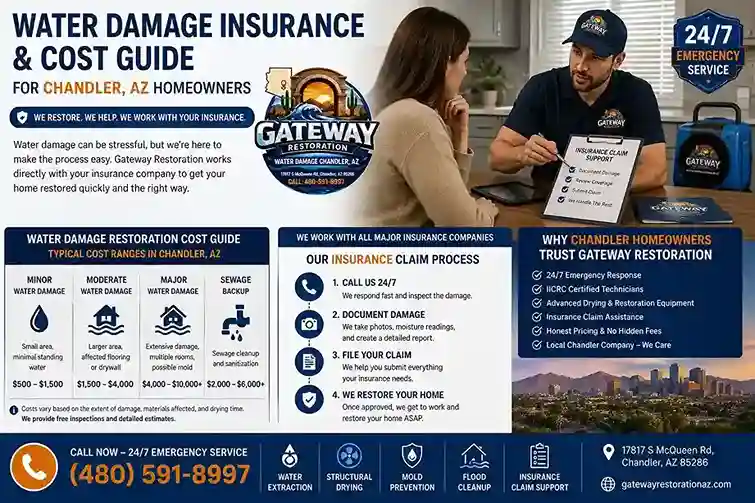
One of the most common points of confusion after water damage is who does what. Insurance carriers and restoration companies play completely different roles, and understanding that difference helps you know what to expect from each.
Your carrier is responsible for the financial and contractual side of your claim.
We are responsible for the physical mitigation and restoration of your property.
Gateway Restoration does not evaluate your policy, does not decide what is covered, and does not have authority to approve or deny any part of your claim. Those decisions belong exclusively to your insurance carrier.
Most Arizona homeowners policies are written to cover water damage that is sudden and accidental — meaning it happened without warning and wasn't the result of a problem the homeowner knew about and failed to address. Whether a specific loss is covered always depends on your individual policy, its endorsements, and any exclusions your carrier has applied.
Because coverage varies significantly by carrier, policy form, and endorsement, the only way to know exactly what your policy covers is to read your declarations page and speak directly with your agent or carrier. For general guidance on homeowners insurance in Arizona, the Arizona Department of Insurance and Financial Institutions publishes consumer resources that explain how residential policies typically work.
Homeowners often use "flood" and "water damage" interchangeably, but insurance carriers treat them as two entirely different types of loss — and that difference can determine whether a claim is covered at all.
Typically originates from inside the home and is often included under a standard homeowners policy when the cause is sudden and accidental.
Involves water entering from outside the structure and is usually excluded from standard homeowners policies.
Chandler and the broader East Valley experience intense monsoon storms between June and September, which can produce flash flooding near washes and low-lying streets. When water enters a home from outside during a monsoon event, that loss is frequently classified as flood damage rather than water damage — meaning it may not be covered by a standard homeowners policy. Many Arizona property owners in flood-prone areas choose to carry a separate flood insurance policy, often through the National Flood Insurance Program or a private flood carrier, specifically to address this gap in standard coverage.
While every claim is different, most water damage claims in Chandler follow a similar general sequence from discovery to final completion.
Shut off the main water valve or the specific supply line causing the leak, if it's safe to do so. Stopping active water flow is the first priority before anything else.
Take photos and video of the affected areas, the water source, and any damaged belongings before cleanup begins. This documentation becomes an important part of your claim record.
Notify your insurance carrier to begin the claims process. Your carrier will provide a claim number and explain what information they'll need from you moving forward.
A restoration company begins water extraction and emergency mitigation to prevent the damage from worsening. Most policies expect mitigation to start promptly rather than waiting for an adjuster.
Structural drying begins using commercial air movers and dehumidifiers, with daily moisture readings logged to track progress and confirm when materials are dry.
Your insurance company's adjuster reviews the loss, often using the documentation and mitigation records provided by the restoration company, to determine coverage.
Once drying is confirmed complete and coverage is determined, repair and reconstruction work begins to return the property to its pre-loss condition.
A final walkthrough confirms all work is complete and the property has been restored, closing out the mitigation and restoration portion of the claim.
Thorough documentation gives your insurance adjuster objective evidence of the loss and the mitigation work performed, which can help a claim move more smoothly and with fewer disputes. Gateway Restoration provides the following documentation as a standard part of every mitigation job.
Visual record of the damage at each stage of the job, from initial discovery through completion.
Video documentation captures the extent of the loss in ways still photos sometimes can't.
Logged measurements showing moisture content in affected materials over time.
Infrared imaging identifies hidden moisture behind walls and under flooring.
Daily records tracking equipment placement, humidity, and drying progress.
Documentation of the air movers, dehumidifiers, and extraction equipment used on site.
Formal classification of the water category, which affects protocols and cost.
Ongoing updates that show the job's status from day to day.
Side-by-side records showing the condition of the property at each stage.
Every water loss is classified by contamination level, and that classification affects both the mitigation protocols required and, in many cases, how a claim is evaluated.
Water from a clean source such as a supply line or appliance, with no contamination risk. This is typically the least complex category to mitigate and document.
Water containing some contaminants, such as overflow from a washing machine or dishwasher, that carries a mild health risk if left untreated.
Grossly contaminated water, including sewage backups, flood water, or water that has sat long enough to grow bacteria. Requires full protective protocols.
Sewage backups and other Category 3 losses often require additional remediation steps beyond standard drying, including removal of affected porous materials and thorough sanitization. Because of the added scope, Category 3 losses are typically documented in greater detail to support the claim, and coverage for sewage backups sometimes requires a specific policy endorsement — another reason to confirm your coverage directly with your carrier.
The following ranges are provided for general educational purposes. Every property and loss is different, and final costs depend on the specific scope of work.
| Damage Type | Typical Cost Range |
|---|---|
| Category 1 Water (clean water) | $1,200 – $3,500 |
| Category 2 Water (gray water) | $2,500 – $6,500 |
| Category 3 Water (contaminated/black water) | $4,500 – $12,000+ |
| Mold Remediation (additional, if needed) | $1,500 – $6,000+ |
| Commercial Losses | Custom estimate based on scope |
| Large-Loss Commercial Projects | Project-specific pricing |
These figures are general ranges only and are not a quote. Call (480) 591-8997 for a free, itemized inspection specific to your property.
It's common for homeowners to be surprised by the line items on a mitigation invoice, especially if they've never been through a water loss before. Here's what those charges typically represent.
Commercial-grade air movers and industrial dehumidifiers are significantly more powerful — and more expensive to purchase, maintain, and run — than household fans or box store dehumidifiers. They're sized and placed according to IICRC drying calculations specific to the room's dimensions and material types, not guesswork, which is what allows a structure to be confirmed dry in days rather than weeks.
Legitimate restoration invoices should clearly itemize equipment used, days of operation, labor performed, and materials involved, and should be backed by daily documentation. Be cautious of vague line items, charges that can't be tied to specific work performed, or pressure to sign broad authorization documents before you understand what you're agreeing to.
Timelines vary based on the size of the loss, the water category, and how quickly your carrier processes the claim, but here's a general framework.
Emergency response and mitigation start
Structural mitigation and drying
Claim review by your carrier
Repairs and reconstruction, depending on scope
Factors that can extend a timeline include the water category, the size of the affected area, material availability for reconstruction, contractor scheduling, and how quickly documentation is submitted and reviewed by the carrier. Category 3 losses and large commercial claims typically take longer than a small Category 1 residential loss.
It depends on the cause. Mold that develops directly from a sudden, covered water event is often included, sometimes subject to a mold sub-limit written into the policy. Mold tied to long-term moisture, deferred maintenance, or a previously known leak is frequently excluded. Reviewing your policy's mold provisions with your agent is the only way to know for certain.
Drywall damaged by a covered water event is commonly included in a claim, since removing and replacing saturated drywall is often necessary to properly dry the wall cavity and prevent mold. The specific scope depends on your adjuster's assessment and your policy terms.
Flooring damaged by a sudden, covered water event is commonly part of a claim, but coverage can vary by material type and whether the flooring was already showing wear prior to the loss. Documentation of the flooring's condition immediately after the event helps support this part of the claim.
Some policies include "loss of use" or "additional living expense" coverage that can reimburse temporary housing costs if a covered loss makes your home uninhabitable during repairs. This coverage, and its limits, varies by policy — check your declarations page or ask your agent.
A sudden slab leak is often covered as a sudden and accidental plumbing failure, though some policies apply specific sub-limits or requirements for slab leak claims, and coverage can depend on whether the leak was discovered promptly. This is another area where policy language matters significantly.
Disagreements over scope or pricing between an adjuster and a restoration contractor do happen. In these situations, additional documentation, moisture readings, or a supplemental inspection can sometimes resolve the difference. For disputes that can't be resolved directly, homeowners may want to consult their policy's appraisal clause or seek guidance from a licensed public adjuster or attorney.
Chandler's climate, soil, and construction create a distinct set of water damage risks that show up repeatedly in local claims.
This section is educational only and is not legal or insurance advice. A few habits can make future claims easier to navigate.
For questions about your specific coverage or legal rights, speak with a licensed insurance agent, a public adjuster, or an attorney. Gateway Restoration is not able to interpret your policy or provide legal guidance.
A deeper look at what standard Arizona homeowners policies typically include and exclude.
A closer breakdown of pricing by category, scope, and common cost drivers.
A step-by-step checklist for documenting a loss from discovery through completion.
What to prepare and document before your adjuster's inspection.
Understanding the difference between emergency mitigation and full restoration work.
What it means to use an insurer's preferred vendor list versus choosing your own contractor.
Warning signs of questionable billing and storm-chasing contractors after major weather events.
What an assignment of benefits agreement is and what to consider before signing one.
Emergency dispatch across Chandler and the East Valley, day or night.
Photo, video, and written records built the way carriers expect to see them.
Objective moisture readings logged daily, not just our word that a structure is dry.
Hidden water behind walls and under flooring is located, not left to become mold.
Documentation formatted for the way adjusters review a claim.
Every job follows IICRC S500 standards for water damage mitigation.
Straightforward updates throughout mitigation, with no surprise line items.
We know the caliche soil, hard water, and monsoon patterns unique to this area.
Scaled response for offices, HOA common areas, and multi-unit properties.
Most Arizona homeowners policies cover sudden and accidental water damage, such as a burst pipe, water heater failure, or storm-related intrusion. Damage from long-term leaks, deferred maintenance, or neglect is typically excluded. Coverage always depends on the specific policy language and endorsements, so review your declarations page or ask your agent directly.
Generally, no. Standard homeowners policies typically exclude flood damage caused by water entering from outside the home, such as surface water or flash flooding. Flood losses usually require a separate flood insurance policy, often through the National Flood Insurance Program or a private flood carrier.
Costs typically range from $1,200 to $3,500 for Category 1 losses, $2,500 to $6,500 for Category 2, and $4,500 to $12,000 or more for Category 3. Mold remediation, if needed, typically adds $1,500 to $6,000 or more. Actual pricing depends on square footage, materials, and how long water sat before treatment.
Keep photos and video of the damage before cleanup, moisture readings, drying logs, equipment records, daily progress reports, and restoration invoices. This documentation supports your claim and gives your adjuster objective evidence of the loss and the mitigation performed.
No. Most policies require homeowners to take reasonable steps to prevent further damage, which means mitigation should begin promptly. Document the damage thoroughly first, then begin emergency mitigation. Waiting days for an adjuster often allows secondary damage like mold to develop.
It depends on the policy and the cause of the mold. Mold that results directly from a sudden, covered water event is often included or covered up to a sub-limit. Mold from long-term moisture or neglect is frequently excluded. Review your policy's mold provisions carefully.
Gradual or long-term leaks are one of the most common reasons claims are denied or reduced. Insurers generally expect homeowners to identify and address slow leaks before they cause significant damage.
Category 3 water is grossly contaminated water, such as sewage backups, flood water, or water that has sat long enough to grow bacteria. It poses a health risk and requires full protective protocols and thorough sanitization.
Most residential structural drying takes three to seven days with commercial equipment running continuously. Larger losses, Category 3 water, or dense materials like tile and concrete can extend that timeline.
Yes. We provide the documentation, moisture logs, and photo records that carriers commonly request, and we communicate with adjusters about the mitigation and restoration work performed. We do not adjust claims or make coverage decisions.
No. Gateway Restoration is a restoration and mitigation company. We do not sell insurance policies, evaluate coverage, or adjust claims. Coverage decisions are made exclusively by your insurance carrier.
No restoration company can guarantee claim approval, and any company that promises this should raise concern. Approval depends on your policy language, the cause of loss, and your carrier's review.
You can request a written explanation from your carrier, ask about the specific policy language cited, and consider requesting a re-inspection. For questions about your legal rights, consult a licensed attorney or contact the Arizona Department of Insurance and Financial Institutions.
Stop the source of water if it's safe to do so, shut off power to affected outlets if water is nearby, photograph and video the damage, and contact a restoration company to begin mitigation. Notify your insurance carrier as soon as reasonably possible.
In Arizona's warm indoor environments, mold spores can begin colonizing damp materials within 24 to 48 hours of water exposure, which is why prompt extraction and structural drying matter so much.
17817 S McQueen Rd, Chandler, AZ 85286
Gateway Restoration provides 24/7 emergency mitigation and documentation support across Chandler, AZ. We're not an insurance company — we're here to help you document damage properly and restore your property.
17817 S McQueen Rd, Chandler, AZ 85286 • 24/7 Emergency Response
 Gateway Restoration