Why Storm Damage Requires Immediate Restoration

Storm damage is rarely a single, isolated problem. A hailstone that fractures a roof tile, a wind gust that lifts three shingles, or a tree branch that punches through a soffit — each of these events creates an opening. And once the rain finds that opening, it begins a chain reaction that spreads far beyond the visible damage.

Water that enters through a compromised roof doesn't stop at the ceiling. It saturates attic insulation, which collapses its thermal value and becomes a mold substrate within days. It migrates along roof decking and rafters until it finds a gap in the ceiling drywall. Then it moves into wall cavities, behind baseboards, and under flooring — all while remaining invisible to the naked eye.

Broken windows and damaged siding allow wind-driven rain to enter through exterior walls, soaking the wall cavity insulation and the interior drywall simultaneously. Electrical boxes in affected areas become shock hazards. And throughout all of this, Arizona's warm interior temperatures create the perfect conditions for mold to begin colonizing wet materials within 24 to 48 hours.

The gap between calling for help immediately and waiting even 48 hours is often the difference between drying materials in place and replacing them entirely — a cost difference that regularly runs into thousands of dollars. Fast, professional mitigation isn't just faster; it's fundamentally less expensive.

⚠️
Mold can begin growing in wet insulation and drywall within 24–48 hours in Arizona's warm indoor temperatures. Do not wait to call. Call (480) 591-8997 now for immediate dispatch.

How a Small Opening Becomes a Major Loss

1
Storm-Created OpeningWind, hail, or debris damages roof, siding, or windows
2
Rain IntrusionWater enters through the compromised area
3
Insulation SaturationAttic insulation absorbs moisture and loses function
4
Drywall SaturationCeilings and walls absorb water and begin to fail
5
Floor DamageWater migrates to flooring, subfloor, and baseboards
6
Mold GrowthBegins within 24–48 hours in warm Arizona interiors
7
Structural DeteriorationFraming, decking, and finishes suffer long-term damage

Storm Weather Risks in Chandler, Arizona

Chandler sits in one of the most meteorologically active desert environments in North America. Homeowners here face a specific seasonal weather pattern that creates unique storm damage risks — many of which are unlike anything homeowners relocating from other states have experienced before.

🌩️

Arizona Monsoon Season

Running roughly June through September, monsoon season brings organized storm systems that can deliver two inches of rain in under an hour — more than some Chandler roofs were designed to shed in a single event. The intense, short-duration nature of monsoon rain is why so many roof leaks occur during these months rather than during lighter, more sustained rainfall.

💨

Microbursts & Wind Events

Chandler experiences microburst events — localized, extremely powerful downdrafts — that can generate wind gusts exceeding 60 to 80 miles per hour within a very small geographic area. A microburst can strip shingles, uproot mature trees, shatter windows, and damage fencing in seconds, often before a homeowner is even aware a storm is developing.

🟤

Dust Storms (Haboobs)

The walls of dust that precede monsoon thunderstorms — known locally as haboobs — can be a thousand feet tall and carry fine particulate matter at high velocity. While less likely to cause structural damage than wind events, haboobs can force fine particles into HVAC systems and any unsealed penetrations, and often precede the intense rainfall that follows the storm system.

🌧️

Flash Flooding & Drainage Overwhelm

Chandler's desert soil absorbs water slowly, and the city's drainage infrastructure can be overwhelmed during peak monsoon events. Low-lying yards, garages, and areas near washes can see water pooling and pushing against foundations, window wells, and door thresholds — creating interior flooding risk that is distinct from roof-related intrusion.

🧊

Hail Events

While less frequent than in the Midwest or Front Range, hail events do affect the Chandler area, particularly during monsoon season and during spring storm systems. Hailstones as small as half an inch can damage asphalt shingles, crack clay tiles, dent gutters and downspouts, break skylights, and compromise flashing seals — often without creating damage that is visible from ground level.

☀️

Extreme Heat & UV Exposure

Chandler's summer temperatures regularly exceed 110°F, and UV radiation at this latitude is among the most intense in the country. Over years, this causes thermal expansion and contraction cycles in roofing materials, degrades the sealant around flashing, and dries out asphalt shingle granules — all of which reduce a roof's ability to resist water intrusion when a storm arrives.

Common Storm Damage We Restore in Chandler

As the pillar service provider for storm-related restoration in the Chandler area, Gateway Restoration handles the complete scope of storm event damage — from the first point of impact on the exterior to the last affected material deep inside the home's structure.

🔗
Storm damage often results in secondary water damage that requires specialized services including roof leak water damage restoration, water extraction, structural drying, and mold remediation.

Chandler Roofs Face Unique Challenges

Chandler's built environment presents roofing challenges that don't exist in most other parts of the country. The combination of extreme UV exposure, thermal cycling, monsoon rainfall intensity, and aging housing stock creates a specific risk profile that every Chandler homeowner should understand — especially heading into storm season.

Aging tile roofs are common throughout Chandler's established neighborhoods. Clay and concrete tiles are durable, but they become increasingly brittle with age and repeated thermal expansion. A tile that can withstand a moderate hailstone at year five of its life may crack under the same impact at year twenty-five. Tiles also shift over time, creating small gaps in the underlayment that go undetected until the first monsoon storm drives rain through them.

Asphalt shingle roofs lose granule coverage progressively over years of UV exposure. Once the protective granule layer thins, the asphalt mat beneath becomes vulnerable to cracking, moisture penetration, and accelerated wind uplift. Homes in Chandler that are 15 to 20 years old often have shingle systems approaching the end of their protective service life — and monsoon season stress-tests them every year.

Flashing failures are among the most common sources of storm-related water intrusion. The sealant around chimney flashing, pipe penetrations, skylight curbs, and roof-to-wall junctions dries and cracks in Arizona's heat, creating micro-gaps that become active leaks the moment wind-driven rain is introduced at pressure.

Before Storm Season: Protect Your Chandler Home

Late summer is when many Chandler families shift their focus — kids return to school, fall activities ramp up, and households settle into a new routine. It's also the ideal window to assess your home's readiness before the monsoon season peaks. A few hours of preparation can prevent a week of emergency restoration.

  • Schedule a professional roof inspection — look for cracked tiles, missing shingles, and lifted flashing
  • Trim tree branches that overhang the roofline or sit close to windows
  • Clean gutters and downspouts to allow full drainage capacity
  • Inspect and reseal flashing around chimneys, skylights, and pipe boots
  • Check attic insulation for any existing moisture or staining from previous seasons
  • Seal exterior penetrations — where utilities enter the home, around window frames, and door thresholds
  • Confirm window seals and weatherstripping are intact
  • Walk the perimeter after any wind event and look for displaced tiles, lifted shingles, or debris

Our Emergency Storm Restoration Process

Every storm damage restoration job follows a structured, documented sequence. This isn't a checklist for its own sake — each step builds on the last, and skipping any of them is how damage gets missed and insurance claims fall apart.

01

Emergency Inspection & Safety Assessment

We assess structural stability, identify active hazards, and document all visible damage before any work begins. Safety comes first — no workers on an unstable structure or near live electrical hazards.

02

Emergency Tarping & Temporary Protection

We deploy heavy-duty tarps over damaged roof areas and board compromised windows to stop further rain intrusion immediately. This step is documented photographically for your insurance record.

03

Water Extraction

Truck-mounted extraction equipment removes standing water from affected interior areas. This step is completed before drying begins — attempting to dry before full extraction is inefficient and leaves hidden moisture behind. See our water extraction service for more detail.

04

Moisture Mapping & Thermal Imaging

We use thermal cameras and calibrated moisture meters to locate every area of water migration — including inside walls, under flooring, and in attic insulation. See our moisture mapping service for details.

05

Structural Drying & Dehumidification

Commercial air movers and industrial dehumidifiers are placed based on IICRC calculations for the affected area. Equipment runs continuously until moisture readings confirm full drying. Learn more about our structural drying and dehumidification services.

06

Daily Monitoring & Documentation

We return daily to record moisture readings, adjust equipment placement, and photograph progress. Every visit is logged and becomes part of your insurance claim documentation package.

07

Insurance Coordination & Reporting

We provide your adjuster with a complete written moisture report, thermal images, scope of damage, and documentation of all mitigation work completed — everything needed to support your claim. See our insurance assistance page for more.

08

Restoration & Final Verification

Once the structure is confirmed dry, we coordinate or perform rebuild work — replacing drywall, insulation, flooring, and finishes. Final moisture readings verify the structure meets drying standards before the job is closed.

Insurance Claims After Storm Damage

Most standard Arizona homeowners insurance policies cover storm damage when it results from a sudden, accidental event — wind, hail, a fallen tree, or rain entering through a storm-created opening. The documentation your adjuster requires to process that claim, however, is specific — and incomplete documentation is the most common reason claims are delayed or disputed.

Document everything before cleanup begins. The moment you discover storm damage, photograph and video the entry point, the affected interior areas, and any damaged belongings. Timestamp your documentation. The sequence of events matters to adjusters, and a documented timeline establishes that the damage was sudden and the response was prompt.

Emergency mitigation is covered separately. Most policies include coverage for reasonable emergency mitigation — the cost of tarping, boarding, and water extraction to prevent additional damage. This is distinct from the repair and restoration coverage, and it should be initiated immediately even before your adjuster schedules a visit. Delaying emergency mitigation is the single fastest way to weaken an otherwise strong claim.

Preserve evidence until the adjuster visits. Do not discard damaged materials, remove wet drywall, or perform permanent repairs before your adjuster has documented the loss. Temporary measures are appropriate — tarping, extraction, containment — but permanent replacements should wait for adjuster sign-off where possible.

We work directly with your adjuster, provide written moisture reports and thermal imaging documentation, and explain how each component of our scope relates to your policy's coverage provisions. We do not guarantee specific coverage outcomes, but thorough, professional documentation consistently supports stronger claim results.

What Storm Damage Restoration Costs in Chandler

Storm restoration costs vary significantly based on the type and severity of damage, materials affected, and how quickly mitigation began. The ranges below represent typical Chandler residential losses.

Damage Type Typical Range
Minor roof leak — ceiling stain only $800–$2,200
Interior ceiling & wall damage from roof intrusion $2,000–$5,500
Wind-driven rain intrusion — multiple rooms $3,500–$8,000
Major roof failure with attic & interior saturation $8,000–$20,000+
Structural drying only (contained area) $1,500–$4,000
Mold remediation following storm damage $2,000–$8,000+

Actual costs depend on water category, affected square footage, material types, drying time required, and severity of roof and structural damage. Contact us for a free, itemized inspection and estimate.

📞 Get a Free Storm Damage Estimate
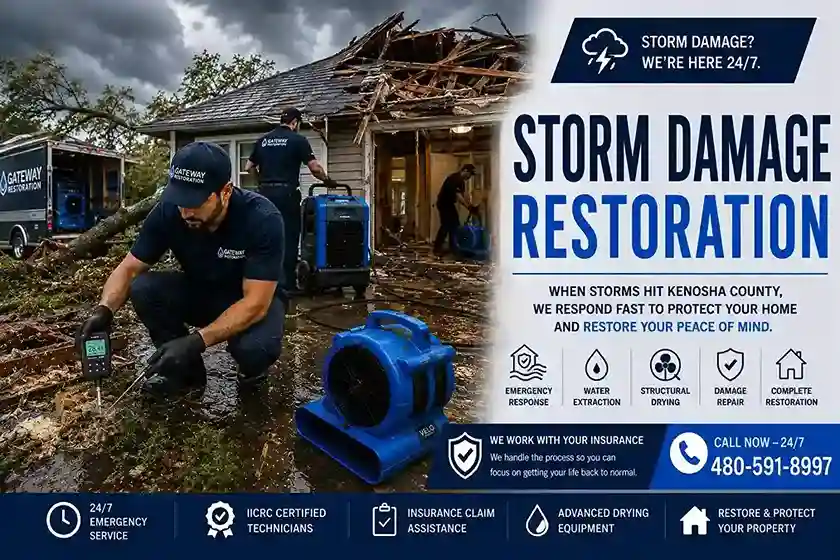
Why Gateway Restoration Handles Your Storm Damage

When a storm has just damaged your home, you need a restoration company that responds immediately, works professionally, and communicates clearly — not a national chain routing your call through an out-of-state center to dispatch whoever happens to be available.

⚡

24/7 Emergency Response

Our crews are available around the clock, every day of the year. Chandler monsoon storms don't respect business hours, and neither do we.

📡

Advanced Moisture Detection

Thermal imaging and calibrated moisture meters find hidden water inside walls, floors, and insulation that visual inspection will miss.

📋

Professional Documentation

Every job produces a written moisture report with dated photos and thermal images — the documentation adjusters need to process claims efficiently.

🤝

Insurance Claim Support

We work directly with your adjuster, explain our scope clearly, and organize our documentation to align with how claims are evaluated.

📊

Daily Monitoring

We don't set equipment and disappear. We return daily to check moisture readings, adjust drying equipment, and keep you informed.

🏅

IICRC Restoration Methods

Every technician follows IICRC standards for water damage mitigation and structural drying — the industry benchmark for restoration quality.

💬

Fast, Clear Communication

You'll know what we found, what we're doing, and what comes next — at every stage of the restoration process.

🏠

Local Chandler Company

We live and work here. We know Chandler's homes, its storm patterns, and its neighborhoods — not a franchise operation dispatching strangers.

Chandler Homeowners Trust Gateway Restoration

Real reviews from real Chandler homeowners who called us after storm events.

★★★★★

"A monsoon microburst took out part of our roof near Ocotillo. Gateway had a crew on-site the same night with tarps up before the rain returned. They documented everything for our adjuster and we were dry within five days. Cannot recommend them enough."

— Chandler Homeowner, Ocotillo
★★★★★

"Hail hit our home near Cooper Commons and we had no idea the tiles were cracked until water started appearing in our master bedroom ceiling. Gateway found two additional moisture pockets in the attic we never would have caught. Thermal imaging is incredible."

— Chandler Homeowner, Cooper Commons
★★★★★

"A tree limb came through our garage roof during the storm. Gateway secured the opening, removed the standing water in the garage, and dried it completely in four days. They also wrote up a scope of work that made our insurance claim simple."

— Chandler Homeowner, Fox Crossing
★★★★★

"Wind-driven rain came in through three windows during a haboob event near Sun Lakes. I was afraid we'd need mold remediation. Gateway started drying within two hours and caught it before mold had a chance to establish. Responsive, professional, and honest."

— Chandler Homeowner, Sun Lakes
★★★★★

"Our skylight cracked in a hailstorm and flooded the hallway below. Gateway came out that evening, covered the skylight, and had commercial drying equipment running overnight. They checked in every day until the job was done."

— Chandler Homeowner, Clemente Ranch

Frequently Asked Questions About Storm Damage Restoration

Answers to the questions Chandler homeowners ask most after a storm event.

Once the storm has passed and it is safe to move through your home, your first priority is safety — not cleanup. Check for downed power lines, broken glass, or structural instability before entering any damaged area. If water is near your electrical panel or outlets, shut off the circuit breaker for that zone. Do not attempt to enter an attic or walk on a roof without professional assessment. Document everything you can see with photos and video before touching anything. Then call a licensed storm damage restoration company as quickly as possible. Every hour that rain-saturated materials sit without professional drying raises the risk of mold growth, drywall failure, and deeper structural damage. Temporary measures like moving furniture and placing buckets are fine, but commercial water extraction and drying equipment are necessary for materials inside walls and floors. Call (480) 591-8997 for immediate dispatch.
Yes — and this is one of the most misunderstood aspects of hail damage. A hailstone impact may not punch a visible hole through a shingle or tile, but it can fracture the asphalt mat beneath the surface granules, creating micro-cracks that allow water infiltration during the next rain event. On tile roofs, which are common in Chandler, hail can crack individual tiles in ways that are invisible from ground level but immediately apparent to a trained inspector on the roof. These hidden failures often go undiscovered until a monsoon storm weeks later drives rain through the compromised area. By that point, insulation and drywall may already be wet. If your home was in the path of a hail event, requesting a professional inspection — even when the interior looks fine — is one of the most protective steps you can take before the next storm arrives.
You do not need to wait until the rain stops to call Gateway Restoration — and we recommend calling as soon as you discover damage. While our crews will not place workers on a roof during active lightning, we can begin interior assessment, deploy water extraction equipment for areas already wet, set up temporary containment, and coordinate emergency tarping as soon as conditions safely allow. Calling early also creates a time-stamped record of your loss, which matters during the insurance claims process. Some adjusters review the date of first professional contact when evaluating whether emergency mitigation was prompt. Calling while the storm is still active does not delay our response — it starts the clock and ensures our team is ready to move the moment conditions allow safe access to your home.
Water should be extracted as quickly as possible — ideally within the first few hours of intrusion. In Arizona's warm interior environments, drywall can begin absorbing moisture within minutes of exposure, and saturated insulation loses its integrity rapidly. Mold colonization can begin in as little as 24 to 48 hours when temperature and humidity conditions align, which is common in Chandler homes during monsoon season. The longer absorbed water remains, the deeper it migrates — from surface flooring down through subfloor, from ceiling drywall up into attic insulation, from wall cavities behind baseboards into framing. Professional water extraction equipment removes far more volume and moisture than any consumer-grade wet-vac, and it is the critical first step before structural drying can begin effectively.
Most standard homeowners insurance policies in Arizona cover sudden storm-related damage, including wind damage, hail impacts, rain intrusion through a storm-created opening, and damage caused by falling trees or branches. The key threshold insurers apply is whether the damage was sudden and accidental versus the result of pre-existing deterioration or deferred maintenance. A roof already missing multiple shingles before the storm may face a more complicated claim than a well-maintained roof that sustained sudden wind damage. What is generally not covered under standard policies is flooding from ground-level water rising, which requires separate flood insurance. We help document your loss with photos, moisture reports, and written assessments that give adjusters objective evidence. We do not guarantee coverage outcomes, but thorough documentation consistently supports stronger claim results. Visit our insurance assistance page to learn more.
Yes. A storm-created roof opening that allows even a moderate amount of rain intrusion can create conditions for mold growth within 24 to 48 hours in Arizona's warm indoor temperatures. Attic insulation is particularly vulnerable — it holds moisture like a sponge, stays wet long after the rain stops, and sits in a warm, poorly ventilated space that is essentially ideal for mold colonization. Drywall absorbs water quickly and, if not professionally dried within the critical window, will become a substrate for mold growth behind the surface. The problem is that mold often begins inside wall cavities and insulation before it becomes visible on painted surfaces — meaning a home can have an active mold problem that is not detected for days or weeks. This is why professional moisture mapping and thermal imaging after a storm event are critical — they are the only reliable way to confirm all wet materials have been located and dried. If mold does develop, our team provides mold remediation services.
This is extremely common after storm events, and it does not mean the damage is minor — it often means the opposite. Water that enters through a roof opening rarely travels straight down. It follows the path of least resistance along roof decking, attic rafters, and insulation before it finds a gap in the ceiling drywall or a wall cavity. A water stain in a hallway ceiling may trace back to a roof penetration on the opposite side of the home. A wet baseboard in a bedroom may be fed by moisture traveling down inside the wall from attic insulation above. Thermal imaging cameras detect temperature differentials created by evaporating moisture behind finished surfaces — showing us exactly where water has migrated without opening every wall. Moisture meters confirm saturation levels in drywall and framing. Together, these tools allow us to map the full extent of intrusion and dry every affected area, not just what is visible to the eye.
Yes — thermal imaging is one of the most effective tools available for locating storm-related water intrusion that has migrated behind finished surfaces. When water evaporates from wet materials, it creates a cooling effect that shows as a distinct temperature differential on a thermal camera. This allows trained technicians to identify wet insulation in an attic, moisture trapped inside exterior walls, water that has traveled from a roof leak down into a ceiling cavity, and saturated subflooring beneath tile or hardwood — all without cutting open walls. Thermal imaging is most effective when there is a meaningful temperature difference between the wet materials and their surroundings, which is why we prefer to scan shortly after the intrusion event. We document all thermal findings with dated images and include them in your insurance claim documentation package, giving your adjuster objective visual evidence of the full scope of damage.
It depends on how long the drywall was wet, the water category, and whether drying was completed before mold had an opportunity to colonize. Drywall that was wet for less than 24 to 48 hours, was not exposed to contaminated water, and was thoroughly dried with commercial equipment may sometimes be restored in place. However, drywall that was saturated for multiple days, that shows active mold growth on the paper facing or backing, that has lost structural integrity, or that was exposed to contaminated water should be removed and replaced. Attempting to dry mold-colonized drywall kills surface spores but leaves the organic paper backing as a food source for future regrowth. We assess each area individually using moisture readings and visual inspection and make recommendations based on the actual condition of each material — not a blanket rule that either saves everything or replaces everything regardless of condition.
The mitigation phase — water extraction, structural drying, and moisture monitoring — typically takes three to seven days for most residential storm losses, depending on the volume of water intrusion, the materials affected, and how quickly mitigation began. Attic insulation replacement, if required, adds additional time. If mold remediation is needed, that adds two to five additional days depending on scope. The rebuild phase — replacing drywall, flooring, insulation, paint, and other finished materials — can take anywhere from a few days for minor losses to several weeks for major structural damage. We provide a detailed project timeline after the initial assessment and update you throughout so you always know the status of your home. Chandler's low relative humidity during drying weather can allow materials to release moisture somewhat faster than in wetter climates, which can reduce drying times when conditions are favorable.

Storm events often create conditions requiring specialized restoration work. Our team handles every phase under one roof.

Storm Damage Restoration Service Areas

We serve Chandler and the broader East Valley — including these communities and ZIP codes.

Chandler, AZ Gilbert, AZ Mesa, AZ Tempe, AZ Queen Creek, AZ Phoenix, AZ
Downtown Chandler
Ocotillo
Sun Lakes
Fox Crossing
Cooper Commons
Clemente Ranch
ZIP 85224
ZIP 85225
ZIP 85226
ZIP 85248
ZIP 85249
ZIP 85286

Request a Free Emergency Storm Inspection

Not sure if your storm damage requires professional restoration? Contact us for a free inspection — we'll assess the damage, identify hidden moisture, and give you an honest evaluation of what your home needs.

Emergency Storm Inspection Request

We respond immediately — day or night.

Gateway Restoration — Chandler, AZ

17817 S McQueen Rd, Chandler, AZ 85286
(480) 591-8997 — Available 24/7

Emergency Service Available 24/7

Storm damage does not wait for business hours. Neither do we. Call anytime.

📞 Call Now — (480) 591-8997

Storm Hit Your Chandler Home? We're Standing By.

Our crews are positioned across Chandler and the East Valley for immediate dispatch. Call now for emergency storm damage restoration, or request a free inspection and we'll assess your home's full condition at no cost.

24/7 Emergency Response
IICRC Certified
Insurance Support
Locally Owned & Operated