Water extraction removes the water you can see. Structural drying removes the moisture you can't — the water trapped inside drywall, framing, insulation, flooring, cabinetry, and ceilings after a loss. That hidden stage is where most restoration outcomes are actually decided.
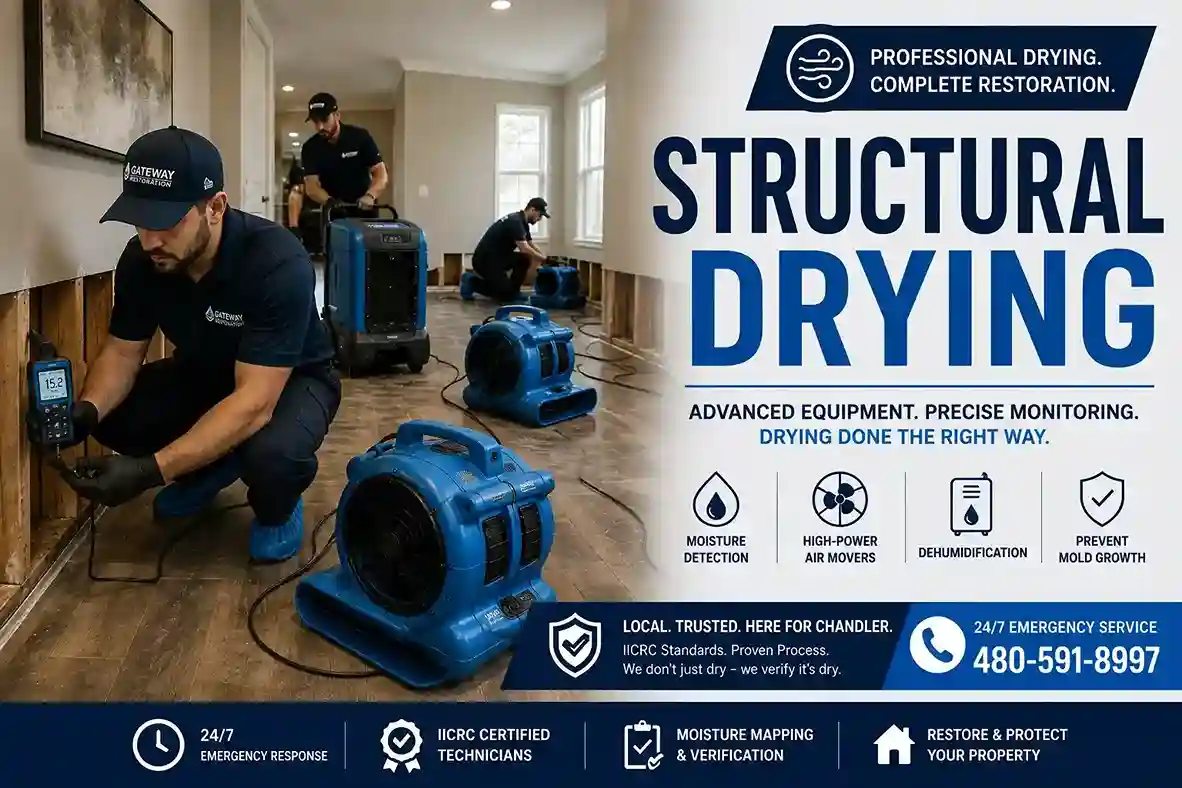
Most water damage projects don't fail at extraction — they fail after the standing water is already gone. Once the floor looks dry and the wet-vac is packed up, it's easy to assume the job is done. In reality, water disappears from sight long before the materials around it are actually dry. Drywall, framing, subfloor, insulation, and cabinetry can hold significant moisture for days or weeks after a surface looks completely normal.
That hidden moisture doesn't just sit quietly. Left unaddressed, it feeds mold growth, produces persistent odors, causes drywall to swell and lose strength, warps hardwood and laminate flooring, and slowly spreads secondary damage into materials that were never touched by the original event. This is why structural drying is not a footnote in the restoration process — it's the critical stage that sits between extraction and rebuild, and it's the stage that determines whether a property truly recovers or quietly develops problems that surface months later.
Gateway Restoration treats structural drying as an engineered process, not a formality. Every project in Chandler and the surrounding East Valley is measured, mapped, and monitored using IICRC S500 drying standards — not just fans left running until someone checks back in a few days.
Professional structural drying is built on IICRC S500 standards, the industry reference for water damage restoration. These standards define how technicians classify water, plan equipment placement, and verify when a structure is actually dry — replacing guesswork with a repeatable, documented process.
At the center of that process are psychrometric drying principles — the relationship between temperature, humidity, and air movement that governs how fast water evaporates from a material and how effectively that moisture can be captured out of the air. Drying isn't just about moving air; it's about managing moisture equilibrium so that materials release trapped water into the air faster than the air can hold it, then removing that moisture before it resettles somewhere else.
That requires deliberate evaporation control, humidity management, and airflow management working together. Just as important is material-specific drying: drywall, hardwood flooring, engineered flooring, framing lumber, and cabinetry all absorb and release moisture differently, and each requires its own approach.
Professional structural drying is not "putting fans in a room and hoping for the best." It's an engineered drying plan, built around measured data and adjusted daily based on what the moisture readings actually show.
Moisture can remain trapped inside a structure long after surfaces appear completely dry — and that gap is where the real risk lives.
Water travels inside wall cavities and beneath flooring, often remaining long after the visible surface looks and feels dry.
Prolonged moisture weakens drywall, delaminates engineered flooring, and can compromise the structural integrity of framing lumber.
Incomplete drying leaves the exact damp, warm conditions mold needs to establish inside wall cavities and under flooring.
Trapped moisture in porous materials produces musty odors that air fresheners can't resolve, because the moisture itself hasn't left.
Carriers expect documented proof that a structure was dried to industry standard, not just that equipment was on-site.
Thorough drying protects resale value and prevents the recurring repair costs that come with chronic hidden moisture.
Every drying plan pairs the right combination of equipment to the specific materials, moisture levels, and layout of your property.
Low Grain Refrigerant (LGR) dehumidifiers pull moisture out of the air more efficiently than standard units, delivering superior moisture removal even in already-dry desert air — critical for commercial-grade drying performance on larger losses.
Standard refrigerant dehumidifiers remain effective in higher-humidity conditions and are often used alongside LGR units to balance capacity across a job.
High-velocity air movers create controlled airflow across wet surfaces, accelerating evaporation and effectively turning a room into a directed drying chamber.
Injectidry systems push dry, filtered air directly into wall cavities, under cabinets, and beneath flooring — drying hidden spaces without unnecessary demolition.
HEPA air scrubbers filter airborne particulates and improve indoor air quality during drying, especially important on jobs involving Category 2 or 3 water.
Pin and pinless moisture meters measure the actual moisture content inside drywall, wood, and subfloor, giving objective numbers rather than a guess.
Thermal imaging reveals temperature differences that indicate hidden moisture behind walls, under flooring, and inside ceiling cavities before it's visible to the eye.
Environmental data loggers continuously track temperature and humidity throughout the drying chamber, giving a verified record of conditions the whole project.
Structural drying comes down to a handful of principles that, once you understand them, explain why this work can't be rushed with a box fan.
Relative humidity is how much moisture is in the air compared to the maximum it could hold at a given temperature. The higher the relative humidity in a room, the slower wet materials can release moisture into that air — which is why dehumidifiers, not just airflow, are essential.
Temperature affects how much moisture air can hold and how quickly water evaporates from a surface. Warmer air generally speeds evaporation, but only if that added moisture is actively being removed from the space.
Vapor pressure is the driving force behind evaporation — moisture moves from areas of higher concentration (a wet wall) toward areas of lower concentration (drier surrounding air). Managing that pressure difference with airflow and dehumidification is what keeps materials releasing moisture instead of reabsorbing it.
Dew point matters because if the air surrounding a wet material cools below its dew point, moisture condenses right back onto surfaces instead of leaving the room — which is one reason drying equipment has to be balanced correctly, not just maximized.
Air movement disrupts the thin layer of saturated air that naturally forms against a wet surface, replacing it with drier air so evaporation can continue at a useful rate.
Moisture content is the actual measurement — expressed as a percentage — of how much water a material is holding, and it's the number we track daily to know whether a drying plan is working.
The drying goal for any project is to bring every affected material's moisture content back in line with an unaffected reference reading from the same structure — not to reach some universal number, but to match what's normal for that specific home or building.
Drying timelines depend on the scope and category of the loss, not a fixed schedule. These ranges reflect typical Chandler-area outcomes.
| Project Type | Typical Timeline |
|---|---|
| Typical Residential Projects | 3 – 5 days |
| Large Loss Projects | 5 – 10+ days |
| Commercial Buildings | Variable, based on scope |
Factors that influence how long drying takes include the total square footage affected, the water category involved, the specific materials present (drywall dries faster than dense hardwood or concrete slab), how thoroughly materials were saturated before extraction began, the airflow requirements of the space, and even current weather conditions. We don't promise a fixed number of days on any project — drying is complete when moisture readings confirm it, not when a calendar date arrives.
Arizona's desert climate changes how a drying plan is engineered — sometimes helping, sometimes complicating the job.
Chandler's naturally low ambient humidity often supports faster evaporation rates than restoration projects in humid climates, when conditions are managed correctly.
High outdoor and attic temperatures influence evaporation rates and equipment performance, requiring adjusted dehumidifier capacity during peak summer months.
Between July and September, monsoon storms introduce sudden moisture loads and elevated outdoor humidity that can slow drying if a home's HVAC and ventilation aren't factored into the plan.
Even after a storm passes, temporarily elevated ambient humidity can linger for a day or more, requiring the drying plan to be recalculated.
Stucco exteriors, common throughout Chandler, retain moisture differently than other siding types and can mask wall cavity moisture behind an exterior that looks unaffected.
Most Chandler homes sit on concrete slab foundations, which dry far more slowly than raised foundations and require different equipment strategy beneath flooring systems.
Chandler attics regularly exceed 120°F in summer, which changes evaporation dynamics for roof leak and HVAC condensate losses affecting ceiling assemblies.
These local conditions are exactly why a generic drying plan doesn't work in Chandler. Our technicians factor desert humidity, seasonal monsoon loads, slab construction, and attic heat into every drying strategy rather than applying a one-size-fits-all approach.
Every job follows the same disciplined, documented sequence from first inspection to restoration readiness.
We begin with a full moisture inspection using meters and thermal imaging to identify every affected material and establish a baseline understanding of the loss.
Every wet area is logged and mapped, creating a clear record of which materials are affected and to what extent before any equipment is placed.
Using psychrometric calculations, we build a drying plan specific to the room dimensions, material types, and water category involved.
Air movers, dehumidifiers, and Injectidry systems are placed according to the plan, not spread evenly across the space by default.
Technicians return daily to take new moisture readings, log humidity and temperature, and adjust equipment based on how the space is actually drying.
Drying continues until readings for every affected material match an unaffected reference reading from the same structure.
Once verification confirms the structure is dry, all drying equipment is removed and the space is inspected a final time.
The property is handed off ready for rebuild — drywall, flooring, and finish work can begin with confidence the structure underneath is genuinely dry.
Every project starts with baseline readings — moisture measurements taken in both affected and unaffected areas before any equipment runs, giving us the reference point every future reading is measured against. From there, we take daily moisture readings in every affected material, along with relative humidity logs and temperature monitoring throughout the drying chamber.
That data feeds into drying progress reports that show, day by day, how each material is trending toward its dry standard. Moisture mapping visually documents which areas remain wet and which have reached target levels, and a final verification report confirms, with numbers, that the structure meets the dry standard before equipment is removed.
This entire process relies on calibrated moisture meters, thermal imaging to catch anything hidden from view, and psychrometric calculations that connect humidity, temperature, and airflow into a coherent plan. The result is a full set of drying records — not a verbal assurance that "it's dry now."
Detailed drying documentation provides proof of proper drying that most insurance carriers specifically require before approving a water damage claim in full. Carrier requirements typically call for daily moisture logs, equipment run-time records, and a final verification report — not just an invoice for equipment rental.
That documentation is what supports a smooth adjuster review, giving the adjuster objective data instead of asking them to take a contractor's word for it. Thorough records also play a major role in avoiding future disputes — if a moisture-related issue surfaces months later, documented proof that the structure was dried to standard protects the property owner from having a new problem blamed on incomplete original work.
Complete drying logs are also the clearest way of demonstrating mitigation efforts, which most policies require the policyholder to reasonably pursue. Ultimately, this documentation exists for one purpose: protecting property owners — both financially, through a supported claim, and physically, through a structure that's verified dry rather than assumed dry. Learn more on our insurance & cost page.
We provide structural drying for single-family homes, condos, townhomes, and apartments throughout Chandler and the East Valley. Common scenarios include drying a kitchen and adjoining hallway after a dishwasher supply line fails, drying a bedroom ceiling and attic insulation after a monsoon roof leak, drying a slab foundation and baseboards following a slab leak, and drying a laundry room and garage wall cavity after a water heater failure. Each of these scenarios calls for a different equipment mix and timeline, which is why we build a specific drying plan for every home rather than applying a standard package.
Related services: Residential Water Damage Restoration, Slab Leak Water Damage, Burst Pipe Water Damage, and Water Heater Leak Damage.
Commercial structural drying carries an added priority: minimizing downtime while still drying the structure to a verified standard. We provide commercial drying for offices, retail stores, warehouses, restaurants, schools, HOA facilities, and medical buildings throughout Chandler.
Commercial projects often require phased drying so portions of a building can reopen while drying continues in affected areas, after-hours equipment placement to avoid disrupting business operations, and drying plans that account for commercial-grade materials like concrete flooring, drop ceilings, and HVAC ductwork. Every commercial drying report is built to satisfy both your insurance carrier and, where applicable, your property management or ownership group.
Related services: Commercial Water Damage Restoration and Appliance Leak Water Damage.
Gateway Restoration provides structural drying throughout Chandler and the surrounding East Valley, including Downtown Chandler, Ocotillo, Sun Lakes, Cooper Commons, Clemente Ranch, and Fulton Ranch, along with Gilbert, Mesa, Tempe, Queen Creek, Phoenix, and other East Valley communities.
Chandler ZIP Codes Served:
See our full coverage area map for details on every community we serve.
Call Gateway Restoration — (480) 591-8997 — Science-Based Structural Drying in Chandler, AZ
Call Now: (480) 591-8997Structural drying is one stage in a full restoration process — explore the related services that come before and after it.
24/7 emergency response for active water damage events.
Around-the-clock dispatch for residential and commercial losses.
Rapid response to monsoon and flash-flood intrusion.
Removing standing water before structural drying begins.
Immediate steps to stop water damage from spreading further.
Commercial-grade humidity control supporting the drying process.
Locating hidden moisture behind walls and under flooring.
Restoration for water intrusion from beneath slab foundations.
Emergency response and drying after sudden pipe failures.
Restoration for water heater tank and fitting failures.
Drying and restoration after washing machine, dishwasher, and fridge leaks.
Full-service restoration for Chandler homes of every size.
Emergency response and drying for offices, retail, and more.
Addressing mold that develops when drying is incomplete or delayed.
Structural drying is the engineered process of removing moisture trapped inside a building's materials — drywall, framing, subfloor, insulation, and cabinetry — after standing water has already been extracted. It uses controlled airflow, dehumidification, and daily moisture measurement to bring materials back to a normal, dry moisture content rather than simply drying what's visible on the surface.
Most residential structural drying takes 3 to 5 days. Large-loss or Category 3 projects, and buildings with dense materials like concrete slab, tile, or plaster, can take 5 to 10 days or longer. Commercial buildings vary widely based on square footage and construction type. Actual drying time is confirmed by daily moisture readings, not a fixed calendar.
In many cases, yes. Wall cavities can often be dried in place using Injectidry systems and controlled airflow, avoiding unnecessary drywall removal. Whether a wall can be dried without opening it depends on the water category, how long it was wet, the wall assembly, and moisture readings taken during the drying plan.
Drying is confirmed when moisture content readings for each affected material return to a normal range consistent with unaffected areas of the same structure, measured with calibrated moisture meters and verified against baseline readings taken at the start of the job, not by visual inspection alone.
Structural drying is typically covered as part of a covered water loss, such as a burst pipe, appliance failure, or storm intrusion, when the damage is sudden and accidental. We provide the daily moisture logs, psychrometric readings, and drying reports adjusters require to support the claim.
Household fans move air across a surface but don't manage humidity, so the moisture they pull out of a wet material simply raises the humidity in the room and slows evaporation instead of removing it. Professional drying combines air movers with commercial dehumidifiers that actively remove that moisture from the air, following an engineered drying plan rather than random air movement.
A dry standard is set for each material by comparing readings from the affected area to an unaffected reference area in the same structure. Rather than a single fixed number, drywall, wood framing, subfloor, and flooring each have their own normal moisture content range, and drying continues until readings match that reference baseline.
Often, yes, if drying begins quickly. Specialized drying mats and controlled airflow can pull moisture out of hardwood without removing it, though the wood may need time to re-acclimate afterward. Floors exposed to prolonged saturation or Category 3 water are less likely to be salvageable and may require an in-person evaluation.
Yes. Every active drying project is monitored daily with moisture meters, relative humidity and temperature readings, and photo documentation to track progress against the drying plan and adjust equipment placement as needed.
Once final moisture verification confirms all materials are within a normal dry range, equipment is removed and the property moves into restoration and rebuild — replacing any drywall, flooring, or finishes that could not be saved, and repairing anything removed to access wall cavities during drying.
17817 S McQueen Rd, Chandler, AZ 85286
Our team is available 24/7 to assess your property and build a drying plan backed by real data.
Call Now: (480) 591-8997 Gateway Restoration