Clemente Ranch is one of South Chandler's most desirable family communities, built around neighborhood lakes, greenbelt walking paths, and HOA-maintained common areas near Alma School Road and Ryan Road. That same water-rich, richly landscaped setting that makes Clemente Ranch such an appealing place to raise a family also creates water damage risks that don't show up the same way in drier, non-lake neighborhoods. Gateway Restoration responds fast when water heater failures, slab leaks, irrigation intrusion, or monsoon storms threaten a Clemente Ranch home.
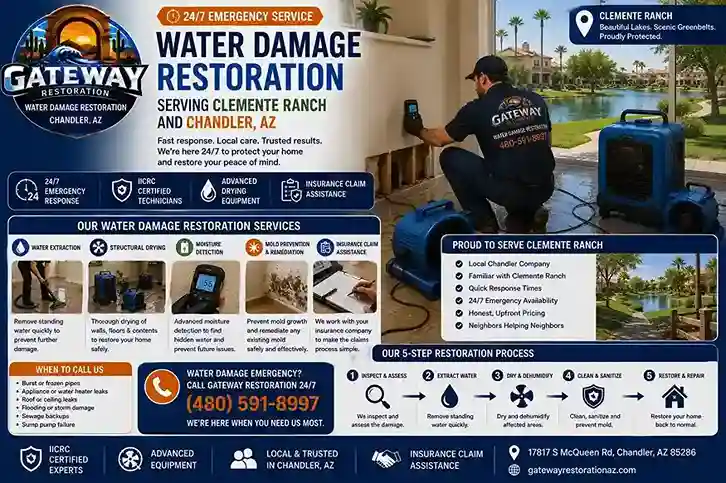
Clemente Ranch's identity is built around water and green space: neighborhood lakes, irrigated greenbelts, walking trails, and Clemente Ranch Park. That's a big part of what makes the community so livable, but it also means water damage risk factors here look different from drier, non-lake Chandler neighborhoods.
Homes near Clemente Ranch's lakes and water features sit in an environment with naturally higher groundwater awareness than the surrounding area. Moisture from lakes and irrigated common areas can migrate slowly through soil over time, and landscape drainage around these features needs to function properly to keep that moisture moving away from home foundations rather than toward them.
Like most Chandler homes, Clemente Ranch properties are built on slab-on-grade foundations. When a hidden plumbing leak develops beneath the slab, water doesn't drain into a basement, it migrates laterally under flooring, often traveling well beyond the original leak point before it becomes visible. Combined with naturally moist soil near lake-adjacent lots, under-slab water migration can be harder to detect early and more likely to raise structural concerns if it goes unnoticed.
Clemente Ranch's extensive common-area landscaping runs on a network of irrigation zones and sprinkler systems maintained by the HOA. Water line failures within these systems, or simple landscape overspray hitting exterior walls repeatedly, can direct unwanted moisture toward the base of nearby homes over time.
As an established community, many Clemente Ranch homes are now old enough that original water heaters, appliances, and plumbing systems are approaching or past their expected service life. Aging equipment fails more often, which makes preventative maintenance and early leak detection especially valuable here. A water heater installed when a home was first built is often well past the 8 to 12 year mark most manufacturers cite as a reasonable service life, and the failure mode for an aging tank is rarely a slow, easy-to-catch drip. More often, a corroded tank gives way suddenly, releasing dozens of gallons in a short window before anyone notices.
Supply lines behind washing machines, dishwashers, and refrigerators age the same way. Rubber and braided lines that were flexible and reliable a decade ago become brittle over time, and a small crack under constant water pressure can turn into a steady leak that runs for days behind an appliance no one moves very often. Combined with Clemente Ranch's already moisture-aware soil conditions near lakes and greenbelts, an aging plumbing system raises the stakes on issues that might be minor elsewhere in Chandler.
Garage units and utility room water heaters are common culprits, whether from slow tank corrosion or a sudden tank failure that releases water quickly across the surrounding floor.
Washing machines, dishwashers, and refrigerator supply lines are frequent sources of slow, easy-to-miss leaks that saturate flooring and cabinetry before anyone notices.
Warm spots on flooring, unexplained rising water bills, cracked tile, and persistent moisture odors are classic signs of a slab leak, one of the most common under-the-radar problems we investigate in Clemente Ranch homes.
During peak Arizona summer cooling demand, condensate lines can clog and overflow, sending water into attics, ceilings, and closets housing the air handler.
Underground irrigation leaks near a home's foundation can saturate soil and drive landscape moisture migration toward the slab edge, particularly in yards close to greenbelt irrigation lines.
Wind-driven monsoon rain can force water past damaged shingles, tile, or flashing, tracking along roof framing before ever showing a stain on the ceiling below.
This is the risk profile that truly sets Clemente Ranch apart from other South Chandler neighborhoods, and it's worth understanding in detail if you own a home near the community's water features.
Community lake properties and waterfront homes along Clemente Ranch's lakes benefit from beautiful views, but that proximity also means the soil beneath and around these lots holds more ambient moisture than lots farther from the water. Over months and years, that moisture doesn't stay put. It moves.
Greenbelt irrigation systems that keep Clemente Ranch's walking paths and common areas green run on a regular watering schedule, and any inefficiency, overspray, or line leak in that system adds to the moisture load in nearby soil. Combined with lake-adjacent groundwater, this creates a pattern of landscape water migration and gradual soil saturation near common areas that can quietly work its way toward home foundations.
The result is a specific kind of foundation moisture issue that's more common in Clemente Ranch than in drier Chandler neighborhoods: slow, low-level moisture intrusion at the slab edge that doesn't look like an emergency, but represents a genuine long-term hidden moisture risk. Moisture can travel considerable distances beneath soil before ever becoming visible inside a home, sometimes surfacing as a musty smell, a soft spot in flooring, or unexplained baseboard staining far from any obvious water source.
This is exactly why we recommend preventative inspections for homes bordering Clemente Ranch's lakes, trails, and greenbelt amenities, even without an active leak. Our moisture mapping and thermal imaging services can identify elevated moisture at the foundation line before it becomes a structural or mold problem.
Arizona's monsoon season brings sudden, intense storms each summer, and Clemente Ranch's mix of hardscape, landscaping, and lake features can concentrate storm runoff in ways that catch homeowners off guard.
Heavy rainfall can pool quickly on patios and back porches, pushing water toward sliding doors and exterior walls.
Storm runoff and poor grading can send water under garage doors, especially during the sharp, brief downpours typical of monsoon storms.
Wind-driven rain forces water past window seals and door thresholds not designed for sustained, heavy rainfall.
Storm damage to roofing materials during monsoon season is one of the most common causes of sudden interior water intrusion.
Lake-adjacent lots and heavily landscaped yards can hold storm water longer, increasing pressure against foundations during and after a storm.
Rapid, intense monsoon downpours can briefly overwhelm neighborhood drainage, particularly around low-lying areas near lakes and greenbelts.
Rapid response after a monsoon event significantly reduces secondary damage. Water that's extracted and dried within the first 24 to 48 hours rarely leads to mold, while water left standing during a hot Arizona summer creates ideal growing conditions almost immediately. Our storm damage restoration and monsoon flood damage restoration teams are equipped to respond the moment storms pass.
Because Clemente Ranch's water and landscaping features raise ambient moisture near many properties, hidden water damage deserves special attention here.
Water can travel a surprising distance beneath tile and its underlayment before surfacing, common in Clemente Ranch's large tiled floorplans.
Wall cavities near lake-facing exterior walls can hold moisture longer than interior walls, especially after storm intrusion or irrigation overspray.
Attic insulation affected by condensate overflow or roof leaks holds moisture and loses its effectiveness while quietly feeding mold risk.
Slab leaks and appliance failures can saturate subfloor material long before any visible sign appears at the surface.
Together, these hidden moisture pockets raise real mold growth risks and indoor air quality concerns for families in the home. This is why moisture mapping matters so much in a community like Clemente Ranch: it's the only reliable way to confirm whether elevated ambient moisture from nearby lakes and greenbelts has actually reached a home's structure, rather than guessing based on what's visible on the surface.
We assess the water source, safety concerns, and full extent of the affected area upon arrival.
Moisture meters document wet and dry zones throughout the property, critical in lake-adjacent homes with elevated ambient moisture.
Infrared scanning identifies hidden moisture behind walls, under tile, and beneath flooring before it's visible.
Standing water is removed quickly to reduce absorption and shorten the overall drying timeline.
Air movers and dehumidification equipment are placed and calibrated based on moisture readings, not guesswork.
Industrial-grade dehumidifiers manage humidity even in Clemente Ranch's more moisture-prone microclimates near the lakes.
Technicians return daily to log readings, adjust equipment, and track drying progress against dry standard.
A final round of moisture readings confirms every material has reached dry standard before equipment is removed.
Every step follows ANSI/IICRC S500 industry standards, with full moisture documentation and insurance-ready reports generated throughout the project. Learn more about the complete process on our water extraction and structural drying service pages.
Water damage in an HOA-managed community like Clemente Ranch often involves more coordination than a standalone property. The following is educational information, not a guarantee of HOA policy, since requirements vary by association and situation.
HOA requirements in planned communities frequently govern exterior repairs, meaning changes to stucco, roofing, or exterior finishes after storm or water damage may need approval before work begins. When damage involves common areas, such as shared irrigation lines, greenbelt drainage, or lake-adjacent landscaping, coordination with the HOA board or property management company is typically required to address both the individual home and any shared infrastructure involved.
Clemente Ranch's architectural standards also apply to reconstruction work following water damage, which is worth confirming with the HOA before finalizing repair materials or exterior color choices. We provide detailed documentation for HOA boards, including photos, moisture readings, and written scope summaries, to support any approval process your association requires. When a leak originates from a shared irrigation zone rather than a private line, we can help identify that distinction early, which often affects how responsibility and cost are handled. Learn more on our HOA property restoration page.
Clemente Ranch is a family-oriented community, and water damage response here should reflect that. Beyond simply drying a structure, we think about the people living in it. Families choose Clemente Ranch for its walking paths, community parks, and neighborhood feel, and a water damage event shouldn't compromise the safety of the home those families come back to every day. Our approach to a family home differs in small but meaningful ways from how we'd approach an unoccupied rental or commercial space, with extra attention paid to the details that matter most when kids and pets are in the house during restoration work.
We provide water damage restoration throughout Clemente Ranch and the surrounding South Chandler area, including homes near Clemente Ranch Park, along Alma School Road and Ryan Road, and properties bordering the community's lakes, walking trails, and greenbelt common areas.
We also serve neighboring South Chandler communities, including Fox Crossing, Cooper Commons, Sun Lakes, and Ocotillo, along with broader coverage across the East Valley.
Clean water sources
Appliance & gray water
Sewage & flood water
Gateway Restoration does NOT sell insurance and is not an insurance company. The information below is educational only.
What we do provide is thorough documentation to support your claim: dated photo documentation of the damage as we find it, detailed moisture reports from our mapping and thermal imaging process, daily drying logs tracking progress toward dry standard, and direct communication with your adjuster when needed to clarify scope or findings. This restoration documentation support is designed to make your claim process smoother, whatever your policy ultimately covers.
We're based nearby and reach Clemente Ranch quickly, day or night.
We understand the specific moisture patterns tied to lake-adjacent and greenbelt properties.
We work directly with boards and property managers on documentation and common-area concerns.
We locate hidden moisture with data, not guesswork, especially important near lakes and irrigation.
Science-based drying gets your home back to dry standard efficiently and verifiably.
We know how Arizona storms behave in Clemente Ranch's landscaped, lake-adjacent setting.
Truck-mounted extraction, LGR dehumidification, and thermal imaging are standard on every job.
We know the neighborhood, from Alma School Road to the greenbelt trails around the lakes.
Our crews are based in Chandler and typically arrive at Clemente Ranch properties within an hour of your call, 24 hours a day, seven days a week.
Yes. We regularly respond to lake-adjacent and waterfront homes throughout Clemente Ranch, including properties bordering community lakes and greenbelt walking paths.
Yes. Homes near community lakes and irrigated greenbelts can experience elevated soil moisture that migrates toward the foundation over time, which is why we recommend moisture mapping for waterfront and greenbelt-adjacent properties, even without an obvious leak.
Shut off the water supply and power to the unit if it's safe to do so, then call for emergency water extraction right away. Water heater leaks in garages and utility rooms can migrate under flooring and into adjacent rooms quickly.
Yes. Most Chandler homes, including those in Clemente Ranch, are built on slab-on-grade foundations, which means plumbing leaks travel laterally beneath flooring rather than draining into a basement, making early detection important.
Most residential structural drying takes three to five days with professional equipment in place. Larger losses, lake-adjacent properties with elevated ambient moisture, or extensive tile flooring can extend that timeline.
Yes. Water can travel significant distances beneath tile and its underlayment before surfacing, which is common in Clemente Ranch homes with large tiled floorplans near lakes and greenbelts.
Coverage depends on the cause. Sudden events like burst pipes or appliance failures are commonly covered, while damage tied to long-term neglect is often excluded. We are not an insurance company, but we provide the documentation your adjuster needs.
Mold can begin developing within 24 to 48 hours in warm, damp conditions, which is why fast extraction and drying are especially important in Clemente Ranch's humid lake-adjacent microclimates.
Yes. We regularly coordinate with HOA boards and property managers in Clemente Ranch on documentation, common-area concerns, and restoration timelines that meet community architectural standards.
From water extraction and flood cleanup to structural drying, slab leak damage, irrigation-related water intrusion, and full HOA coordination, Gateway Restoration handles every step with documented moisture mapping your family and your association can trust.
Gateway Restoration — 17817 S McQueen Rd, Chandler, AZ 85286
📞 (480) 591-8997 — 24/7 Emergency Water Damage Restoration Serving Clemente Ranch and South Chandler.