 Gateway Restoration
If you're reading this with wet socks, a dripping ceiling, or a phone propped against a puddle, take a breath — you're in the right place. Water damage feels chaotic in the moment, but it actually follows a predictable pattern, and so does the right response to it. What you do (or don't do) in the first 60 minutes has an outsized effect on four things: your total restoration cost, your mold risk, your insurance outcome, and how much of your flooring, drywall, and belongings can be saved rather than replaced.
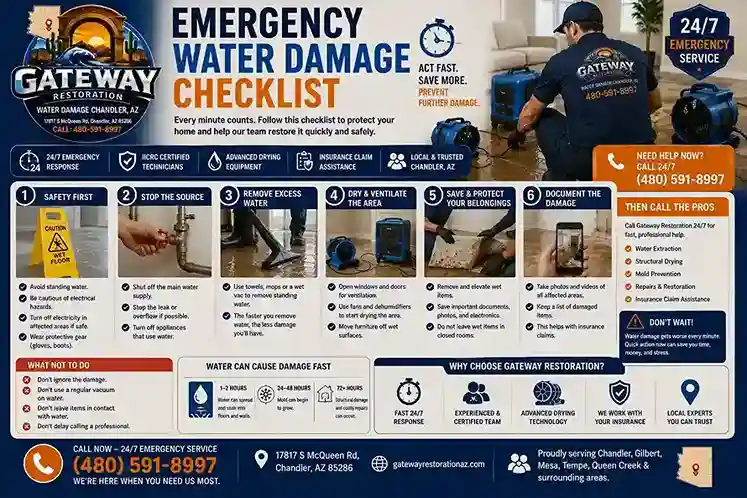
This guide breaks the first hour into four 15-minute blocks, gives you a printable checklist you can screenshot or save right now, and walks through the specific water emergencies most common in Chandler homes — from burst pipes to monsoon flooding. You don't need any special training to follow it. You just need to move through it calmly, in order.
STOP: Read These 5 Safety Rules Before Doing Anything Else
Before you touch a mop, move a box, or wade into a room, run through these five safety checks. Water damage restoration only matters if everyone in the house is safe first.
1. Electrical hazards come first. Water and electricity are a lethal combination. If standing water is anywhere near outlets, power strips, appliances, or your electrical panel, do not enter that area. If you can safely reach your breaker panel without stepping through water, shut off power to the affected zone before doing anything else. If the panel itself is wet or you have to cross standing water to reach it, stay out and call an electrician or your utility provider instead.
2. Not all water is "just water." Clean water from a supply line is one thing; water from a toilet, sewer backup, or flood is another. Contaminated water (what restoration professionals classify as Category 2 or Category 3 water) can carry bacteria and pathogens. Avoid direct contact, and never let children or pets near it.
3. Ceilings and floors can fail. A sagging, bulging, or discolored ceiling is a sign that a significant amount of water has pooled above it and the structure may be compromised. Stay out from underneath it. Likewise, water-saturated subfloor can feel soft or spongy — treat that as a sign to stay off it, not push through it.
4. Wet floors are slip hazards. Tile, wood, and stone flooring become dangerously slick when wet, especially when you're moving quickly and carrying items. Wear shoes with grip, move deliberately, and keep a hand free.
5. Gas appliances need extra caution. If a water heater, furnace, or other gas appliance is involved in the leak, or if water has reached a gas appliance's base or connections, don't attempt to inspect or move it yourself. Shut off the gas supply if you can do so safely, and let a professional assess it.
If any of these conditions exist — energized water, ceiling sag, structural instability, or gas involvement — stop, get everyone out of the affected area, and call (480) 591-8997 or 911 if it feels like an emergency beyond water damage alone.
The First 15 Minutes: Stop The Water Source
Once you've confirmed the area is safe to approach, your first job is simple: stop more water from entering the house. Everything else is secondary until the source is controlled.
Shut off the main water valve
Locate your home's main shutoff valve — usually near the water meter, in a garage, basement, or exterior wall closest to the street. Turn it clockwise until it stops. This cuts water to the entire house, which is the fastest way to stop a burst pipe regardless of which pipe failed. If you don't know where your main shutoff is, this is worth finding today, before the next emergency, not during one.
Shut off the water heater's supply valve and power
Most water heaters have a dedicated shutoff valve on the cold-water supply line coming into the top of the tank. Turn it off. If it's a gas water heater, turn the gas control to "off" or "pilot." If it's electric, switch off the dedicated breaker. A failed tank can release 40 to 80 gallons quickly, so speed matters here.
Shut off the supply line behind the appliance
Washing machines, dishwashers, and refrigerators with ice makers each have a small shutoff valve on the water line behind or beneath them. If you can't reach it safely, or the leak is severe, shut off the main water valve instead.
Shut off the valve at the base of the toilet
Turn the small oval valve on the wall or floor behind the toilet clockwise. If it's stuck or missing, shut off the main water valve. Treat toilet overflow water as contaminated until you know otherwise.
Turn off the AC unit at the thermostat
A clogged condensate line or overflowing drain pan usually means water is dripping from a vent, ceiling, or closet where the air handler sits. Turning off the AC stops new condensation from forming while you sort out the clog or call a technician. This won't stop water already pooled, but it stops the source.
Shut off the irrigation controller and the line's valve
If a broken irrigation line is pushing water toward your foundation or into a garage, shut off the irrigation controller and, if you can locate it, the shutoff valve for that zone. Because irrigation lines run close to slab foundations in Chandler, this type of leak deserves a follow-up inspection even after the immediate water is gone.
When to call a plumber versus a restoration company: A plumber fixes the broken pipe, valve, or appliance connection. A restoration company extracts the water and dries the structure so mold doesn't take hold. In an active emergency, you often need both — but call the restoration company first, since dispatch and drying setup can begin while you're still arranging a plumber, and every hour of delay adds to the damage. Gateway Restoration can also help you identify whether the situation calls for a plumber referral first.
The Next 15 Minutes: Protect People and Pets
With the water source under control, shift your attention to the people and animals in the house. This step often gets skipped in the rush to protect property, but it comes before documentation and cleanup for a reason.
- Evacuate affected rooms, not necessarily the whole house. Most residential water emergencies don't require leaving the property entirely. Close doors to affected rooms, keep foot traffic out, and continue normal activity elsewhere in the home unless contamination, structural concerns, or air quality make that unsafe.
- Keep young children away from the water and any exposed outlets. Children are drawn to standing water and don't recognize electrical or contamination risks. Keep them in an unaffected part of the home.
- Keep pets out of the affected area. Pets can track contaminated water throughout the house or injure themselves on wet flooring, debris, or exposed materials. Crate or contain them in a dry room.
- Check on elderly or mobility-limited occupants first. Wet, slick flooring is a serious fall risk. Help anyone with mobility limitations move to a dry, stable area before you start dealing with the water itself.
- Watch for signs of chemical or gas odor. If you smell gas, sewage, or a strong chemical odor along with the water, leave the area and ventilate if it's safe to do so. A strong gas odor means leaving the house and calling your gas utility or 911 from outside.
The Next 15 Minutes: Document Everything
Once people and pets are safe, take five to ten minutes to document the damage before you start moving things around or cleaning up. This step is easy to skip when you're anxious to start drying things out, but it's one of the most valuable things you can do for your insurance claim and for the restoration company that arrives.
- Photograph the water source itself — the burst pipe, the failed water heater, the overflowing toilet — before you disturb it.
- Take wide photos of every affected room, then closer photos of standing water depth, water lines on walls, and any visible staining.
- Record a slow video walkthrough narrating what you're seeing and roughly when you discovered it. Video captures context that still photos miss.
- Photograph damaged contents — furniture, rugs, electronics, boxes — individually where possible, especially higher-value items.
- Note moisture locations you can feel but not see, such as damp baseboards, soft flooring, or a musty smell in a specific corner. Write these down; you may not remember them precisely later.
- Note the date and approximate time you discovered the damage. This timestamp matters for both insurance purposes and for how restoration professionals classify the loss.
The Final 15 Minutes: Start Damage Control
With the source stopped, people safe, and documentation done, you can spend your last stretch of the first hour limiting how far the damage spreads — without waiting for a crew to arrive.
- Remove standing water safely where you can. Towels, a mop, or a wet/dry shop vacuum rated for water pickup can handle small amounts. Do not attempt this near any area with electrical risk.
- Move furniture off wet flooring where it's safe and physically manageable. Use furniture blocks or small pieces of wood to lift legs out of standing water if you can't move a full piece.
- Protect electronics and cords by unplugging anything near the water (only if the outlet itself isn't wet) and relocating devices to a dry surface.
- Save valuables first — important documents, photos, heirlooms, and anything irreplaceable — by moving them to a dry room, even if you can't address everything else yet.
- Increase airflow where it's safe by opening interior doors between the affected room and the rest of the house, and turning on ceiling fans in unaffected rooms to encourage air movement. Avoid running electrical fans directly in or near standing water.
- Prop up furniture cushions and rugs on their edges to promote drying and reduce prolonged contact with wet flooring.
None of this replaces professional extraction and structural drying — it simply limits how much worse things get in the time before a crew arrives.
Still dealing with active water damage?
Every extra hour raises the risk of mold and secondary damage. Gateway Restoration dispatches 24/7 crews throughout Chandler and the East Valley.
📞 Call (480) 591-8997 NowYour Emergency Water Damage Checklist (Printable Version)
Save this section, screenshot it, or use your browser's print function to keep a paper copy near your water shutoff valve.
✅ Safety
- Confirm no live electrical risk before entering the affected area
- Shut off power at the breaker if water is near outlets or the panel
- Treat any water from a toilet, sewer, or flood as contaminated
- Stay off sagging ceilings or spongy flooring
- Shut off gas to any affected water heater or appliance if safe to do so
✅ Water Shutoff
- Identify the source (pipe, water heater, appliance, toilet, HVAC, irrigation)
- Shut off the closest dedicated valve, or the main water valve if unsure
- Turn off power or gas to the failed appliance if applicable
- Note whether a plumber is needed in addition to restoration
✅ People & Pets
- Move children and pets away from the affected area
- Check on elderly or mobility-limited household members
- Watch for gas, sewage, or strong chemical odors
- Ventilate and evacuate if any hazardous odor is present
✅ Documentation
- Photograph the water source before disturbing it
- Photograph and video every affected room
- Photograph damaged furniture, rugs, and electronics individually
- Write down hidden moisture locations you can feel but not see
- Record the date and approximate time damage was discovered
✅ Property Protection
- Remove standing water where safe with towels or a wet-rated shop vac
- Move furniture and rugs off wet flooring
- Unplug and relocate electronics away from the water
- Move important documents, photos, and valuables to a dry room
- Increase safe airflow with fans in unaffected rooms and open doors
✅ Emergency Calls
- Call Gateway Restoration at (480) 591-8997 for 24/7 dispatch
- Call a plumber if the source requires a repair, not just a shutoff
- Call an electrician if power is compromised or water reached the panel
- Call 911 if there's a gas leak, structural danger, or medical emergency
✅ Drying Measures
- Avoid relying on household fans alone for anything beyond surface water
- Keep the affected area closed off from the rest of the home if contaminated
- Let professional-grade air movers and dehumidifiers handle structural drying
- Track daily moisture readings once professional drying begins
✅ Insurance Notification
- Contact your insurance company once documentation is complete
- Provide your photos, video, and discovery date and time
- Ask about coverage for sudden versus gradual damage
- Keep receipts for any emergency mitigation steps you pay for yourself
✅ Restoration Contact
- Schedule a professional inspection and water category classification
- Confirm extraction and drying equipment placement with the crew
- Request a written, itemized estimate before work begins
- Ask how documentation will be shared with your insurance adjuster
What NOT To Do During A Water Damage Emergency
❌ Don't Use Household Vacuums
A standard household vacuum is not built for water and can short out, damage the motor, or create an electrical shock hazard. Use a wet/dry shop vacuum specifically rated for water, or leave extraction to professional equipment.
❌ Don't Turn On Electrical Devices
Never turn on a device, outlet, or switch in an area with standing or recent water until you've confirmed it's safe. If in doubt, leave power off to that zone until an electrician or restoration technician clears it.
❌ Don't Ignore Wet Drywall
Drywall absorbs moisture like a sponge and can lose structural integrity quickly. A small damp patch today can mean a much larger section needing removal in a few days if it's left untreated.
❌ Don't Assume Carpet Will Dry Naturally
Carpet padding traps moisture against the subfloor, and Arizona's warm indoor air accelerates mold growth in that trapped moisture. Padding usually needs to be removed and the carpet professionally dried or replaced, not just aired out.
❌ Don't Delay Drying
Every hour of delay increases how far moisture travels into subfloor, framing, and adjoining rooms. Waiting a day "to see how bad it is" almost always increases the scope and cost of the job.
❌ Don't Throw Away Evidence Too Soon
Hold onto damaged items and materials until you've documented them and, ideally, spoken with your insurance company or restoration company. Discarding items before documentation can complicate a claim.
❌ Don't Wait For Visible Mold
Mold doesn't need to be visible to already be a problem. If materials stayed wet for more than 24 to 48 hours, assume there's a risk even without a visible spot, and have the area professionally assessed.
Chandler's Most Common Water Damage Emergencies
Chandler's soil, climate, and construction create a distinct set of risks compared to homes in wetter parts of the country. Here's why each one happens locally.
Water Heater Failures
Chandler's hard water accelerates mineral buildup and corrosion inside tank water heaters, shortening their lifespan and increasing the odds of a sudden tank rupture or fitting failure.
Slab Leaks
Most Chandler homes sit on slab-on-grade foundations, and the region's expansive clay soil shifts seasonally, stressing plumbing lines buried beneath the slab until they leak.
AC Condensate Overflows
Heavy summer air conditioning use strains condensate lines and drain pans, leading to slow leaks in attics and closets that often go unnoticed until a ceiling stain appears.
Appliance Leaks
Washing machines, dishwashers, and refrigerator supply lines are frequent sources of sudden Category 1 or Category 2 water loss, often from an aging or poorly connected supply hose.
Roof Leaks
Wind-driven monsoon rain and aging roofing materials allow water to travel through attic insulation and ceilings well before it's visible from inside the home.
Monsoon Flooding
Between July and September, intense, fast-moving monsoon storms overwhelm roofs, gutters, and yard grading within minutes, pushing water into garages and ground-floor rooms.
Irrigation System Failures
Landscape irrigation lines running near foundations can leak or burst, driving water intrusion into garages and lower-level rooms if the break goes unnoticed.
Burst Pipes
Aging or hard-water-corroded plumbing, combined with soil movement around slab foundations, makes sudden pipe failures — often behind walls or under slabs — a leading cause of large-volume water loss.
What To Do After A Burst Pipe
Burst pipes release water fast, and because they're often hidden behind walls or under a slab, the damage can be more extensive than it first appears. Start with the shutoff procedure covered earlier: turn off the main water valve immediately rather than trying to trace the exact pipe. Once water is stopped, document the visible damage, then call for extraction before you assume the affected area is limited to what you can see — water travels along framing and under flooring far beyond the original leak point. Professional moisture mapping is especially valuable here because it identifies how far the water actually spread. Drying typically needs to address wall cavities and subfloor, not just visible surfaces, and your insurance carrier will usually want documentation of both the pipe failure and the extent of the water spread for a sudden, accidental loss claim.
What To Do After A Water Heater Failure
Water heater failures typically follow a predictable pattern: water pools around the base of the tank and spreads outward across the garage or laundry room floor, often finding its way under adjacent flooring in bathrooms or hallways. Because most tanks sit in garages or utility closets with hard flooring, the water tends to travel farther before it's noticed than a leak in a carpeted room would. After shutting off the water and power/gas supply, expect the affected zone to include not just where the tank sits but any adjoining rooms with a lower floor elevation, since water follows gravity. Flooring materials like laminate and engineered wood are particularly vulnerable to water heater failures because they sit close to where the leak originates. Once the immediate water is addressed, you'll also need to plan for water heater replacement — most failed tanks aren't repairable, and a plumber will typically need to size and install a new unit.
What To Do After A Monsoon Flood
Monsoon-driven flooding brings a different set of concerns than a clean-water plumbing failure. Flash flood water that enters a home from outside — through a garage, patio door, or low grading point — is typically classified as Category 3 water because of what it can pick up from the ground: soil, debris, and potential contaminants. That means safe cleanup procedures matter more here than with a burst pipe. Avoid direct contact with the water where possible, keep children and pets away, and don't assume a quick mop-up is sufficient. Beyond the visible flooding, monsoon events raise two other concerns: foundation moisture, since heavy rain against a home's perimeter can push moisture into the slab and lower walls even without visible flooding indoors, and mold risk, since flood water combined with warm Arizona temperatures creates ideal conditions for rapid mold growth if drying doesn't start quickly. If your flooding was flash-flood related, treat it with the same urgency and caution as a sewage backup until a professional confirms otherwise.
What To Do After An AC Leak
AC condensate leaks are sneaky because they're slow and often hidden. A clogged condensate line or a cracked drain pan can drip for days inside an attic or closet before it ever shows up as a ceiling stain in a bedroom or hallway below. By the time you see the stain, the moisture has usually been present long enough to soak insulation and, in Chandler's warm attic environments, create a real hidden mold risk above the ceiling line — not just at the visible stain. After shutting off the AC unit at the thermostat, resist the urge to simply patch the stain. The area above the ceiling, including insulation and any wood framing that stayed wet, typically needs inspection and, if damp, drying or removal before you address the cosmetic ceiling damage. Because Chandler summers push AC systems hard for months at a time, this is one of the most common "invisible" sources of water damage we see, and it's worth having your condensate line and drain pan checked seasonally.
What To Do After A Slab Leak
Slab leaks are among the hardest water emergencies to catch early because the water is moving beneath your flooring, not across it. Common warning signs include an unexplained warm spot on the floor (especially over a hot water line), a section of flooring that feels damp or discolored with no obvious source, or a spike in your water bill with no visible leak. Because the water is pushing up from underneath, flooring damage often shows up as buckling, warping, or discoloration in a specific area rather than obvious standing water. Once a slab leak is suspected, avoid the temptation to simply mop up the surface symptom — the priority is professional moisture mapping to find the extent of the leak beneath the slab and monitor how far the moisture has traveled. Foundation monitoring matters here too, since prolonged slab leaks can affect soil moisture beneath the foundation. A plumber typically needs to locate and repair the specific line (sometimes rerouting rather than repairing the original slab line), while a restoration company addresses the moisture that has already reached your flooring and subfloor.
Why The First 24 Hours Matter So Much
Water damage isn't a static problem — it actively gets worse the longer it's left untreated. Understanding the timeline helps explain why speed matters as much as it does.
First Hour
Water spreads through capillary action into baseboards, wall cavities, and beneath flooring. Materials like drywall and carpet padding begin absorbing moisture immediately. This is the window where the checklist above has the most impact.
First 24 Hours
Untreated moisture continues migrating through porous materials. In Arizona's warm indoor temperatures, conditions become favorable for mold spores to begin colonizing damp surfaces as this window closes.
48 Hours
Mold growth can become established in materials that stayed wet this long, drywall exposed to contaminated water typically needs removal rather than drying, and odors from trapped moisture often become noticeable throughout the affected area.
One Week
Structural materials left wet for a week or more frequently show measurable deterioration — swelling, warping, or weakening — and secondary damage such as spreading mold or damaged finishes becomes far more likely, along with a higher total cost of restoration.
This timeline is also why insurance carriers pay close attention to how quickly a homeowner responded. Fast, documented action supports a claim; delay can create questions about whether damage was truly sudden or allowed to worsen unaddressed.
What Restoration Professionals Do When They Arrive
Knowing what a professional crew actually does can make the process feel less like a mystery once help arrives.
- Inspection: Technicians assess the source, scope, and category of water (clean, gray, or contaminated) to determine the right response protocol.
- Moisture Mapping: Moisture meters and thermal imaging locate hidden water inside walls, under flooring, and in framing that isn't visible to the eye.
- Water Extraction: Truck-mounted or portable extraction equipment removes standing water far more thoroughly and quickly than shop vacuums or towels.
- Structural Drying: Commercial air movers are positioned based on room size and material type to accelerate evaporation from walls, floors, and framing.
- Dehumidification: Industrial dehumidifiers pull moisture out of the air itself so it doesn't resettle on drying surfaces.
- Monitoring: Daily moisture readings track drying progress and confirm when a structure has actually reached a safe, dry baseline rather than just looking dry.
- Documentation: Every reading, photo, and drying log is compiled into records built for insurance adjusters.
- Restoration Planning: Once the structure is confirmed dry, a plan for drywall, flooring, and finish repairs returns the property to its pre-loss condition.
Emergency Water Damage Costs in Chandler
Costs vary by water category, how long the water sat before treatment, affected square footage, and which materials need replacement. These ranges reflect typical Chandler-area losses, but a free, itemized inspection is the only way to get an accurate number for your specific situation.
| Damage Type | Typical Cost Range |
|---|---|
| Category 1 Water (clean) | $1,200 – $3,500 |
| Category 2 Water (gray) | $2,500 – $6,500 |
| Category 3 Water (black) | $4,500 – $12,000+ |
| Mold Remediation (additional) | $1,500 – $6,000+ |
Variables that push costs higher include how many rooms and floors were affected, how long the structure sat wet before mitigation began, whether flooring or drywall needs full replacement rather than drying, and whether hidden moisture in walls or subfloor was addressed early or discovered later. This is the core reason the first-hour checklist above matters financially, not just for comfort or convenience — fast action consistently keeps losses in the lower end of these ranges.
Emergency Water Damage and Insurance
Most Chandler homeowners policies cover sudden, accidental events — a burst pipe, a water heater failure, an appliance leak, or storm-related water intrusion. These are considered covered losses because they happen without warning, which is exactly what standard policies are designed to address.
What's typically excluded is damage tied to long-term neglect or a gradual leak that went unaddressed for weeks or months. Insurers generally expect homeowners to catch and repair slow leaks before they escalate, and many policies carry separate mold sub-limits or exclusions. This is part of why documentation in the first hour matters so much — clear photos, video, and a discovery timestamp help establish that a loss was sudden rather than gradual.
When working with an adjuster, be ready to share your documentation, a description of what happened and when, and any moisture reports generated during professional drying. Gateway Restoration does not provide insurance coverage or sell insurance products. We help document the loss thoroughly and communicate directly with your insurance company throughout the claims process, but decisions about coverage rest with your insurance provider. For general guidance on coverage and cost, see our insurance & cost page.
Chandler Neighborhoods We Commonly Respond To
Gateway Restoration dispatches emergency crews throughout Chandler, including these communities and the surrounding areas:
Our local crews know Chandler's soil conditions, common plumbing ages by neighborhood, and monsoon-season flood patterns, which means less time spent explaining your situation and more time spent responding to it. See our full Chandler coverage area page for details.
Building Your Family Water Damage Emergency Plan
The best time to prepare for a water emergency is before it happens. A short family plan can shave minutes off your response time when it counts most.
- Know your shutoff locations. Find and label your main water shutoff valve, water heater shutoff, and the shutoff valves behind major appliances. Make sure every adult in the household knows where they are.
- Keep emergency contacts visible. Post Gateway Restoration's number, (480) 591-8997, along with your plumber's and electrician's numbers, somewhere accessible — not just saved in one person's phone.
- Store documentation digitally. Keep photos of your home's systems (water heater, panel, shutoff valves) and a copy of your insurance policy in a cloud folder you can access from anywhere, including after evacuating.
- Build in a backup plan. Know which room or level of the house you'd move valuables to quickly, and keep a wet-rated shop vacuum and a few heavy towels accessible rather than buried in storage.
- Schedule seasonal inspections. Have your water heater, AC condensate line, and irrigation system checked seasonally, especially heading into monsoon season and the height of Chandler summer AC use.
Why Chandler Homeowners Trust Gateway Restoration
When water is actively damaging your home, you need a crew that responds fast, knows the local terrain, and treats your home like their own. Gateway Restoration provides 24/7 emergency response throughout Chandler and the East Valley, backed by truck-mounted water extraction, commercial-grade structural drying and dehumidification, moisture mapping and thermal imaging to catch what isn't visible, and proactive mold prevention treatment on every job. As a locally based team, we understand Chandler's slab foundations, hard water, monsoon patterns, and stucco construction — the specific factors that shape how water damage behaves in this area — and we provide the documentation your insurance adjuster expects to see, from first call to final rebuild.
Facing a water emergency right now?
Don't wait for damage to spread. Our Chandler-based crews are ready to dispatch 24/7.
📞 Call (480) 591-8997Frequently Asked Questions
What should I do first when I discover water damage?
Stop the water source if it's safe to do so, cut power to any affected outlets or fixtures, and call a Chandler water damage restoration company immediately. Document the damage with photos and video before cleanup begins, then move valuables and furniture off wet flooring.
How quickly should I call a restoration company?
Call within the first 15 to 30 minutes of discovering water damage. Materials like drywall and carpet padding begin absorbing moisture immediately, and mold can start developing within 24 to 48 hours in Arizona's warm indoor environments, so faster response directly lowers total restoration cost.
Is water damage dangerous?
It can be. Standing water near outlets, appliances, or an electrical panel creates a serious shock risk, floors can become slippery or structurally unstable, and Category 2 or 3 water may carry contaminants that pose health risks. Always assess safety before entering an affected area.
Can mold start growing in 24 hours?
Yes. In Arizona's warm indoor temperatures, mold spores can begin colonizing damp materials within 24 to 48 hours of water exposure. This is why immediate extraction and structural drying matter more than waiting to see if an area dries on its own.
Should I file an insurance claim immediately?
In most cases, yes, especially for sudden and accidental damage like a burst pipe or water heater failure. Document the damage thoroughly with photos and video first, since strong documentation supports a smoother claims process. Gateway Restoration is not an insurance company and does not sell insurance policies, but we help property owners document water damage for restoration and claim purposes.
Can I remove water myself?
You can safely remove small amounts of surface water with towels or a wet/dry shop vacuum rated for water, but never use a household vacuum, and never attempt extraction in standing water near live electrical circuits. Larger volumes need truck-mounted extraction equipment to prevent moisture from settling into subfloor and framing.
What if the water came from a sewer backup?
Sewer backups are Category 3 contaminated water and pose a real health risk. Avoid all contact with the water, keep children and pets away from the area, do not attempt DIY cleanup, and call a restoration company immediately for full protective handling and sanitization.
How much does emergency water damage restoration cost?
Typical Chandler-area costs range from $1,200 to $3,500 for Category 1 clean water, $2,500 to $6,500 for Category 2 gray water, and $4,500 to $12,000 or more for Category 3 black water, with mold remediation adding $1,500 to $6,000 or more if needed.
How long does water damage restoration take?
Most residential structural drying takes three to five days with commercial air movers and dehumidifiers running continuously. Larger losses, Category 3 contamination, or homes with dense materials like tile and concrete slab can take longer, and rebuild timelines depend on how much drywall and flooring need replacement.
What information should I document before cleanup starts?
Photograph and video the water source, every affected room, damaged belongings, and visible moisture lines, and note the date and time you discovered the damage. This documentation protects your insurance claim and gives your restoration company a clear starting point for moisture mapping.
Related Reading
- Emergency Water Damage Restoration
- 24-Hour Water Damage Restoration
- Emergency Flood Cleanup
- Water Extraction
- Structural Drying
- Dehumidification Services
- Slab Leak Water Damage
- Water Heater Leak Damage
- AC Leak Water Damage
- Monsoon Flood Damage Restoration
- How Fast Does Mold Grow After Water Damage?
- Signs of Hidden Water Damage
- Water Damage Restoration in Chandler, AZ
Water damage emergencies are stressful, but the right actions in the first hour can dramatically reduce restoration costs, prevent mold growth, and protect your property. Having a clear emergency checklist helps homeowners respond confidently when every minute counts.