 Gateway Restoration
Gateway Restoration
Gateway Restoration
Structural drying is the controlled removal of moisture from building materials after a water intrusion event. It involves specialized equipment, precise moisture measurements, psychrometric calculations, and daily monitoring to return a home's framing, flooring, and walls to their pre-loss condition. If your Chandler home has active water damage, don't wait for it to "air out" on its own.
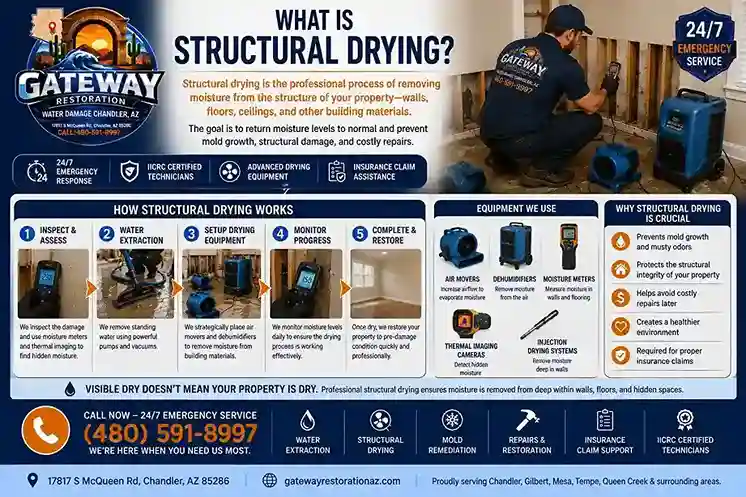
Structural drying is the process of removing moisture that has been absorbed into a building's materials, drywall, subfloor, framing, insulation, cabinetry, and concrete, after water has entered a structure. It's different from simply removing the water you can see. Extraction deals with standing water sitting on top of a surface. Structural drying deals with the water that has already soaked in.
This distinction matters because water behaves differently once it's inside a material. Standing water is what pools on a floor and can be pumped or vacuumed away in a matter of hours. Bound water is moisture that has been absorbed into porous materials like drywall, wood, and insulation, it doesn't drain away on its own and requires evaporation, driven by controlled air movement and dehumidification, to remove. Hidden moisture is water that has migrated into wall cavities, under flooring, or behind baseboards where it isn't visible at all. And moisture migration describes how water continues moving through a structure for hours or days after the original event, following gravity and capillary action into areas that were never directly wetted.
This is why visible dryness can be misleading. A carpet can feel dry to the touch within a few hours while the padding beneath it, and the subfloor beneath that, remains saturated. A wall can look completely normal on the surface while the drywall behind the paint holds enough moisture to support mold growth. Structural drying is the phase of water mitigation that addresses what you can't see, not just what you can, which is exactly why it's considered the most important, and most frequently underestimated, part of the entire restoration process.
When structural drying is incomplete or skipped altogether, the consequences rarely show up immediately, they show up weeks or months later, often as a much larger and more expensive problem. Mold growth is the most well-known risk; mold spores are present in nearly every environment and only need sustained moisture to begin colonizing a material. Material deterioration follows closely behind, as wood framing can begin to soften and lose structural integrity, and engineered wood products can delaminate when left wet.
Warped flooring is one of the most common visible signs of incomplete drying; hardwood planks cup and crown as they absorb moisture unevenly, and laminate flooring swells at the seams. Drywall damage can range from bubbling paint to complete structural failure of the panel if moisture sits long enough. Persistent odors often develop even when visible mold hasn't yet appeared, a sign that organic material somewhere in the structure is staying damp. And beyond the physical damage, incomplete drying frequently leads to insurance claim problems, since adjusters expect to see documentation that drying reached an acceptable standard, not just that equipment was placed in a room for a few days.
Consider a real-world pattern we see often: a homeowner has a supply line leak under a bathroom vanity, extracts the standing water themselves with towels and a wet-vac, and runs a box fan for two days. The visible water is gone and the floor feels dry. Three weeks later, a musty smell develops near the baseboard, and by the time a contractor opens the wall, mold has already colonized the lower two feet of drywall and the subfloor beneath the vanity has begun to delaminate. The water was "cleaned up." It was never actually dried.
These two phases are often confused, but they solve different problems and require different tools entirely.
| Water Extraction | Structural Drying |
|---|---|
| Removes standing water | Removes trapped, bound moisture |
| Uses pumps and extraction tools | Uses air movers and dehumidifiers |
| Typically completed in hours | Typically takes several days |
| Addresses visible water | Addresses hidden moisture |
Extraction alone is not enough because it only removes water that is free-standing on a surface. It does nothing for the moisture that has already been absorbed into drywall, subfloor, framing, or insulation. Skipping straight from extraction to "the room looks fine now" leaves exactly the kind of trapped moisture that leads to mold, warping, and odor problems down the line. Extraction is step one. Structural drying is what actually finishes the job. Learn more about our water extraction services and how they lead directly into full structural drying.
Before any equipment is placed, technicians use moisture meters, thermal imaging cameras, and hygrometers to identify which materials are affected and how far moisture has traveled. This step establishes the full scope of the job and identifies which materials, drywall, subfloor, insulation, need drying versus which are unaffected.
Truck-mounted or portable extraction systems remove standing water from floors, carpet, and other surfaces. This step is fast, typically a matter of hours, and its job is simply to remove the bulk of the surface water before the drying phase begins.
Air movers are positioned to create controlled airflow across wet surfaces, accelerating evaporation by continuously replacing the humid air layer sitting against a wet material with drier air. This is what pulls bound moisture out of materials and into the surrounding air.
As air movers push moisture out of materials and into the air, dehumidifiers remove that moisture from the air itself, preventing humidity from climbing and stalling the evaporation process. Without this step, evaporation slows dramatically and moisture can simply resettle into materials nearby.
Technicians take daily moisture readings from every affected material and compare them against an established drying goal. Once readings confirm materials have reached an acceptable, pre-loss moisture level across multiple consecutive checks, the drying equipment is removed and the project is documented as complete.
At its core, structural drying relies on a handful of physical principles that, once explained simply, make the entire process much easier to understand.
Evaporation is the process of water changing from a liquid trapped in a material to a vapor released into the air. It happens naturally, but slowly, without help. Relative humidity is a measure of how much moisture the air is currently holding compared to how much it could hold at that temperature; the higher the relative humidity, the slower evaporation happens, because the air is already closer to "full." Dew point is the temperature at which air becomes so saturated with moisture that it begins to condense back into liquid water, which is why poorly managed drying setups can actually create new condensation problems.
Vapor pressure describes the tendency of moisture to move from an area of higher concentration, like a wet piece of drywall, to an area of lower concentration, like the surrounding air, and it's the underlying force that makes evaporation possible in the first place. Temperature control matters because warmer air holds more moisture and speeds up evaporation, which is why technicians sometimes manage indoor temperature alongside airflow and humidity. Put simply: evaporation moves water out of materials, warm airflow speeds that process up, and dehumidification keeps the air from getting so humid that evaporation slows to a crawl or reverses entirely.
Psychrometrics is the branch of science dealing with the properties of moist air, and it's the mathematical foundation restoration professionals use to plan a drying project correctly instead of guessing. In plain terms, psychrometric calculations answer a specific question: given this room's size, the materials affected, the current temperature, and the current humidity, how much air movement and how much dehumidification capacity does this space actually need to dry efficiently?
Restoration companies use these calculations because underpowering a drying setup is one of the most common reasons projects drag on far longer than necessary, or fail to fully dry a structure at all. A psychrometric calculation accounts for the square footage and class of water loss to determine the number of air movers needed for adequate air exchange, and it accounts for the amount of moisture load, the total water that needs to be removed from the space, to determine the pounds-per-day capacity of dehumidification required. These aren't rough estimates; they follow formulas established in IICRC S500 water damage restoration standards, the industry reference for how professional drying projects should be planned, executed, and documented.
For a homeowner, the practical takeaway is this: two rooms that look similarly wet can require very different equipment setups depending on their size, materials, and current humidity, which is exactly why a professional assessment, rather than a fixed number of fans "that usually works," is what actually gets a structure dry on schedule.
Direct focused airflow across wet surfaces to accelerate evaporation and prevent humid air from settling against a wet material.
Move large volumes of air across broad surfaces like open floors and walls, ideal for general drying coverage.
Deliver focused, high-velocity airflow into tight spaces like cabinets, closets, and wall cavities.
Low-grain refrigerant units pull moisture from the air even in already-dry conditions, ideal for the later stages of drying.
Standard units effective at removing large volumes of moisture from the air in the early, high-humidity stages of a project.
Use a chemical drying agent rather than refrigeration, useful in cooler conditions or specialty applications like crawlspaces.
Measure the moisture content inside materials directly, giving technicians an objective drying target rather than a guess.
Reveal temperature differences that indicate hidden moisture behind walls, under flooring, and inside ceilings.
Automatically records temperature and humidity readings over time, building a documented history of the drying process.
Chandler's desert climate brings real advantages to structural drying. Lower average outdoor humidity for much of the year means outside air often has extra capacity to absorb moisture, and high temperatures can help accelerate evaporation when air exchange with the outdoors is part of a drying strategy. This is a genuine benefit compared to more humid climates, where outdoor air offers little help.
That said, this advantage is easy to overstate. Indoor humidity after a water event is driven primarily by how much water actually entered the structure and how enclosed the space is, not by the desert conditions outside the walls. A home with a significant leak can maintain high indoor humidity in a sealed, air-conditioned interior regardless of how dry it is in the yard. Monsoon season complicates this further: between roughly June and September, Chandler experiences sudden humidity spikes and flash flood events that can push outdoor humidity well above indoor levels, working against natural drying rather than supporting it. The gap between indoor and outdoor humidity during these months is exactly why professional monitoring, not an assumption about "Arizona's dry air," is what determines whether a structure is actually drying on schedule.
Timelines vary by material and by the severity of the water event, but general ranges based on typical residential projects look like this:
Drywall, carpet, and carpet padding in Category 1 (clean water) losses with prompt drying often reach target moisture levels within this window.
Hardwood flooring, cabinetry, and standard insulation typically take longer due to denser materials and slower moisture release.
Concrete slabs, crawlspaces, and larger commercial properties often require extended drying due to material density and project scale.
Several factors affect where a given project falls within, or beyond, these ranges: how quickly drying began after the water event, the total amount of water involved, the types of materials affected, ambient temperature and humidity, and how well the drying equipment was sized to the space in the first place. This is exactly why daily moisture monitoring, not a fixed calendar estimate, ultimately determines when a job is finished.
Ending a drying project before materials reach their target moisture level is one of the most common, and most costly, mistakes in water damage restoration. Hidden moisture left inside a wall cavity or under flooring doesn't resolve itself once equipment is removed; it simply continues sitting there. Mold colonization often follows within days once conditions stabilize at an elevated humidity level. Secondary damage can include warped subfloor, delaminated cabinetry, and corroding metal fasteners that weren't part of the original loss but result directly from lingering moisture.
Flooring failures, cupped hardwood, buckled laminate, deteriorating tile adhesive, frequently show up weeks after a project was considered "done." Paint failures, bubbling, peeling, and discoloration, often signal moisture still moving through a wall assembly. Beyond the physical damage, incomplete drying creates real insurance disputes, since a claim that appears closed can reopen when secondary mold or material damage surfaces later, often with the insurer questioning whether the original mitigation work was adequate.
It's an understandable assumption: water is wet, fans move air, air makes things dry. But this misconception is responsible for a large share of the secondary damage restoration companies see.
Move general room air but lack the focused velocity needed to drive evaporation from saturated materials effectively.
Circulate air broadly but don't direct airflow at the specific wet surfaces that need it most.
Can help or hurt depending on outdoor humidity, and offer no control once conditions change, such as during monsoon season.
Sized for everyday indoor comfort, not for pulling significant moisture loads out of saturated building materials.
DIY drying methods can work for very minor, immediately addressed spills, but they have real limitations: no way to measure whether materials are actually dry, no calculated air movement to reach bound moisture, and no dehumidification capacity to keep pace with what's being pulled out of the air. Professional drying becomes necessary any time water has soaked into carpet, drywall, subfloor, or framing, rather than sitting briefly on a hard, non-porous surface.
Moisture mapping is the process of documenting exactly where moisture is present in a structure and how severe it is in each location, creating a detailed picture technicians use to guide the entire drying process. It combines thermal imaging, which reveals temperature differences that often indicate moisture behind walls or under flooring, with moisture meters, which take direct, quantified readings from specific materials.
Together, these tools build a moisture profile of the structure, a record of readings across every affected area that establishes clear drying targets for each material type. Daily monitoring then tracks how those readings change over time, confirming the drying plan is working or signaling that equipment needs to be adjusted. This entire process is captured through documentation that shows, area by area, when moisture levels returned to normal. Moisture mapping is what prevents hidden damage: without it, drying decisions are based on guesswork rather than the structure's actual condition. Learn more about our moisture mapping and thermal imaging process.
Mold prevention is a race against time. In typical indoor conditions, mold can begin developing within a 24-hour window of sustained moisture exposure, and visible colonization is often possible within a 48-hour window if conditions remain damp. Mold generally needs relative humidity above roughly 60% sustained over time to establish itself on an organic material like drywall paper or wood.
Professional structural drying directly targets these moisture thresholds, using calculated air movement and dehumidification to bring humidity down well below the level mold needs before that window closes. This is the core difference between prevention and remediation: drying quickly and correctly the first time is dramatically less disruptive and less expensive than addressing mold that has already colonized a wall cavity or subfloor. It also protects indoor air quality, since undetected mold growth can affect a home's air long before it becomes visible. In Chandler specifically, where indoor humidity after a water event can climb well above the area's typical outdoor conditions, this window matters just as much as it would in a more humid climate. Learn more about how we approach mold remediation after water damage when prevention wasn't possible, and see our detailed guide on how fast mold grows after water damage.
Structural drying documentation plays a significant role in how water damage insurance claims are evaluated. Adjusters generally expect to see clear evidence that a professional drying process took place and reached an acceptable standard, not just that a claim was filed and equipment was mentioned. That documentation typically includes dated moisture logs tracking readings from the start of the project to completion, equipment usage records showing what was placed and for how long, and daily monitoring reports that demonstrate the drying process was actively managed rather than left unattended.
Meeting adjuster expectations around this documentation can meaningfully affect how smoothly a claim moves through the review process. It's worth being direct here: Gateway Restoration is not an insurance company and does not provide insurance coverage. We don't determine what your policy covers or guarantee claim outcomes. What we do is provide the thorough documentation, moisture readings, photos, equipment logs, and progress reports, that supports the restoration work performed, giving your insurance company accurate information to evaluate your claim. For general guidance on how the claims process typically works, visit our insurance resource page.
A slow leak from an aging water heater in a garage went unnoticed for several days, saturating the drywall and baseboard along the shared wall with the home's interior.
A clogged condensate drain line caused an attic-mounted AC unit to overflow into the ceiling below, affecting drywall and insulation in a hallway ceiling.
Flash flooding during a monsoon storm pushed water beneath an exterior door, affecting flooring and lower drywall across a living room and adjoining hallway.
A supply line behind a dishwasher failed overnight, sending water beneath kitchen cabinetry and into the adjoining subfloor before it was discovered the next morning.
An underground slab leak pushed moisture up through the concrete foundation, affecting flooring and the lower portion of drywall across two rooms.
Indoor humidity after a water event is driven by how much water entered the structure, not by the desert climate outside. A sealed, air-conditioned home can stay humid for weeks without mechanical drying, regardless of the weather outside.
Surface materials often feel dry to the touch within hours while moisture remains trapped in the layers beneath, padding, subfloor, or wall cavities. Only measured moisture content confirms a material is actually dry.
Air movers without adequate dehumidification simply push moisture into the surrounding air, where it can raise humidity and slow evaporation rather than speed it up. Air movement and dehumidification have to be balanced, not maximized independently.
Carpet exposed to clean water and dried promptly with professional equipment can often be saved. Replacement typically becomes necessary with contaminated water, extended saturation time, or when padding beneath it has broken down.
Placing air movers and a dehumidifier in a room is only useful if the setup is properly sized for the space and monitored daily against measured drying targets. Without psychrometric planning and moisture verification, equipment alone doesn't guarantee a dry structure.
Structural drying is a technical, standards-driven process, and getting it right the first time protects both your home and your peace of mind. Our team brings structural drying expertise grounded in IICRC S500 standards, using moisture mapping and thermal imaging to locate hidden moisture rather than guessing at it, and daily monitoring with clear documentation so you and your insurance company know exactly where the project stands at every stage.
We respond 24/7 across Chandler and the surrounding East Valley, with local knowledge of the neighborhoods and conditions we work in every day, including Downtown Chandler, Ocotillo, Sun Lakes, Fox Crossing, Cooper Commons, and Clemente Ranch. If you're dealing with water damage right now, our emergency water damage restoration team can respond quickly, and our water mitigation and dehumidification services pages have more detail on how we approach each phase of a project. If you're unsure whether your walls can be saved, our guide on whether wet drywall can be saved is a good next read.
Structural drying is the controlled process of removing moisture from a building's materials, framing, flooring, drywall, and insulation, after a water intrusion event, using specialized equipment and scientific monitoring rather than passive air-drying. It goes beyond removing standing water; it targets moisture that has soaked into materials themselves, using calculated air movement, dehumidification, and daily moisture readings until every affected material reaches an acceptable, pre-loss moisture level. The process follows industry standards developed by the IICRC (Institute of Inspection, Cleaning and Restoration Certification), which define how drying professionals should assess, plan, and verify a drying project from start to finish.
Most residential structural drying projects take between three and seven days, though the exact timeline depends heavily on which materials were affected, how much water was involved, and how quickly the drying process began. Drywall and carpet often dry within three to five days under professional equipment, while hardwood flooring, cabinetry, and insulation can take five to seven days or longer because they absorb and release moisture more slowly. Larger events involving concrete slabs, crawlspaces, or commercial properties can extend to seven to fourteen days or more. Daily moisture monitoring, not a fixed calendar date, is what ultimately determines when drying is complete.
For very small, surface-level spills caught immediately, basic drying with fans and a household dehumidifier may be enough. However, once water has soaked into carpet padding, drywall, subfloor, or framing, DIY drying methods typically can't move enough air or pull enough moisture from the air to dry materials before mold has a chance to develop. Box fans and open windows may make a room feel dry to the touch while moisture remains trapped deep inside a wall cavity or under flooring. Professional structural drying uses calibrated equipment and moisture meters to confirm materials are actually dry, not just dry on the surface, which is difficult to replicate without the right tools and training.
Professional structural drying typically involves several categories of equipment working together. Air movers, including axial and centrifugal fans, create controlled airflow across wet surfaces to accelerate evaporation. Dehumidifiers, whether low-grain refrigerant (LGR), standard refrigerant, or desiccant units, remove the resulting moisture from the air so it doesn't resettle into materials. Moisture meters and thermal imaging cameras are used to locate hidden moisture and track drying progress over time, while data logging equipment records temperature, humidity, and moisture readings throughout the project to document that drying goals were met.
Arizona's generally low outdoor humidity can be an advantage during structural drying, since dry outside air has more capacity to absorb moisture than humid air does. However, this benefit is easy to overstate. Indoor humidity after a water loss is driven primarily by the amount of water that has entered the structure, not by the weather outside, and a closed-up home with saturated materials can maintain high indoor humidity regardless of how dry it is outdoors. During Arizona's monsoon season, outdoor humidity spikes dramatically and can work against the drying process rather than helping it. Professional drying still relies on calculated air movement and mechanical dehumidification rather than opening windows and hoping the desert air does the work.
Restoration professionals rely on measured moisture content, not visual appearance or touch, to determine when a material is dry. Before drying begins, technicians establish a moisture reading for unaffected, comparable material in the same structure to use as a baseline drying goal. Throughout the project, moisture meters and thermal imaging are used to take daily readings from affected drywall, flooring, framing, and other materials, and drying is considered complete only once those readings return to within an acceptable range of the established baseline, typically documented across multiple consecutive readings rather than a single measurement.
Psychrometrics is the science of how air holds and releases moisture, and psychrometric calculations are how restoration professionals determine exactly how much air movement and dehumidification a specific space needs to dry efficiently. These calculations factor in the size of the affected area, the current temperature and relative humidity, the types of materials involved, and how much moisture has entered the structure, then translate that into a specific number of air movers and dehumidifier capacity needed. Without these calculations, a drying setup can easily be undersized, which extends drying time, or poorly balanced, which can push moisture into areas that weren't previously affected.
Coverage depends on your specific homeowners insurance policy and the cause of the water damage; Gateway Restoration is not an insurance company and does not determine or guarantee coverage. Many policies cover sudden, accidental water damage and the mitigation work needed to prevent further loss, which typically includes structural drying, while damage resulting from gradual leaks or deferred maintenance is often excluded. What we can do is provide the documentation, moisture logs, equipment usage records, and daily monitoring reports, that insurance adjusters commonly request when evaluating a water damage claim.
Mold growth is a risk any time moisture is present, and the goal of professional structural drying is specifically to remove that moisture before mold has the opportunity to establish itself. In indoor conditions, mold can begin developing within roughly 24 to 48 hours of sustained moisture exposure, which is why starting the drying process quickly matters so much. When drying equipment is properly sized and monitored daily, moisture levels typically drop well below the threshold mold needs to grow within that early window. Delays in starting the drying process, undersized equipment, or stopping drying before materials are fully dry are the most common reasons mold develops after a water event.
Air movers speed up evaporation by moving moisture out of wet materials and into the surrounding air, but that moisture has to go somewhere, and without dehumidification it simply raises the humidity in the room and can resettle into materials that were already dried. Dehumidifiers pull that airborne moisture out and either collect it or exhaust it outside the structure, keeping relative humidity low enough for evaporation to keep happening efficiently. Running air movers without adequate dehumidification is one of the most common reasons DIY drying attempts stall out or fail, since the room may feel like moving air is helping while humidity quietly climbs.
Structural drying is far more than placing a few fans around a wet room. It is a science-based process designed to remove hidden moisture, protect building materials, prevent mold growth, and return a property to a safe, dry condition. The tools, moisture mapping, psychrometric calculations, calibrated air movement, and mechanical dehumidification, exist because guessing isn't good enough when it comes to protecting your home.
Gateway Restoration
17817 S McQueen Rd, Chandler, AZ 85286
📞 (480) 591-8997
24/7 Water Damage Restoration, Structural Drying, and Moisture Monitoring Services Throughout Chandler and the East Valley