 Gateway Restoration
Gateway Restoration
Gateway Restoration
Water damage and mold growth are directly connected — wherever water sits unaddressed, mold has an opportunity to take hold. If your Chandler home has recently experienced a leak, flood, or plumbing failure and you're noticing a musty odor, staining, or discoloration, acting quickly matters. Gateway Restoration provides emergency mold remediation across Chandler, tracing moisture back to its source, removing contaminated materials, and drying your home completely so the problem doesn't return.
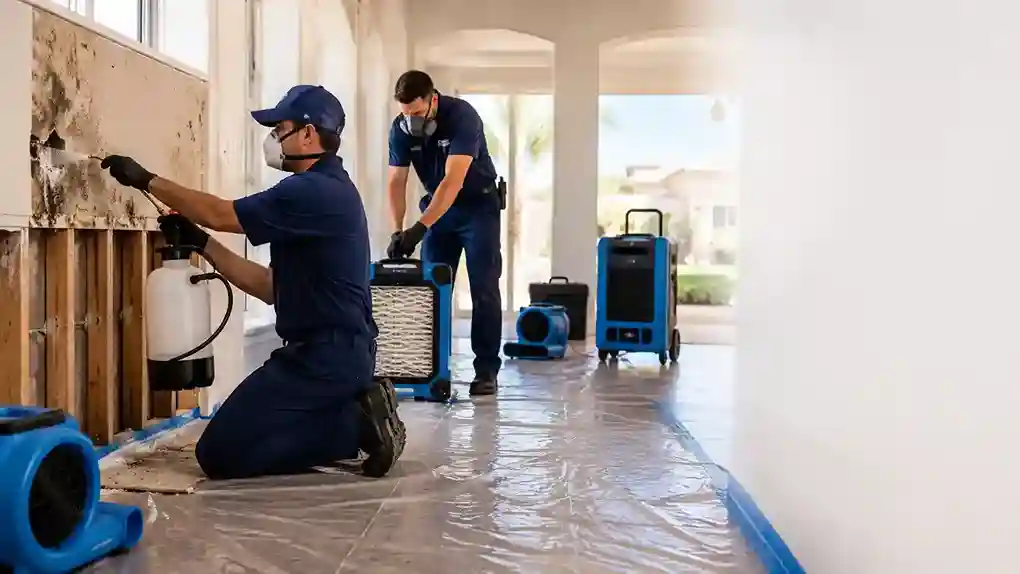
Mold isn't something that gets introduced into your home after a leak — it's already there. Mold spores exist naturally in nearly every indoor environment, floating in the air and settling on surfaces in quantities too small to notice. What a water event changes is the environment those spores need to activate. Once drywall, wood framing, or insulation stays wet, spores that were dormant suddenly have the moisture and organic material they need to begin colonizing.
EPA guidance recommends drying water-damaged materials within 24 to 48 hours to reduce the risk of mold growth. That window is short, and in Chandler it can close even faster than homeowners expect. Extreme summer heat keeps interior wall cavities warm, and the humidity spikes that follow monsoon storms add extra moisture load to a home that may already be dealing with a leak. The combination of warmth and trapped moisture is exactly the environment mold needs to establish itself.
We see the same handful of water sources trigger mold problems again and again across Chandler neighborhoods.
A slab leak near Ocotillo can push moisture under flooring for weeks before a homeowner notices a warm spot or a water bill spike, giving mold time to establish under tile or laminate.
A clogged condensate line in a Sun Lakes attic can drip steadily above a bedroom ceiling for months in Arizona's heavy-AC climate before a stain ever appears.
A failed water heater in a Cooper Commons garage frequently soaks the drywall behind the unit long before the leak is discovered.
A slow dishwasher or washing machine leak near Fox Crossing can saturate cabinet bases and subfloor without ever creating a visible puddle.
A monsoon-damaged roofline in Downtown Chandler can let water track along framing into a ceiling cavity far from the actual point of entry.
Fast-moving monsoon storms and flash flooding near low-lying streets and washes can push water into homes faster than grading and gutters can handle.
A failed irrigation line running close to a Clemente Ranch foundation can feed moisture into the soil beneath a home for an extended period.
A sewage backup introduces both contamination and moisture, creating conditions that require both mold remediation and biohazard-level cleanup protocols.
Across every scenario above, the common thread is time — the longer a leak goes unnoticed, the more likely mold has already started before restoration begins.
Local construction methods and climate patterns shape how mold develops in Chandler homes differently than in other parts of the country.
Stucco is the dominant exterior finish across Chandler, and moisture that gets behind the assembly through a cracked seal or roof intrusion can stay trapped against the sheathing for an extended period, invisible from outside.
Stone veneer accents common on Chandler homes can trap moisture behind the finish in a similar way to stucco, particularly around poorly flashed windows and rooflines.
Concentrated storm events between June and September introduce sudden, heavy moisture loads that homes built for a dry climate aren't always equipped to shed quickly.
Poor-draining caliche and expansive clay soils common in the East Valley mean water from a slab leak or grading issue often has nowhere to go but up into the foundation.
The temperature difference between Chandler's intense summer heat and cooled interior air increases condensation risk at points where insulation or vapor barriers are incomplete.
Newer Chandler homes aren't immune. Moisture trapped in framing during construction, combined with poor vapor barrier installation, can allow mold to develop behind walls even in homes only a few years old.
Visible mold on a surface is often only a small portion of a larger problem developing out of sight.
A persistent earthy or musty smell, even without visible staining, is one of the most reliable early indicators of hidden mold growth.
Yellow, brown, or gray discoloration on drywall or ceilings often signals moisture has been present for some time.
Drywall that feels soft, spongy, or bows slightly under light pressure has likely absorbed significant moisture.
Paint that bubbles or peels away from a wall or ceiling often indicates moisture building up underneath the surface.
Cupping, buckling, or warping in wood or laminate flooring points to moisture intrusion from below or beside the material.
A musty smell that intensifies when the air conditioning runs can indicate mold growth inside ductwork or around an AC coil or condensate line.
Unexplained sneezing, congestion, or irritation that improves when away from the home can be worth investigating alongside other signs.
A home that consistently feels humid or has condensation on windows may have an underlying moisture source feeding mold growth.
Color alone doesn't tell you what type of mold you're dealing with or how concerning it is — proper identification requires sampling and assessment, not a visual guess.
One of the most commonly found indoor molds, often appearing as olive-green to black patches on materials that have experienced moderate, sustained moisture.
Frequently found on drywall and insulation in humid, poorly ventilated spaces, often appearing in shades of green, yellow, or white.
Commonly associated with water-damaged materials such as wallpaper, carpet, and insulation, typically blue or green in appearance.
Requires sustained, heavy moisture to develop and is typically found on materials that stayed wet for an extended period, such as chronically damp drywall or wood.
Often found alongside water leaks in drywall and wallpaper, usually indicating a longer-term moisture problem rather than a recent event.
A common mold found in showers, sinks, and other areas exposed to repeated moisture cycling rather than a single water event.
In every case, the moisture condition required to sustain that mold matters more than the species name. That's why our process focuses on finding and eliminating the moisture source first, with professional assessment guiding any material sampling needed to confirm the scope of a job.
A structured, ten-step process for every remediation job, regardless of size.
We identify the water source behind the mold growth and confirm it has been stopped before remediation begins.
Infrared cameras locate hidden moisture behind walls, under flooring, and inside ceiling assemblies not visible to the eye.
Readings are logged throughout the affected area to define the true boundary of the contamination.
Physical barriers and negative air pressure isolate the work area to prevent spores from spreading to unaffected rooms.
HEPA air scrubbers continuously filter airborne spores from the contained work area throughout the project.
Drywall, insulation, and other porous materials that can't be cleaned are removed and bagged for disposal.
Remaining structural surfaces are treated with EPA-registered antimicrobial products to address residual spores.
LGR dehumidifiers and air movers dry the structure completely, removing the moisture source that allowed mold to grow.
Final moisture readings and visual inspection confirm the area meets the target dry standard before reconstruction begins.
Removed drywall, insulation, flooring, and finishes are rebuilt to return the space to its pre-loss condition.
| Usually Salvageable | Frequently Removed |
|---|---|
| Tile (non-porous surface, cleanable) | Wet drywall (absorbs moisture into paper facing) |
| Concrete (non-porous, dries and cleans well) | Insulation (traps moisture, difficult to fully dry) |
| Metal fixtures and framing components | Carpet padding (absorbs and holds moisture) |
| Hardwood — case-dependent on exposure length | Pressboard/particleboard cabinets (swell and delaminate) |
| Solid wood framing after proper drying | Certain porous materials with extended saturation |
The general rule: non-porous materials like tile, concrete, and metal can typically be cleaned and dried in place. Porous materials that absorb water deep into their structure — drywall paper, insulation fibers, pressboard — are usually more cost-effective to remove and replace than to attempt to fully dry and disinfect, especially once mold has already colonized the material.
A wall can feel completely dry to the touch while still holding enough moisture inside to support active mold growth.
Surface moisture evaporates first. Moisture that has migrated deeper into a wall cavity, subfloor, or cabinet base takes considerably longer to release, and it's invisible without the right tools. A drywall surface that feels cool and dry can still be sitting against wet insulation or a damp stud, both of which remain ideal conditions for mold even after the room looks and feels normal again.
We approach this topic carefully and factually, without exaggeration.
Some individuals may experience sneezing, runny nose, or skin irritation when exposed to mold spores or fragments.
Airborne spores can cause throat or nasal irritation in some people, particularly with prolonged exposure in an enclosed space.
Individuals with asthma may find that mold exposure aggravates symptoms, making prompt remediation especially important in homes with asthmatic residents.
Even where health symptoms aren't present, persistent musty odors affect indoor air quality and comfort.
Children, older adults, and individuals with existing respiratory conditions may be more sensitive to indoor mold exposure than the general population.
Addressing moisture and mold quickly reduces the duration and extent of any potential exposure for everyone in the home.
| Project Scope | Typical Cost Range |
|---|---|
| Small, isolated remediation | $1,500–$3,500 |
| Moderate contamination | $3,500–$8,000 |
| Large remediation projects | $8,000–$20,000+ |
| Reconstruction | Additional, based on scope |
Actual pricing depends on the size of the contaminated area, how accessible it is, whether containment and negative air pressure are required, how much material has to be removed versus cleaned in place, the length of the drying period, and the extent of reconstruction needed afterward. We provide a free, itemized inspection before any work begins so you know the likely scope before committing.
When mold results directly from a sudden, covered water loss — a burst pipe, an appliance failure, or a water heater leak that is discovered and addressed promptly — the resulting mold remediation is often included in the claim.
Mold tied to long-term neglect, deferred maintenance, or a repeated moisture issue that went unaddressed over time is typically excluded, since insurers expect ongoing maintenance issues to be caught before mold develops.
What determines the outcome is documentation. We provide dated moisture logs, photographs, and daily drying reports for every job, giving your adjuster the objective record needed to evaluate whether the mold resulted from a sudden covered event — the same standard adjusters use to make coverage decisions.
The best mold remediation job is the one that's never needed. Prevention is built into every water damage job we handle, whether or not mold has developed yet.
Fast standing-water removal limits how much moisture has the chance to be absorbed into building materials in the first place.
Commercial LGR dehumidifiers pull moisture out of the air before it can re-condense into materials that have already dried on the surface.
Daily readings track drying progress against a defined target rather than guessing when a job is finished.
Technicians check on equipment and conditions daily throughout the drying period, catching problems early.
Preventive antimicrobial application on affected materials during the drying phase helps limit spore activation.
Complete structural drying — not just surface drying — closes the window mold needs to establish itself.
Homes that receive fast, thorough drying after a water event rarely need mold remediation at all. Investing in complete drying up front is almost always less expensive than remediation and reconstruction after mold has already taken hold.
Our Chandler-based crews provide mold remediation after water damage across the East Valley.
Mold spores are already present in nearly every indoor environment, waiting for moisture. Once building materials stay wet, conditions favorable to growth can develop in as little as one to two days, and visible colonization is often reported within about a week. Chandler's summer heat can accelerate this timeline when moisture is trapped in warm, conditioned interior spaces.
Conditions that support mold growth can begin developing within 24 hours of a material staying wet, which is why EPA guidance recommends drying water-damaged materials within 24 to 48 hours. This doesn't mean visible mold appears overnight, but the window for preventing it starts closing almost immediately after a water event.
No. Water damage that is extracted and dried quickly, typically within the first day or two, often does not develop mold at all. Remediation becomes necessary when water sat unaddressed for an extended period, when moisture was trapped behind walls or under flooring without detection, or when a leak went unnoticed for weeks or months.
Mold typically produces a musty, earthy odor, sometimes described as similar to wet cardboard, damp basement air, or old soil. The smell often shows up before mold is visible, especially when growth is developing inside a wall cavity or under flooring, which is why an unexplained musty odor after a water event is worth investigating.
Color alone doesn't indicate the type or risk level of mold. Several common indoor molds appear dark or black, and identifying the species reliably requires sampling and lab analysis rather than a visual guess. Any mold growth, regardless of color, should be addressed because it indicates an underlying moisture problem that needs correcting.
Yes, and it's one of the most common places we find it after a water event. Drywall's paper facing is an organic material mold can colonize, and moisture trapped inside a wall cavity after a leak or flood is often invisible from the room side until a musty odor, staining, or soft drywall develops.
Often, yes, when the mold results directly from a sudden, covered water loss such as a burst pipe, water heater failure, or appliance leak that is reported and addressed promptly. Mold tied to long-term neglect, a slow undetected leak, or repeated moisture problems is typically excluded, which is why documentation from the start matters.
Small, isolated remediation projects typically run $1,500 to $3,500. Moderate contamination across multiple areas generally runs $3,500 to $8,000. Large-scale remediation involving extensive material removal can run $8,000 to $20,000 or more, with reconstruction billed separately based on what needs to be rebuilt.
Mold can return if the underlying moisture source isn't fully corrected or if hidden moisture wasn't completely dried before the space was closed back up. This is why clearance verification and structural drying are treated as separate, required steps in our process rather than being skipped once visible mold is removed.
Hidden moisture is confirmed gone through measurement, not appearance. We use moisture meters and thermal imaging to check materials that were affected, comparing readings against a dry, unaffected reference area in the same structure, and document those readings before considering the space fully dry.
17817 S McQueen Rd, Chandler, AZ 85286
If your home has had a recent leak, flood, or plumbing failure and you're noticing a musty odor, staining, or soft drywall, don't wait for it to get worse. Our Chandler crews respond fast, offer a free inspection, and work directly with your insurance company to document the loss from start to finish.
Serving Chandler, Gilbert, Mesa, Tempe, Queen Creek, and Phoenix, AZ.