Fast Response For Flooded Homes & Businesses
When floodwater enters your property, every minute matters. Gateway Restoration provides emergency flood cleanup, floodwater extraction, structural drying, and complete flood recovery throughout Chandler and the East Valley — call now for immediate dispatch.
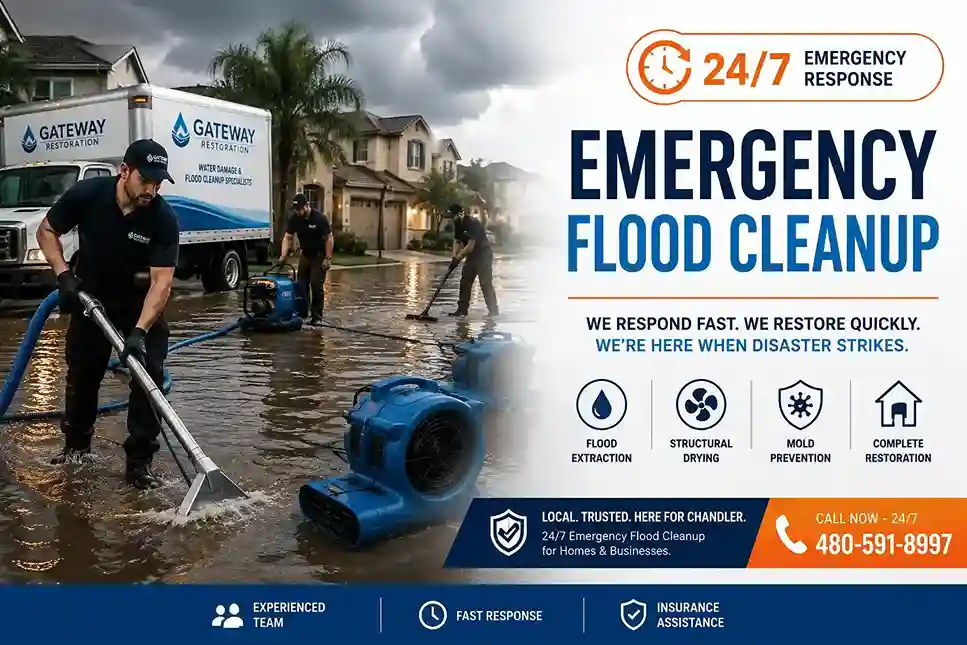
A burst pipe under a sink is clean water. Floodwater is not. By the time stormwater or monsoon runoff reaches your home, it has usually crossed yards, streets, parking lots, and drainage channels, picking up soil, fertilizer, oil residue, and outdoor bacteria along the way. That's why nearly every flood event is treated as at least Category 2 water, and often Category 3, from the moment our crew arrives — a very different starting point than a routine appliance leak.
Floodwater also tends to enter a property fast and from multiple directions at once, whether that's water sheeting under a garage door, backing up through a low-lying entry point, or pushing in around window wells. This rapid structural saturation means baseboards, drywall, subfloor, and insulation can all become wet within minutes rather than hours, which changes both the extraction strategy and the drying timeline compared to a slow, contained leak.
Because of this, our flood response always starts with water category identification and containment before any drying equipment goes in, protecting both your property and the people inside it.
Not every flood looks the same. Here's how we categorize the flood events we respond to across the East Valley.
July–September storms bring intense, fast-moving rain that overwhelms roofs, gutters, and grading in a matter of minutes across Chandler neighborhoods.
Rapid runoff from nearby washes and overwhelmed drainage systems can push water against homes with little to no warning.
Water pooling faster than storm drains can absorb it often finds its way into garages and first-floor living space.
Wind-driven rain during monsoon storms penetrates exterior walls, window seals, and stucco long before anyone notices water inside.
Heavy rainfall events can push neighborhood retention basins past capacity, sending water toward adjacent properties.
Flat-roof commercial structures common across Chandler business parks are especially vulnerable to ponding and roof drain failures during storms.
Underground irrigation leaks and landscape flooding can saturate soil against a foundation until water finds its way indoors.
Many Chandler flood calls involve more than one source at once — a monsoon storm plus a failed sump pump or overwhelmed drain, for example.
Chandler's monsoon season runs roughly from mid-June through September, and flash flood warnings are common during this stretch as fast-moving storm cells drop large volumes of rain in short bursts. The ground beneath much of Chandler is capped by caliche soil, a dense, cement-like layer that limits absorption. Instead of soaking in, storm runoff sheets across yards and streets and increases the volume of water pushing toward homes and low-lying entry points.
Much of the surrounding desert hardpan surface behaves the same way, shedding water rather than absorbing it, which is part of why Chandler's flat terrain struggles with water accumulation during intense storms. As newer subdivisions have expanded across the East Valley, urban expansion and runoff have added even more paved surface area that water has to cross before it reaches a drain, retention basin, or wash.
Neighborhood drainage challenges show up differently street to street. Some Chandler communities were graded and engineered decades apart, so storm drains, curb cuts, and retention basins don't always handle water volume evenly across a subdivision. When a storm exceeds a system's design capacity, stormwater collection system overloads can send water backing up toward the lowest-lying homes on a block rather than away from them.
We respond to flood events throughout Downtown Chandler, Ocotillo, Sun Lakes, Cooper Commons, Fox Crossing, and Clemente Ranch, and we've seen firsthand how each neighborhood's grading, retention basins, and street drainage behave differently once a monsoon cell moves through.
Flood response follows a specific sequence, because starting drying equipment before water is safely categorized and contained can spread contamination further into the structure.
We check for electrical hazards, structural instability, and standing water depth before anyone enters the affected area.
Floodwater is tested and classified so the crew uses the correct protective equipment and cleanup protocol from the start.
Truck-mounted extraction removes standing water quickly, reducing how long materials stay saturated.
Affected areas are contained to prevent contaminated water and airborne particles from spreading to unaffected rooms.
Moisture meters and thermal imaging identify exactly how far water traveled behind walls and under flooring.
We evaluate which materials can be dried in place and which need to be removed due to contamination or saturation.
Air movers and dehumidifiers are placed according to IICRC calculations based on room size and material type.
Photos, moisture readings, and a written scope of work are logged from the first visit to support your claim.
Flood conditions are classified the same way all water losses are, though most flood events start at Category 2 or 3 due to outdoor contamination.
Rare in true flood events, but possible with fast-moving rainwater that hasn't crossed contaminated ground. Still monitored closely, since conditions can shift quickly during an active storm.
Stormwater that has picked up moderate contaminants from roofs, gutters, or yards. Carries a health risk and requires sanitization along with standard extraction and drying.
Floodwater that has crossed streets, drainage systems, or agricultural areas, or mixed with sewage. Requires full protective equipment, aggressive material removal, and thorough sanitization.
Category directly drives the restoration requirements and insurance implications of a flood claim: Category 3 losses typically require more material removal and documentation, which is why accurate classification during the first visit matters so much for both your safety and your claim.
Recovery depends heavily on water category and how long materials stayed wet.
We inventory belongings before removal, separate what can be cleaned on-site from what needs off-site restoration, and are upfront when an item exposed to Category 3 water isn't safe to keep, even if it looks salvageable.
Homeowners insurance and flood insurance are not the same coverage, and this distinction matters most after a Chandler monsoon. Standard homeowners insurance generally covers sudden, storm-driven water intrusion — wind-driven rain forcing its way through a roof, window, or wall during an active storm. That falls under typical storm damage claims.
Rising floodwater from an outside source, however — water that enters because ground-level flooding surrounded your home — is usually excluded from a standard homeowners policy. That kind of loss requires a separate flood insurance policy, and in some cases FEMA disaster assistance may apply if your area is declared a federal disaster zone following a major flood event.
Because coverage depends on exactly how water entered your home, documentation matters even more with flood claims than with a routine leak. We recommend:
We provide all of this as standard practice on every flood job and can walk you through which type of policy is likely to apply based on how the water entered your property.
Flood cleanup costs more than a typical water loss because of contamination, faster material loss, and often more square footage affected.
| Flood Severity | Typical Cost Range |
|---|---|
| Minor Flood Cleanup | $1,500 – $4,000 |
| Moderate Flood Damage | $4,000 – $10,000 |
| Major Flood Restoration | $10,000 – $30,000+ |
| Category 3 Contaminated Flooding | $5,000 – $20,000+ |
| Commercial Flood Losses | Custom Estimate |
Final cost is driven mainly by contamination level, how long affected materials stayed wet, how much demolition and reconstruction is required, and whether contents restoration is needed alongside the structure itself. We provide an itemized, free inspection before any work begins.
A flooded business isn't just a property problem — it's lost revenue every hour doors stay closed.
We provide emergency flood cleanup for retail locations, offices, warehouses, medical facilities, restaurants, and HOA properties across Chandler and the East Valley. Each of these property types has different priorities during a flood event: a restaurant needs health-code-compliant sanitization before reopening, a medical facility needs contamination controlled around sensitive equipment, and a warehouse may need targeted drying around specific inventory zones rather than the entire floor.
Across all commercial flood jobs, our focus stays on business continuity: working in phases where possible so parts of a facility can reopen while drying continues elsewhere, scheduling around operating hours, and communicating a realistic timeline so you can plan staffing and customer communication around the restoration, not the other way around.
We know Chandler's caliche soil, drainage patterns, and monsoon behavior neighborhood by neighborhood.
Crews positioned across the East Valley for fast arrival when floodwater is actively spreading.
Commercial air movers, dehumidifiers, moisture meters, and thermal imaging on every flood job.
Contamination protocols built specifically for flood conditions, not a generic leak response.
Documentation built the way adjusters expect it, for both homeowners and flood policy claims.
Direct answers about what's salvageable, what isn't, and what a claim is likely to cover.
Emergency flood cleanup across Chandler and the East Valley.
Zip codes we cover across Chandler:
Our crews dispatch immediately and typically begin floodwater extraction within a couple of hours of your call. Minor flooding can be extracted the same day, while larger floods take longer to fully extract before drying starts.
Yes. Floodwater picks up outdoor pollutants, soil, and often sewage as it travels across yards and streets, so it's treated as contaminated water requiring protective equipment and sanitization, unlike a clean supply-line leak.
Category 3 floodwater is grossly contaminated water that may contain sewage, bacteria, or chemical runoff picked up from streets and drainage systems. It requires full protective protocols and thorough sanitization.
It depends on the water category and how long it was wet. Drywall exposed briefly to clean water can sometimes be dried in place, but drywall that absorbed contaminated floodwater is usually cut out and replaced.
Standard homeowners insurance typically covers sudden storm-related water intrusion, like wind-driven rain through a roof. Rising floodwater from an external source is usually excluded and requires separate flood insurance.
Stay clear of standing water near electrical outlets or panels, call for emergency flood cleanup, document the damage with photos, and avoid walking through contaminated water without protective gear.
Most flood-affected structures take four to seven days to dry with commercial equipment running continuously, though larger floods or contaminated water can extend that timeline.
Yes, mold can begin colonizing damp materials within 24 to 48 hours after a flood in Arizona's warm indoor environments, which is why immediate extraction and drying are critical.
Yes, Gateway Restoration provides 24/7 emergency flood cleanup dispatch throughout Chandler and the East Valley, including nights, weekends, and holidays.
Yes, in addition to Chandler, we provide emergency flood cleanup and flood damage restoration throughout Gilbert, Mesa, Tempe, Queen Creek, and Phoenix.
Our crews are standing by 24/7 for emergency flood cleanup across Chandler and the East Valley. Call now for immediate dispatch.
17817 S McQueen Rd, Chandler, AZ 85286
 Gateway Restoration