 Gateway Restoration
Gateway Restoration
Gateway Restoration
Professional recovery and restoration of water-damaged documents, photographs, records, books, blueprints, and irreplaceable paper materials after floods, leaks, burst pipes, and water damage emergencies.
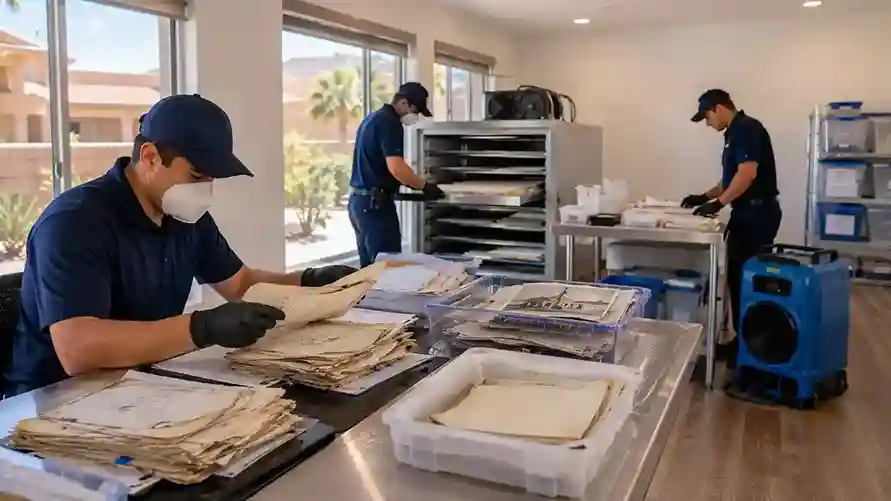
When water damages documents, the clock starts immediately. Many homeowners believe wet paperwork is automatically ruined — in reality, important documents can often be stabilized and restored when recovery begins quickly. Our process focuses on stopping deterioration, preventing mold growth, and using specialized drying methods to preserve information and structure.
Paper is one of the most time-sensitive materials in any water damage loss. Unlike drywall or flooring, documents can become permanently unreadable within hours if they aren't stabilized correctly.
Water causes many inks — especially inkjet, ballpoint, and older typewritten text — to smear or bleed across the page, sometimes making signatures and figures illegible within minutes of exposure.
Paper fibers swell as they absorb moisture, causing cockling and warping. The longer pages stay wet, the more permanent the distortion becomes once the material dries unassisted.
In Chandler's warm indoor environments, mold can begin colonizing damp paper within 24 to 48 hours, a threshold widely cited by restoration and archival preservation organizations.
Wet documents left stacked or bound often fuse together as they dry. Once pages bond, separating them without specialized techniques can tear or destroy the content entirely.
Coated papers, glossy photos, and laminated documents are especially vulnerable to surface damage that obscures text and images even when the paper itself survives.
Cellulose fibers weaken with prolonged saturation. Beyond a certain point, no drying method can reverse structural breakdown — which is why speed matters more than any other factor.
Salvageability depends on paper type, ink, contamination level, and how long the materials sat wet. Below are the categories we recover most often for Chandler homeowners and businesses.
Government-issued vital records printed on standard or security paper typically respond well to rapid stabilization and controlled drying.
Often salvageable, especially when recovered before pages bond together or ink begins to migrate.
Deeds, titles, and surveys can usually be stabilized, though embossed seals and raised print need careful handling.
Multi-page tax filings are commonly recovered, particularly when drying begins before pages fuse into a solid block.
Policy documents and endorsements are frequently restorable, and preserving them can be essential to supporting your own claim.
Patient charts and treatment histories often require priority handling due to their sensitivity and regulatory retention requirements.
Contracts, court filings, and case files can frequently be recovered, though heavily bound files need specialized separation techniques.
Transcripts and enrollment files are commonly restorable when treated before mold sets in.
Large-format drawings on vellum or bond paper require flat, controlled drying to prevent permanent creasing or ink loss.
Blueprints and technical plans can often be stabilized, though heavy roll formats need specialized unrolling and drying support.
Bound volumes are among the more challenging items, but many can be recovered using interleaving and controlled drying, especially hardcover editions.
Photos and albums often have the narrowest recovery window and benefit the most from immediate professional handling.
Aged or fragile paper requires gentler handling, but many historical items can still be stabilized when recovery starts quickly.
Operational files, invoices, and internal records are commonly recovered as part of a structured business inventory process.
Signed agreements can often be restored, preserving both the content and, where possible, the original signatures.
Statements, ledgers, and accounting records are frequently salvageable when treated before extended saturation occurs.
Personnel files often carry retention obligations, making prompt recovery a compliance priority for many employers.
Chandler's climate and construction create specific patterns of document loss that homeowners and businesses run into again and again.
Intense summer storms push water through roof lines, garages, and ground-level rooms where filing cabinets, boxes, and bookshelves are often stored.
A failed tank in a garage or closet frequently soaks nearby storage boxes containing tax records, photos, and files before anyone notices.
Slow leaks beneath Chandler's slab foundations can saturate flooring and lower shelving for weeks before visible signs appear.
A sudden pipe failure near a home office or storage closet can drench file cabinets and bookcases in minutes.
Washing machines, dishwashers, and refrigerators positioned near laundry or utility rooms often damage nearby stored records.
Attic storage — a common spot for photo boxes and archived files — is especially vulnerable to slow roof intrusion.
Arizona's heavy AC use means condensate line failures are a frequent, often-overlooked cause of interior document damage.
Backups introduce contamination that changes the entire recovery approach and requires specialized handling protocols.
A structured, repeatable process protects both the physical documents and the information they contain.
We evaluate the water source, contamination category, and the condition of affected documents on arrival to determine the safest, fastest path to stabilization.
Materials are carefully separated, kept flat or upright as appropriate, and protected from further saturation, handling damage, or contamination while a recovery plan is developed.
Every box, file, and item is logged and sorted by document type, damage severity, and priority — creating a clear record for you and your insurance carrier.
We assess saturation levels across the collection to determine which materials can go through standard drying and which require more intensive recovery methods.
Based on paper type, ink, and saturation, we choose the appropriate drying approach — air drying, dehumidification, freezing, or vacuum freeze-drying for heavily saturated items.
Documents are dried, gently cleaned where needed, and handled to preserve legibility, structure, and — wherever possible — their original condition.
Recovered materials are stored in a controlled environment to prevent re-humidification, further mold risk, or physical damage before return.
You receive your recovered documents along with a full inventory and condition report, useful for your records and for insurance claim support.
Different documents call for different techniques. Here's what each method actually does, in plain English.
Documents are laid out and exposed to controlled airflow — suitable for lightly dampened, loose-leaf materials that haven't fully saturated.
Commercial dehumidifiers pull ambient moisture from the room, helping paper dry evenly without over-drying or additional warping.
Freezing halts further deterioration and mold growth, buying time to plan a careful recovery for large or heavily damaged collections.
Frozen documents are dried in a vacuum chamber where ice converts directly to vapor — the industry standard for heavily saturated books and bound records.
Desiccant materials draw moisture out of the surrounding air in enclosed spaces, useful for slower, gentler drying of sensitive items.
Historical and archival materials receive extra care, including gentle handling and conservation-informed techniques to protect fragile paper.
Printed photos, albums, photo collections, scrapbooks, negatives, and historical images are often the items families care about most — and unfortunately among the most time-sensitive to recover. Glossy photo paper can stick to adjacent surfaces within hours, and image emulsion can lift or distort quickly once wet.
Early intervention significantly improves recovery potential. Professional restoration companies consistently emphasize rapid stabilization and careful handling of photographic materials — separating stuck photos incorrectly, or letting them air-dry stacked together, is one of the most common ways irreplaceable images are permanently lost.
If you've discovered water-damaged family photographs, albums, or negatives, avoid pulling stuck pages apart yourself. Call Gateway Restoration at (480) 591-8997 before attempting to separate or dry them at home.
Organizations that rely on physical records face unique regulatory, operational, and client-trust pressures after a water loss.
Case files, client records, and signed originals often carry retention and confidentiality obligations.
Patient charts and treatment histories require prompt, careful handling under regulatory expectations.
Client financial records and filings often need to be preserved for audit and compliance purposes.
Lease agreements, resident files, and financial records affect multiple tenants or owners at once.
Student transcripts, enrollment records, and administrative files often carry long-term retention requirements.
Membership records, historical archives, and financial documents are often decades old and irreplaceable.
Specifications, compliance files, and production records often support ongoing operations and audits.
Blueprints, technical drawings, and project files can represent thousands of hours of design work.
Transaction files, contracts, and disclosures often need to be preserved for years after closing.
A document loss event doesn't just damage paper — it can interrupt operations and create compliance exposure if not managed correctly.
Unrecovered files can mean lost history for accounts, cases, or projects that took years to build.
Staff often can't proceed with active files, claims, or client matters until records are located and assessed.
Industries with retention mandates face added pressure to demonstrate that records were protected and recovered properly.
Downtime, replacement costs, and staff time spent reconstructing records all add up quickly after a loss.
A clear, prioritized recovery plan helps critical documents get treated first, minimizing operational disruption.
Detailed inventories and condition reports support both your internal records and your insurance claim.
Professional document recovery supports business continuity by stabilizing critical files quickly, prioritizing active matters, and providing the documentation your organization needs to keep moving — even while the rest of a water damage restoration project is underway.
Arizona's climate creates a specific pattern of risk for paper materials stored in homes and offices.
Sudden, heavy rainfall between June and September can soak stored records before anyone realizes water has entered the home or building.
Homes near washes and low-lying streets face fast-moving water that can reach ground-level storage in minutes.
Heavy air conditioning use raises the odds of condensate line failures near attic and closet storage.
Slow leaks behind walls or beneath slabs can dampen nearby records for weeks before visible signs appear.
Warm indoor conditions accelerate mold development on damp paper compared to cooler climates.
Elevated humidity following monsoon activity can prolong dampness in paper materials even without direct water contact.
We believe in setting realistic expectations. Some materials are significantly harder to recover than others.
Documents exposed to Category 3 water carry health risks that can limit recovery options for safety reasons.
Once active mold growth has set in, staining and structural breakdown are often permanent even after treatment.
Coated and glossy surfaces are prone to sticking and emulsion damage, narrowing the recovery window considerably.
Certain inks dissolve or migrate on contact with water, which can permanently affect legibility regardless of drying method.
Materials that sat wet for an extended period before discovery have a substantially reduced chance of full recovery.
Extended saturation weakens paper fibers structurally, sometimes beyond what any drying process can reverse.
Even in these harder cases, partial recovery — legible pages, salvaged sections, or digitized content before full loss — is often possible. We'll always give you a straightforward assessment of what can realistically be saved.
Document recovery is frequently covered under both personal property and business records provisions, depending on your policy.
Many homeowners policies include coverage for damaged personal belongings, which can extend to important papers and photographs.
Commercial policies may include specific provisions for the cost of restoring or recreating damaged business records.
Most carriers expect a detailed inventory of affected items — exactly what our recovery process produces automatically.
Photos, condition reports, and moisture logs give adjusters objective evidence to support your claim.
We can coordinate directly with your insurance adjuster to explain the recovery process and provide requested records.
You receive a final report detailing what was restored, what was partially recovered, and what could not be saved.
Gateway Restoration provides document drying and restoration services throughout Chandler and the surrounding East Valley.
In many cases, yes. Documents that are stabilized quickly and dried using the correct method — air drying, dehumidification, or freeze-drying for heavily saturated items — can often be fully or partially recovered, especially when they're loose-leaf, uncoated paper.
As soon as possible. Industry guidance points to the first 24–48 hours as the most critical window before mold growth, ink bleeding, and page adhesion make recovery significantly harder.
Often, yes, particularly when they're stabilized quickly and not pulled apart while stuck together. Photos have one of the narrowest recovery windows of any document type, so fast professional handling matters most here.
Freeze-drying involves freezing saturated materials to halt further deterioration, then removing moisture through a vacuum process that converts ice directly to vapor — a technique widely used for heavily wet books and bound records.
Mold can begin affecting damp paper within 24 to 48 hours in warm indoor conditions. Once active mold growth sets in, staining and structural damage often become permanent, which is why rapid drying is so important.
Many legal and financial documents can be recovered when treated promptly, though heavily bound files, water-soluble inks, and sewage contamination can limit full recovery in some cases.
Coverage often depends on your policy type — personal property provisions for homeowners, or business records provisions for commercial policies. We can help document the loss to support your claim.
Bound books are more challenging than loose paper but are frequently recovered using interleaving techniques and controlled or freeze-drying methods, particularly for hardcover volumes.
Timelines vary based on volume and saturation level. Simple loose-leaf recovery may take a few days, while large collections or freeze-drying projects can take longer to complete properly.
Avoid separating stuck pages yourself, don't use a household hair dryer or microwave, keep materials out of direct sun, and call Gateway Restoration at (480) 591-8997 so we can assess and stabilize them correctly.
17817 S McQueen Rd, Chandler, AZ 85286
Call anytime for emergency document stabilization: (480) 591-8997
Every hour matters. Call Gateway Restoration now so we can stabilize and begin recovering your important documents, records, photographs, and files before the damage becomes permanent.