When a pipe bursts, a monsoon floods your roofline, or a slab leak soaks your flooring, Gateway Restoration provides 24/7 emergency Water Damage Restoration Phoenix AZ homeowners and businesses can count on. Our IICRC-trained crews are dispatched around the clock, every day of the year — call (480) 591-8997 now for immediate help.
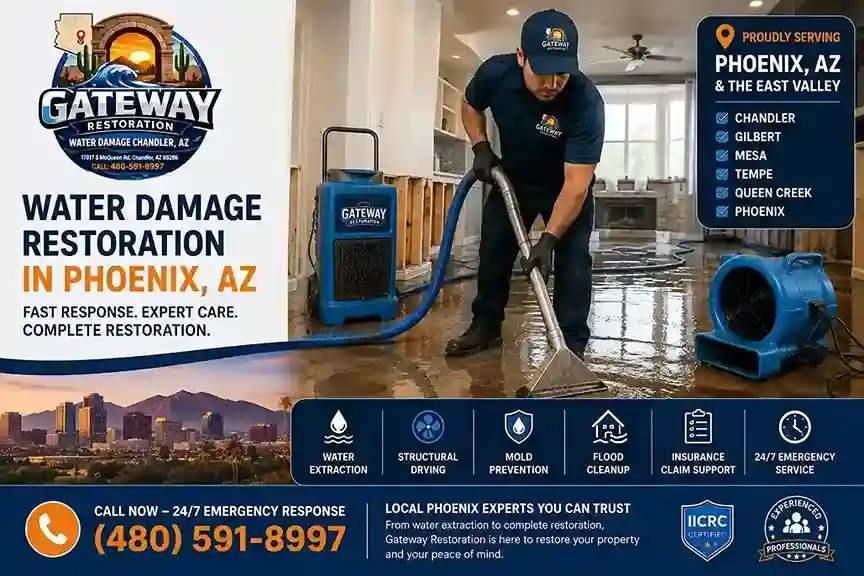
Phoenix averages roughly eight inches of rain a year, which leads many homeowners to assume water damage is a problem for wetter states. In practice, the Valley's combination of monsoon intensity, aging infrastructure, and extreme summer heat creates its own distinct set of water damage risks — the desert climate changes the source of the water, not whether the damage happens.
Monsoon season, which runs roughly from June through September, brings some of the most intense rainfall rates in the country in short, violent bursts. A dust storm, or haboob, often rolls through first, followed within the hour by torrential rain that overwhelms roof drains, window seals, and grading before homeowners have time to prepare. These sudden downpours are responsible for a large share of the emergency water damage calls we receive across Phoenix every summer.
Flash flooding is a second major concern. Phoenix's washes, canals, and low-lying streets can go from dry to running with water in minutes during a heavy monsoon cell, pushing water against foundations and into garages and ground-floor living space in neighborhoods near natural drainage channels.
Established neighborhoods like Encanto, Central Phoenix, and Sunnyslope still run galvanized or early-generation copper supply lines that corrode and pinhole with age, especially given Phoenix's hard water.
Flat commercial roofs, rooftop HVAC penetrations, and aging fire-suppression lines make offices, retail centers, and warehouses vulnerable to sudden large-scale water losses.
Sun-baked roofing materials develop cracks and brittle flashing over years of intense UV exposure, then fail exactly when monsoon rain finally arrives.
With air conditioning running nearly year-round, a clogged condensate line or failed pan is one of the most common sources of slow, hidden interior water damage in Phoenix homes.
Wind-driven monsoon rain can force water behind stucco cladding, where it can sit undetected against sheathing and framing for weeks before a stain appears.
Older Phoenix properties with flood-irrigation or drip systems near the foundation can silently saturate soil and push moisture into crawlspaces and slab edges.
In short, Phoenix's dry climate doesn't eliminate water damage risk — it just concentrates it into a handful of predictable, high-intensity events. Understanding these sources is the first step in protecting your property, and knowing who to call the moment something goes wrong is the second.
Gateway Restoration handles every stage of a water loss for Phoenix properties, from the first emergency call through final repairs. Below is an overview of the core services our crews provide throughout the Valley.
Round-the-clock dispatch to stop active water intrusion, whether it's a burst supply line at 2 a.m. or a monsoon downpour flooding a Phoenix living room.
Learn about Emergency Water Damage Restoration →Truck-mounted extraction equipment removes standing water fast from carpet, tile, and hardwood before it soaks deeper into subfloor and framing.
Learn about Water Extraction →Commercial air movers and LGR dehumidifiers dry framing, drywall, and subfloor using IICRC-based placement calculations, not guesswork.
Learn about Structural Drying →Full cleanup after monsoon flooding or flash-flood intrusion, including debris removal, sanitization, and moisture control for affected rooms.
Learn about Flood Cleanup →Emergency response for burst supply lines and pinhole leaks in aging Phoenix plumbing, from source containment through full structural drying.
Learn about Burst Pipe Water Damage →Detection and drying for slab leaks common in older Phoenix homes, where water travels laterally under tile before ever surfacing as a visible stain.
Learn about Slab Leak Water Damage →Full protective-equipment protocols for Category 3 sewage backups, including removal of contaminated materials and complete sanitization.
Learn about Sewage Backup Cleanup →Antimicrobial treatment and remediation once moisture readings confirm mold risk, preventing a water loss from becoming a mold problem.
Learn about Mold Remediation →Rapid-response restoration for Phoenix offices, medical facilities, restaurants, and retail spaces, built around minimizing business interruption.
Learn about Commercial Water Damage Restoration →Careful pack-out, cleaning, and storage of furniture, electronics, and documents so belongings can be restored rather than discarded.
Learn about Content Pack-Out Restoration →Every Phoenix water loss is different — call for a free, itemized inspection.
Call (480) 591-8997Every Phoenix job follows the same disciplined, IICRC S500-based process, from the first phone call to the final repair. This consistency is what protects your property and strengthens your insurance claim.
A technician inspects the source of water, the extent of the intrusion, and any safety hazards such as exposed electrical components before extraction begins.
Category 1 is clean water from a supply line or appliance with no contamination risk. Category 2 ("gray water") carries some contaminants, such as overflow from a washing machine or dishwasher, and poses a mild health risk. Category 3 is grossly contaminated water — sewage, flood water, or water that has sat long enough to grow bacteria — and requires full protective protocols. Classification determines every step that follows.
Truck-mounted extraction equipment removes standing water quickly, pulling far more volume than portable shop-vacs and determining how much flooring and subfloor can be saved.
Air movers and LGR dehumidifiers are placed according to IICRC calculations for room size, humidity, and material type, then monitored daily with moisture mapping and thermal imaging until every reading confirms dry.
Once the structure is verified dry, we rebuild — replacing drywall, flooring, baseboards, and paint as needed to return your Phoenix property to its pre-loss condition.
Phoenix is a patchwork of very different housing stock and property types, and the water damage risks shift block by block. Here's how we approach some of the neighborhoods we serve most often.
High-rise condos and mixed-use retail bring shared plumbing risers and flat commercial roofs, where a single leak can affect multiple units at once.
Mid-century ranch homes with older copper plumbing and mature citrus groves fed by irrigation lines that can leak near foundations.
Upscale condos and estate homes often have complex roof lines and elaborate irrigation systems that create multiple points of possible intrusion.
A dense mix of apartments, condos, and single-family homes where shared walls make fast response critical to limiting damage to neighboring units.
Historic homes near Encanto Park often retain original plumbing that's decades old, raising the risk of pipe failure and slab leaks.
Established single-story homes with slab foundations, where slab leaks and irrigation seepage are common causes of hidden water damage.
Hillside and foothill lots see fast stormwater runoff during monsoon storms, pushing water toward garages and lower-level entries.
Large custom homes with extensive roof and window glazing that can develop leaks around flashing after years of intense sun exposure.
Newer construction with modern plumbing, but large HVAC systems and irrigation-heavy landscaping still create condensate and irrigation-related risks.
Homes built against South Mountain see concentrated storm runoff during monsoon season, increasing the risk of water intrusion at lower elevations.
Historic bungalows and loft conversions mix old plumbing with modern renovations, sometimes hiding water damage behind updated finishes.
A dense corridor of older homes and mid-rise buildings where aging supply lines and flat roofs both contribute to water losses.
Properties near washes and lower-lying streets face elevated flash-flood exposure during heavy monsoon cells.
Foothill homes with pool equipment and irrigation systems positioned close to slab foundations, a common source of slow leaks.
One of Phoenix's older neighborhoods, where original plumbing and aging roofing materials combine to raise both leak and storm-damage risk.
A water loss inside a Phoenix business isn't just a property problem — it's lost revenue, disrupted operations, and, for some industries, regulatory exposure. Our commercial response is built around getting your doors back open as fast as safely possible, with clear communication throughout.
For occupied buildings, we sequence work to keep as much of the space operational as possible, coordinate around business hours where feasible, and provide the documentation property managers and facility directors need for insurance and ownership reporting. Medical facilities and schools receive extra attention to sanitation protocols given their occupancy requirements, while restaurants and retail centers get priority scheduling to limit lost revenue days.
Arizona's monsoon season runs roughly from mid-June through the end of September, and it's the single biggest driver of storm-related water damage calls we receive in Phoenix each year. Storm cells can drop more rain in thirty minutes than the city sees in an average month, overwhelming drainage systems built for a much drier baseline.
Flash flooding along washes and low-lying roadways can rise fast enough to strand vehicles and push water against garages and ground-floor entries within minutes of a storm cell arriving. Roof failures are common when wind-driven rain finds weak flashing or aging shingles that have spent months baking under intense summer sun. Window intrusion happens when wind pressure forces rain past seals that were never rated for monsoon-level wind speeds, and storm runoff from poor grading can channel water directly toward foundations instead of away from them.
Emergency response planning matters most before the storm hits: know where your main water shutoff is, keep gutters and drains clear heading into June, and have a restoration company's number saved before you need it. When damage does happen, our crews mobilize as soon as it's safe to travel, prioritizing active leaks and structural risk first.
Costs vary based on the water category, square footage affected, materials involved, and how long the water sat before treatment began. The ranges below reflect typical Phoenix-area residential jobs.
| Damage Type | Typical Cost Range |
|---|---|
| Category 1 Water | $1,200–$3,500 |
| Category 2 Water | $2,500–$6,500 |
| Category 3 Water | $4,500–$12,000+ |
| Commercial Loss | Custom Estimate |
| Mold Remediation (additional) | $1,500–$6,000 |
The biggest cost driver is response time — water that's extracted and dried within the first 24 hours almost always costs less to restore than water that's been allowed to sit. Square footage, whether tile, hardwood, or carpet was affected, and whether drywall or cabinetry needs replacement also factor heavily into the final estimate. Call for a free, itemized inspection before any work begins.
Most Phoenix homeowners policies distinguish between sudden, accidental damage and damage caused by neglect. Understanding which category your loss falls into helps set expectations before you file a claim.
We document every job with photos, moisture logs, and detailed reports built for your adjuster, and we can work directly with many carriers to explain how your deductible applies. Thorough documentation from day one is often the difference between a smooth claim and a disputed one, which is why our crews treat it as a core part of the restoration process, not an afterthought.
Based in Chandler with crews dispatched throughout the Phoenix metro, not routed through an out-of-state call center.
Truck-mounted extraction, commercial air movers, and LGR dehumidifiers sized to the job, not a one-size-fits-all setup.
Room-by-room moisture tracking that shows exactly where drying is complete and where equipment still needs to run.
Infrared cameras locate hidden water inside walls and under flooring that isn't visible to the naked eye.
Photo logs, moisture readings, and reports built specifically for what Phoenix-area adjusters expect to see.
Experience restoring occupied offices, medical facilities, and retail spaces without unnecessary downtime.
Emergency dispatch every hour of every day, including holidays and the height of monsoon season.
Direct updates throughout the job instead of vague timelines, so you always know where drying stands.
Crews positioned to reach Downtown Phoenix, the I-17 corridor, and the East Valley quickly when every hour counts.
Our Phoenix response covers the full metro area, including neighborhoods and districts near Phoenix Sky Harbor, Downtown Phoenix, South Mountain Park, the Desert Botanical Garden, Papago Park, the Biltmore area, Roosevelt Row, and the Camelback corridor.
Indoors, mold can begin colonizing damp drywall, baseboards, and carpet padding within 24 to 48 hours, even in Phoenix's dry outdoor climate. Air-conditioned interiors stay warm and humid enough behind walls to support mold growth quickly, which is why fast extraction and structural drying matter as much here as in wetter states.
Yes. Phoenix's low annual rainfall doesn't prevent water damage — it just changes the source. Monsoon storms, burst pipes, AC condensate line failures, slab leaks, and aging plumbing in older neighborhoods cause the majority of water losses we respond to, independent of how little it rains each year.
Most residential structural drying takes three to five days with commercial air movers and LGR dehumidifiers running continuously. Phoenix's high indoor cooling loads and dense materials like tile-over-slab construction can extend drying time, so we confirm completion with daily moisture readings rather than a fixed schedule.
Shut off the water source if it's safe to do so, cut power to any affected outlets or the electrical panel if water is nearby, and call (480) 591-8997 for emergency dispatch. Photograph the damage before cleanup begins and avoid relying on household fans alone, since they can't dry moisture trapped inside walls and subfloor.
Standard homeowners policies typically cover sudden, accidental water damage such as burst pipes, appliance failures, and storm-related roof intrusion. Flooding from rising water — such as a wash overflowing during a monsoon — is often excluded unless you carry separate flood insurance, so it's worth reviewing your policy before storm season.
We dispatch crews across the Phoenix metro area 24 hours a day, seven days a week, with rapid response to Downtown Phoenix, Arcadia, Camelback East, and neighborhoods along the Interstate 17 and Loop 202 corridors. Call for the fastest available arrival window based on your location.
Often, yes, if drywall has only absorbed clean or lightly contaminated water and drying begins within the first 24 to 48 hours. Drywall exposed to Category 3 water, or drywall that has stayed wet for several days, usually needs to be removed and replaced to prevent hidden mold growth.
Our crews use truck-mounted extraction units, commercial air movers, LGR dehumidifiers, moisture meters, and thermal imaging cameras to locate and remove water. Equipment placement follows IICRC S500 calculations based on room size, material type, and humidity, not guesswork.
Yes. We restore office buildings, medical facilities, restaurants, retail centers, warehouses, schools, and HOA and property-managed communities throughout Phoenix, with a focus on minimizing business interruption and coordinating around occupied space.
We respond throughout Phoenix, including Downtown Phoenix, Arcadia, Biltmore, Camelback East, Encanto, Maryvale, North Mountain, Paradise Valley area, Desert Ridge, Ahwatukee Foothills, Roosevelt Row, Central Phoenix, South Mountain, Moon Valley, and Sunnyslope.
Gateway Restoration is based at 17817 S McQueen Rd, Chandler, AZ 85286, with crews dispatched throughout Phoenix, Chandler, Mesa, Gilbert, Tempe, Queen Creek, Scottsdale, Glendale, and Peoria.
Gateway Restoration
17817 S McQueen Rd, Chandler, AZ 85286
Available 24 Hours a Day · 7 Days a Week
 Gateway Restoration