Gateway Restoration provides 24/7 emergency water extraction, structural drying, flood cleanup, and mold prevention throughout Queen Creek and the surrounding East Valley — from master-planned neighborhoods to acreage and equine properties. Call now: (480) 591-8997.
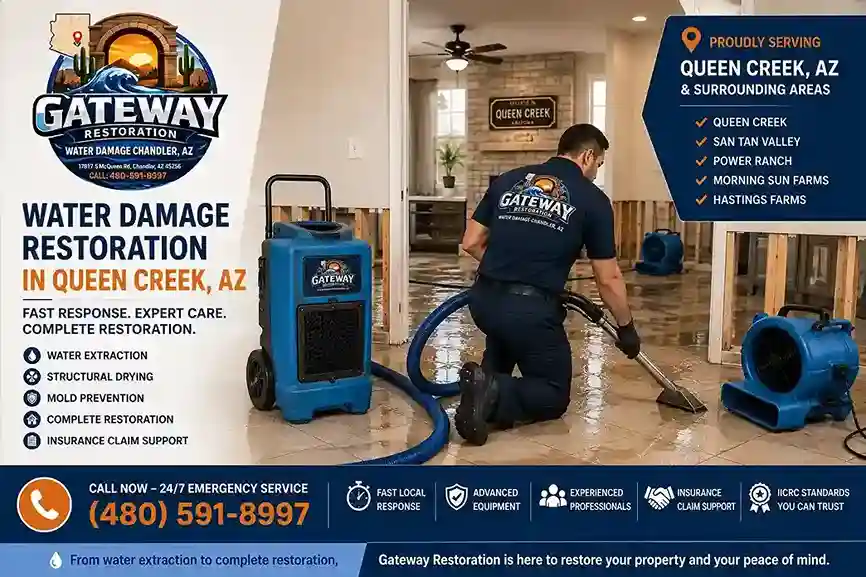
Queen Creek is one of the fastest-growing communities in the East Valley, and that rapid residential growth is changing the kind of water damage calls we respond to here. New housing developments are being built faster than ever, and expanding infrastructure — new water mains, new residential plumbing, and new subdivisions layered onto existing systems — creates conditions where failures are more likely simply because there is so much more freshly installed plumbing and irrigation in the ground.
Even in brand-new homes, water heater failures and appliance leaks are common during the first few years, often tied to manufacturing defects or installation issues rather than age. Queen Creek's extensive irrigation-related moisture problems add another layer — many properties run drip systems, flood irrigation, or landscape irrigation lines close to the home, and a single failed valve or cracked line can quietly saturate soil against a foundation for days before anyone notices.
HVAC condensate issues are common too, especially in newer two-story homes where attic-mounted units and long condensate lines are more prone to clogs. Add in seasonal monsoon flooding, ongoing landscaping irrigation leaks, and the slab foundation moisture problems that come with slab-on-grade construction, and it's clear why Queen Creek's growth story comes with a distinct set of water damage risks that didn't exist here a decade ago.
Queen Creek's identity is built around large master-planned communities like Meridian, Hastings Farms, Ironwood Crossing, Cortina, Sossaman Estates, Victoria, Harvest, Barney Farms, and the growing Queen Creek Station area. These communities share amenities, HOA oversight, and consistent construction standards — but that also means a plumbing or irrigation defect found in one home is often present across an entire phase of similarly built houses.
Unlike the denser subdivisions of Chandler or Tempe, Queen Creek still has a substantial share of acreage properties, equine properties, and custom homes with extensive irrigation systems supporting large yards, arenas, and pastures. These properties often have more total plumbing and irrigation infrastructure per lot than a standard suburban home, which means more potential failure points.
New construction brings its own risks: plumbing defects that surface only after a home has been lived in for a season, builder warranty water losses tied to installation errors, irrigation installation failures where landscape contractors tie into supply lines incorrectly, and drainage grading issues where a lot wasn't graded to move water away from the foundation as designed.
What makes Queen Creek genuinely different is how it blends brand-new suburban subdivisions with older rural-residential parcels, sometimes on the same street. That mix means our crews need to be equally comfortable diagnosing a slab leak under a two-year-old tract home and tracing an irrigation failure across two acres of horse property — and we are.
Queen Creek's growth has outpaced parts of its drainage infrastructure, making monsoon season a real annual risk for many neighborhoods.
Sudden desert storms bring intense rainfall in short bursts, often triggering flash flooding and rapid water intrusion before homeowners have any warning.
Queen Creek's caliche-heavy soil has limited absorption capacity, driving rapid runoff and foundation water accumulation during heavy storms.
Development, new roads, and concentrated runoff channels across Queen Creek and surrounding Maricopa County can increase localized flood risk in ways that shift as the area continues to grow.
Garage flooding, patio flooding, landscape flooding, and foundation intrusion are all common outcomes when storm intensity outpaces a neighborhood's drainage capacity.
Every stage of the restoration process, from first call to final rebuild, is available throughout Queen Creek.
24/7 rapid dispatch for active water damage anywhere in Queen Creek, day or night.
Round-the-clock service for residential and commercial losses, including weekends and holidays.
Fast response to monsoon and flash-flood water intrusion in garages, patios, and living space.
Truck-mounted and portable extraction to remove standing water from any size property.
Engineered drying plans for drywall, framing, and flooring based on IICRC standards.
Immediate action to stop water damage from spreading through your home or building.
Commercial-grade humidity control to protect materials throughout the drying process.
Locating hidden moisture behind walls, under flooring, and inside cabinetry.
We begin with a full inspection using moisture meters and thermal imaging to identify the water source, classify the water category, and map every affected area of your Queen Creek property.
Standing water is removed with truck-mounted and portable extraction equipment, following IICRC procedures to limit how far the loss spreads.
Air movers and commercial dehumidifiers are placed according to an engineered drying plan built around your home's specific materials and layout.
Daily monitoring tracks drying progress with moisture mapping and thermal imaging, producing insurance-ready documentation throughout the project.
Once moisture readings confirm the structure is dry, we move into repairs and rebuild — drywall, flooring, cabinetry, and finishes — to return your property to pre-loss condition.
Common in newer Queen Creek developments, where a failed tank or fitting can release dozens of gallons before it's noticed. See our emergency water damage services.
Frequent on slab-on-grade homes throughout Queen Creek's newer subdivisions. Learn more about slab leak water damage.
A leading cause of foundation moisture on acreage and equine properties. See our irrigation system leak damage page.
Washing machines, dishwashers, and refrigerator lines remain a top cause of sudden Category 1 or 2 losses.
Attic-mounted systems in newer two-story homes are especially prone to slow, hidden condensate leaks.
Wind-driven monsoon rain can force water through roofing and vents before an owner ever sees a ceiling stain.
Poor grading or nearby irrigation can push water against a slab foundation, especially on newly landscaped lots.
A frequent monsoon-season call throughout Queen Creek's newer subdivisions with developing drainage systems. See emergency flood cleanup.
Flash flooding and washes can push water into ground-floor living space during intense summer storms.
Gateway Restoration understands the housing stock and water damage risks specific to each Queen Creek community.
A large master-planned community of newer single-family homes, where irrigation installation issues and builder-related plumbing defects are the most common calls we see.
Family-oriented tract homes with extensive shared landscaping, where irrigation leaks near shared walls and fence lines are a recurring concern.
One of Queen Creek's larger established communities, with a housing stock old enough that water heater and appliance failures are now more common than in newer phases.
A growing community of newer construction homes, where slab leaks and drainage grading issues tied to recent development are the primary risk.
Larger lots with more extensive landscaping and irrigation, increasing exposure to irrigation-related foundation moisture.
A family-oriented neighborhood of single-family homes where HVAC condensate overflow is a frequent hidden-leak scenario in attic-mounted systems.
One of Queen Creek's flagship master-planned communities, combining dense residential streets with shared amenity irrigation that can affect nearby homes if a main line fails.
A newer community still in active development phases, where builder warranty water losses and fresh plumbing installation issues are the leading cause of calls.
Larger acreage and equine properties with extensive private irrigation systems, where leak detection across a wide property is often the biggest challenge.
A mix of established and newer homes near the San Tan foothills, where monsoon runoff and grading play a larger role in water intrusion risk.
An established, quieter residential pocket where aging water heaters and plumbing are the most common source of water damage calls.
One of the fastest-growing parts of town, with new construction still underway and a steady stream of plumbing and irrigation installation issues typical of active development.
Queen Creek's rapid growth spans several ZIP codes, each with its own mix of new construction and established housing.
85140 covers much of central and southern Queen Creek, home to a mix of established neighborhoods and continuing new construction, with steady demand for both routine plumbing-related restoration and larger acreage-property calls.
85142 includes many of Queen Creek's newer master-planned communities, where builder warranty issues and fresh irrigation installations are the most frequent source of water damage restoration needs.
85143, shared with San Tan Valley, includes a mix of newer subdivisions and acreage parcels, where irrigation-related foundation moisture and monsoon runoff are common concerns.
85144 is one of Queen Creek's newest ZIP codes, reflecting the area's continued southward and eastward expansion, with active new construction driving most current restoration activity.
Queen Creek's rapid growth has brought a wave of new commercial development alongside its residential expansion. We provide commercial water damage restoration for retail centers, restaurants, medical offices, churches, schools, professional offices, industrial buildings, and agricultural support facilities throughout the area.
We also work closely with the HOAs and management companies overseeing Queen Creek's many master-planned communities, and with property managers responsible for portfolios that span multiple neighborhoods. Learn more on our commercial water damage restoration, property management water damage services, and HOA property restoration pages.
Costs vary based on water category, property size, and how long the water sat before treatment began. These ranges reflect typical Queen Creek-area projects; we provide a free, itemized inspection before any work begins.
| Damage Type | Typical Cost Range |
|---|---|
| Category 1 Water | $1,200 – $3,500 |
| Category 2 Water | $2,500 – $6,500 |
| Category 3 Water | $4,500 – $12,000+ |
| Flood Cleanup | $3,000 – $15,000+ |
| Mold Remediation | $1,500 – $6,000 |
Cost factors include property size (especially relevant given Queen Creek's larger custom and acreage homes), water category, drying duration, material type, and the overall reconstruction scope once affected materials are addressed.
Most Queen Creek homeowners policies typically cover sudden, accidental losses: burst pipes, water heater failures, appliance leaks, sudden accidental discharge, and storm-created openings such as wind or hail damage that lets water into the home.
Usually not covered are losses tied to long-term neglect, known maintenance issues left unaddressed, and groundwater flooding without separate flood insurance — an important distinction for Queen Creek properties near washes and drainage corridors.
To support your claim, we handle full documentation: detailed loss records, ongoing moisture logs throughout the drying process, and direct adjuster communication so your claim moves without unnecessary delay. This information is general guidance only — for questions about your specific coverage, consult your insurance provider, as we do not provide legal advice. Learn more on our insurance & cost page.
We respond to water damage emergencies throughout the neighborhoods surrounding Queen Creek's most familiar landmarks.
Queen Creek continues to invest heavily in long-term water planning and infrastructure expansion to keep pace with its population growth. Ongoing water conservation initiatives and new utility investments are part of the town's broader strategy for managing water resources responsibly as more master-planned communities come online.
For homeowners, that growth means infrastructure that is often newer than what you'll find in more established East Valley cities — but also infrastructure that is still being tested under real-world demand, expanding subdivisions, and seasonal monsoon stress. Gateway Restoration stays close to how Queen Creek's water systems and residential development are evolving, so our drying and restoration approach reflects the town's actual conditions rather than a generic playbook.
Call Gateway Restoration — (480) 591-8997 — 24/7 Emergency Water Damage Response
Call Now: (480) 591-8997Gateway Restoration dispatches emergency crews to Queen Creek as soon as you call, with technicians typically on-site within a fast response window for active water damage. Because we serve the entire East Valley, arrival time can vary based on your specific neighborhood and current call volume, but emergency water damage is always treated as a priority dispatch.
Yes. Gateway Restoration provides 24/7 emergency water damage response throughout Queen Creek and the surrounding East Valley, including nights, weekends, and holidays. Call (480) 591-8997 for immediate dispatch.
In Arizona's warm indoor temperatures, mold can begin colonizing damp materials within 24 to 48 hours of water exposure. This is why fast extraction and structural drying are critical in Queen Creek homes affected by leaks, irrigation intrusion, or monsoon flooding.
Often, yes, if the drywall was affected by clean water and dried quickly with professional equipment. Drywall exposed to contaminated water, or that stayed wet for more than 24 to 48 hours, usually needs to be removed and replaced to prevent hidden mold growth.
Most homeowners policies cover the resulting water damage from a sudden slab leak, though coverage for locating and accessing the leak itself, such as slab penetration, varies by policy. We document the loss thoroughly and work directly with your adjuster to support your claim.
Most residential structural drying in Queen Creek takes 3 to 5 days with commercial air movers and dehumidifiers running continuously. Larger custom homes, acreage properties, or Category 3 losses can take longer, and actual drying time is confirmed with daily moisture readings rather than a fixed schedule.
Shut off the water source if it's safe to do so, move furniture and valuables away from wet flooring, avoid walking through standing water near outlets, and photograph the damage for your insurance claim. Avoid relying on household fans alone, since they can't pull moisture out of drywall or subfloor the way commercial equipment can.
Yes. Irrigation and landscaping leaks near a home's perimeter can saturate soil against the foundation, and on slab-on-grade construction common throughout Queen Creek, that moisture can migrate beneath flooring and into wall cavities if left unaddressed.
Yes. We regularly work with HOAs and property management companies across Queen Creek's master-planned communities, providing documentation, timely communication, and coordination that fits how these communities operate.
We serve all of Queen Creek including Meridian, Hastings Farms, Ironwood Crossing, Cortina, Sossaman Estates, Victoria, Harvest, Barney Farms, and the surrounding ranchette and acreage areas, along with neighboring Chandler, Gilbert, Mesa, and San Tan Valley.
Our crews are standing by 24/7 for Queen Creek and the surrounding East Valley. Call now for immediate dispatch, or request a free inspection.
(480) 591-8997 — 24/7 Emergency Response — Free Inspection Available — Serving All of Queen Creek, AZ
Call Now: (480) 591-8997Prefer to reach out online? Visit our contact page to request a callback, or browse our full list of services and coverage areas.
 Gateway Restoration