 Gateway Restoration
Gateway Restoration
Gateway Restoration
When water damage hits a shared community, one leak can affect a hallway, a clubhouse, and several units at once. Call now for 24/7 emergency response — Gateway Restoration coordinates directly with your board, property manager, and insurance carrier while keeping common areas operational and residents informed.
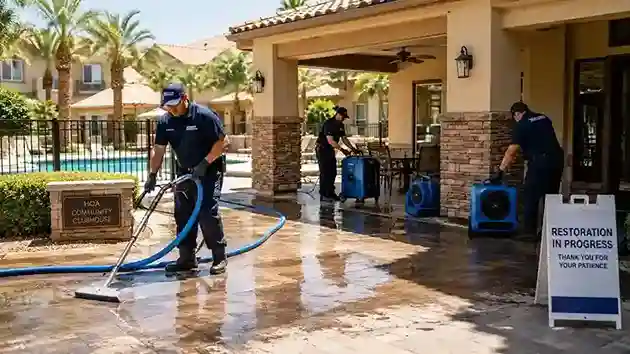
Water damage in a single-family home is a two-party problem: the homeowner and, if needed, an insurance carrier. Water damage in an HOA community is rarely that simple. A single failure can involve a board of directors making decisions on behalf of the association, a property management company coordinating logistics, multiple affected unit owners, one or more vendors, and both a master insurance policy and individual owners' policies, sometimes all responding to the same event at once.
That complexity changes how a restoration company has to operate. A leak that starts in a third-floor unit doesn't stay there. It can travel through floor assemblies into the unit below, along shared walls into a neighboring unit, and into a common hallway or stairwell before anyone realizes how far it has spread. A roof leak over a clubhouse can affect a fitness center, a leasing office, and a meeting room simultaneously. Fire sprinkler discharges and shared plumbing failures routinely cross unit lines and property boundaries that were never designed with a water event in mind.
Because HOA water losses often affect common areas and privately owned units at the same time, restoration has to be coordinated as a single project rather than a series of disconnected repairs. That means clear communication with the board and management from the first call, documentation organized in a way that supports both the master policy and any individual claims, and a plan that keeps the community functioning while the work gets done.
Riser and stack plumbing failures can affect multiple stacked units in a single event, often before anyone hears water running.
A single roof failure over an attached building can send water into several top-floor units and the hallways below them.
Accidental or malfunctioning fire sprinkler heads release large volumes of water quickly, often across hallways and multiple units.
Amenity buildings see heavy use and complex plumbing, making them a frequent source of community water events.
Lobbies, hallways, and mail rooms can flood from a nearby failure, disrupting daily resident access.
Underground irrigation leaks near buildings or common landscaping can migrate toward foundations and ground-floor units.
Intense seasonal storms can overwhelm roofing, drainage, and grading across an entire community at once.
Blocked or undersized community drainage can back water up into parking structures, breezeways, and ground-floor units.
Shared sewer line failures can affect multiple connected units and require immediate containment and sanitization.
Pool buildings, restrooms, and maintenance facilities face constant moisture exposure and frequent plumbing demands.
Common area restoration requires more planning than restoring a single unit, since these spaces stay in near-constant use by residents and guests. We restore:
Restoration in shared spaces almost always requires more planning than a single unit does. We phase the work section by section wherever possible, use containment barriers to isolate active work areas, and build a schedule around resident traffic and amenity usage so a clubhouse or fitness center can often stay partially accessible instead of closing entirely. Safety planning, wet-floor signage, air quality precautions, and clear access routes, is built into every common area project from day one.
Attached communities create pathways for water that don't exist in single-family homes. A leak in one unit can migrate to a unit below through the ceiling assembly, sideways through a shared wall into a neighboring unit, or up through a stack plumbing failure that affects every unit connected to that line. Upper-unit leaks are especially common, since gravity pulls water down through flooring and ceiling materials long before it becomes visible in the unit where it started.
When we respond to a multi-unit event, our first priority is containment, stopping water from spreading to additional units while the source is addressed. From there, we use moisture mapping to identify every affected space, not just the unit where the leak was reported, since ceiling stains and wet drywall often show up in a different unit than the one causing the problem. Coordinating access across multiple units, each with different owners, schedules, and sometimes different tenants, requires close communication with the property manager, and we handle that scheduling directly so the board and residents aren't left coordinating it themselves.
Crews are dispatched immediately to stop active water intrusion and begin containment across all affected areas.
We inspect every affected unit and common area, not just the reported location, to establish the full scope of the loss.
We connect directly with the board and property manager to align on access, priorities, and communication expectations.
Photos, moisture logs, and reports are compiled to support both the master policy and any individual unit owner claims.
Standing water is removed and commercial drying equipment is placed across every affected unit and common space.
We provide the board or manager with clear updates and timelines they can share directly with affected residents.
Once moisture readings confirm the structure is dry, we rebuild affected drywall, flooring, and finishes to pre-loss condition.
A final walkthrough with the board or manager confirms the work meets expectations before the project is closed out.
Water losses in HOA communities frequently involve questions about responsibility between the association, unit owners, and their respective insurance carriers. Master policies typically cover common areas and the building's original structure, while individual unit owner policies, often HO-6 policies for condos, generally cover interior finishes and personal belongings within a unit. Exactly where that line falls depends on your community's specific master policy and governing documents, which is why we don't make coverage determinations ourselves.
What we do provide is the documentation both sides need to work through it: dated photos of every affected area, moisture logs tracking drying progress over time, vendor reports summarizing the scope of work, and clear communication with the board throughout the process. This documentation is built to hold up whether it's being reviewed by the association's carrier, a unit owner's individual carrier, or both at the same time on a multi-unit loss.
For general guidance on how water damage claims are typically evaluated, see our insurance resource center.
Water damage response guidance consistently points to the same conclusion: delays increase both damage severity and claim costs. In a community setting, that math is magnified because a delayed response doesn't just affect one household, it can extend across several units and shared spaces at once.
Faster drying reduces the window for mold to develop in shared walls and common area cavities.
Quick, visible response reassures residents that the board and management are handling the situation well.
Materials dried early are often saved; materials left wet too long often need full replacement.
Prompt, documented response supports the board's fiduciary responsibility to the community.
Restoration in a shared community affects more people than the ones directly impacted by the water. Boards need timely updates to make informed decisions and satisfy their reporting obligations to ownership. Residents need to know what's happening, how long it will take, and whether any areas are off-limits. Property managers need consistent status reporting they can rely on without having to chase it down.
We build our communication approach around these different audiences rather than treating a community the same way we'd treat a single household. That includes board updates at key project milestones, resident notices coordinated through management for anything affecting shared spaces or access, emergency notifications when a situation requires immediate resident awareness, and straightforward vendor coordination when other contractors, such as plumbers or roofers, are working alongside us on the same event.
Multi-story condo buildings with shared plumbing stacks, hallways, and structural systems.
Attached townhomes with shared walls and roof lines that require coordinated response.
Large communities with multiple amenity buildings, common areas, and infrastructure systems.
Age-restricted communities where resident communication and accessibility planning are especially important.
High-end properties requiring careful attention to finishes, documentation, and resident experience.
Properties combining residential units with retail, office, or amenity space, each with distinct restoration needs.
Associations managing shared ownership structures with complex common area responsibilities.
24/7 dispatch across Chandler communities to limit how far damage spreads before work begins.
Documentation formatted for board meetings, management reports, and insurance carriers alike.
Moisture logs, photos, and reports built to support both master and individual unit claims.
Phased work and access planning that keeps common areas usable wherever safely possible.
A single point of coordination for boards and managers throughout multi-unit and common area events.
Status updates delivered on a schedule the board and management can rely on.
Clear notices and timelines that reduce confusion and complaints during active restoration.
Equipment and crew capacity to handle events affecting multiple units or entire amenity buildings.
We support HOA boards, community managers, and associations throughout Chandler, including communities near Ocotillo, Sun Lakes, Cooper Commons, Clemente Ranch, Fox Crossing, and Downtown Chandler, as well as the surrounding East Valley.
Our crews regularly work near community landmarks including Downtown Chandler, the Chandler Fashion Center, Veterans Oasis Park, the Price Road Corridor, the Intel Ocotillo Campus, the Loop 202, Arizona Avenue, and near Chandler Municipal Airport.
Choosing a restoration partner for a community involves more due diligence than choosing one for a single home. These are the questions we encourage boards and managers to ask any contractor, including us:
It depends on where the damage originated and how your governing documents (CC&Rs) define ownership boundaries. In most communities, the HOA's master insurance policy is responsible for damage to common areas and the building's original structure, such as shared roofs, exterior walls, and common plumbing. Damage inside a privately owned unit, including flooring, cabinetry, and personal belongings, is typically the unit owner's responsibility under their own HO-6 or condo policy. When a leak originates in one unit and affects another, responsibility can become more complex, often involving both the association's policy and one or more unit owners' policies. We don't determine coverage, but we document the source, path, and extent of damage clearly enough that boards, managers, and carriers can work through responsibility with accurate information.
Yes, and in multi-story or attached communities this is one of the most common ways HOA water losses escalate. Water from a failed supply line, roof leak, or overflowing fixture doesn't stay contained to the unit where it started. It travels downward through floor assemblies into the unit below, sideways through shared walls, and along corridors into hallways, stairwells, and sometimes elevator shafts. A leak that looks minor in the originating unit can mean ceiling damage in one unit below, wall damage in an adjacent unit, and moisture in a shared hallway all at once. This is why our assessment process always checks surrounding units and common areas, not just the unit where the leak was reported.
Master policies generally cover damage to common areas and the building's original structure, but coverage details vary significantly between associations depending on how the policy is written and what your governing documents require. Some master policies are written on an "all-in" basis that includes fixtures within units, while others cover only bare walls and common elements, leaving interior finishes to unit owners' individual policies. Because of this variation, we recommend boards and managers review their specific master policy language rather than assume a standard answer. What we can do is provide clear, well-documented moisture reports and photos that give your carrier and board the information needed to determine how the policy applies to a specific loss.
As soon as possible, ideally within hours of the water source being stopped. In community settings, delays don't just add cost, they compound quickly because water is already affecting multiple units, shared walls, and common infrastructure. Every additional hour increases the chance that ceiling assemblies, drywall, and flooring in more than one unit will need replacement instead of drying, and it raises the risk of mold developing in shared wall cavities where it's harder to detect. We prioritize emergency response for HOA and multi-unit events specifically because the exposure grows faster than it would in a single-family home, and getting extraction and drying equipment in place quickly protects both the association's common areas and individual owners' units.
We work with the board and property manager to establish a communication plan appropriate to the size and scope of the event, rather than communicating with residents independently or informally. For smaller events affecting a single unit or hallway, this often means a written notice posted or distributed by management describing the work, the timeline, and any access restrictions. For larger events affecting common areas like a clubhouse, pool building, or multiple units, we provide status updates the board or manager can share on a regular schedule, along with realistic timelines so residents aren't left guessing. Our goal is to make sure the association controls the messaging to its own residents while we supply the accurate project information behind it.
In many cases, yes, though it depends on the extent of the damage and safety considerations. We use phased work plans and containment barriers whenever possible so that portions of a clubhouse, fitness center, or lobby can remain accessible while another section is being dried or repaired. Equipment is positioned to minimize noise and disruption where it's safe to do so, and we coordinate scheduling around resident traffic patterns and amenity usage hours when the board or manager has a preference. When a full closure is unavoidable, such as when flooring must be removed or air quality is a concern, we communicate that clearly in advance so the board can plan around it rather than being surprised by it.
Yes. HOA boards operate under fiduciary and reporting obligations to their membership, so we provide documentation built with that in mind, including dated moisture logs, thermal imaging results, photos of affected areas, a summary of the work performed, and status updates at each phase of the project. This documentation is formatted so it can be referenced directly in board meeting minutes, shared with the community's insurance carrier, or attached to a manager's report to ownership. If your management company or board has a specific reporting format they prefer, we're glad to work within it rather than asking you to adapt to ours.
Multi-unit events require us to treat the loss as a single coordinated project rather than a series of separate, disconnected jobs, even though several different insurance policies may ultimately be involved. We begin by mapping every affected space, common areas and individual units alike, so the full scope is understood from the start rather than discovered piecemeal. From there, we document each affected unit and common area separately with its own moisture readings and photos, which makes it easier for the board, property manager, and any insurance adjusters involved to sort out how the master policy and individual unit owner policies apply. Clear, unit-by-unit documentation is what prevents multi-unit claims from becoming disputed or delayed.
Yes, and shared walls between units present a particular challenge because moisture can be trapped inside the wall cavity where neither unit owner can see it. When water travels through a shared wall from a leak in one unit, or from a common area plumbing failure, it can saturate insulation and framing on both sides without producing an obvious wet spot in either unit right away. In Arizona's warm indoor temperatures, mold can begin developing in that hidden, damp environment within 24 to 48 hours. This is why we recommend checking both sides of a shared wall, and adjoining units, whenever a leak is reported near one, rather than assuming the damage is contained to the unit where it was discovered.
Yes. Water losses in HOA communities don't wait for business hours, and a pipe failure, roof leak, or fire sprinkler discharge that happens overnight or on a weekend can affect multiple units and common areas before anyone from management arrives on site. Our crews are available around the clock for emergency dispatch throughout Chandler, so boards, property managers, and on-call staff have a direct line to a response team regardless of when an event occurs. Getting extraction and containment started quickly, even before a full board discussion can happen, is often what limits how many units and how much common area square footage ultimately need repair.
A stack plumbing failure hit three units at once in our building near Ocotillo. Gateway coordinated with our management company and kept every owner updated with clear timelines.
Our clubhouse flooded after a monsoon storm and they phased the drying work so the fitness center stayed open the whole time. Documentation for our insurance carrier was thorough.
A fire sprinkler discharged in a hallway and affected two adjoining units. Gateway mapped the whole scope quickly and gave us a report we could bring straight to the board meeting.
17817 S McQueen Rd, Chandler, AZ 85286
From single-unit leaks to multi-building common area events, our crews respond fast and keep your board, management team, and residents informed. Call now or schedule a community assessment.