Category 3 water — also called black water — is the most hazardous classification recognized by restoration professionals. It contains sewage, bacteria, and pathogens capable of causing serious illness. Call Gateway Restoration now: (480) 591-8997 for immediate, IICRC-standard emergency response.
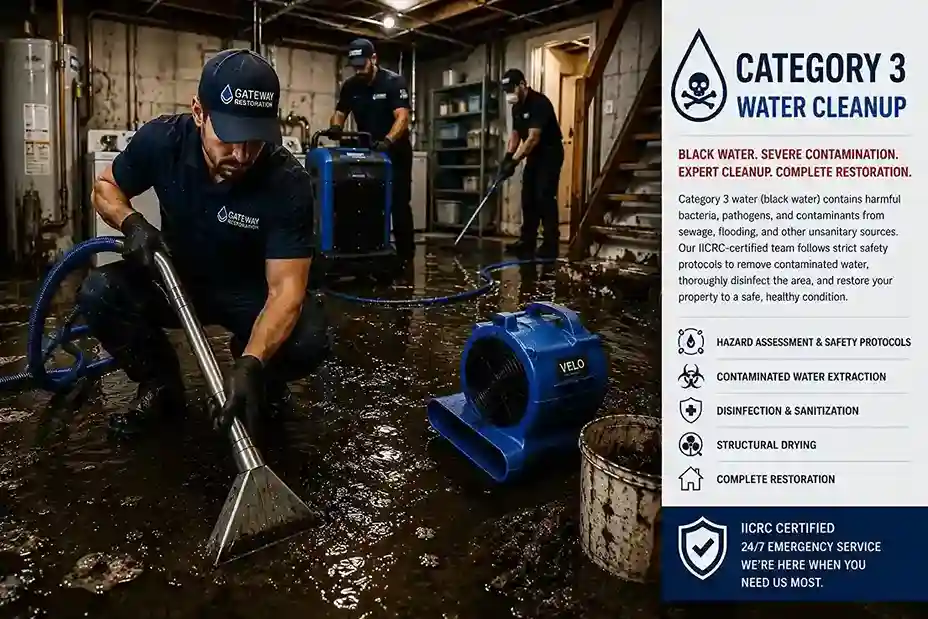
The IICRC classifies water damage into three categories based on contamination level. Category 3 sits at the top of that scale — water so contaminated that contact, ingestion, or inhalation of aerosolized particles can cause real harm. This isn't a marketing distinction; it's a formal industry classification that determines exactly how a restoration crew is required to respond.
Category 3 water can carry pathogens, viruses, bacteria, and sewage organisms including E. coli, salmonella, and other disease-causing microbes. Because of this, it's frequently referred to as black water, contaminated water, or biohazard water — all describing the same dangerous classification.
Common sources include sewage backups, toilet overflows carrying waste, floodwater that has traveled across the ground, and standing water from any source that has been left untreated long enough to become a breeding ground for bacteria. Once a loss is classified as Category 3, every step of the cleanup — from PPE requirements to what materials can be salvaged — changes.
Chandler homeowners encounter Category 3 water through several distinct paths, each requiring the same level of urgency.
Main line or lateral sewer backups push raw sewage into drains, tubs, and toilets — one of the most common Category 3 events we respond to in Chandler.
A toilet overflow carrying waste material is automatically treated as Category 3, regardless of how the clog occurred.
Water that enters a structure from outside during a storm has typically traveled across soil, streets, and storm drains, picking up contamination along the way.
Groundwater pushing up through slab cracks or foundation gaps often carries soil bacteria and contaminants from beneath the property.
Chandler's monsoon storms can drive contaminated runoff into garages, patios, and ground-floor rooms within minutes.
Overflow from nearby irrigation canals and flood-irrigation systems can introduce agricultural runoff and standing-water bacteria into a property.
High-wind monsoon storms can force contaminated rainwater through roof vents, window seals, and door thresholds.
Gray water left untreated for roughly 48 hours or longer is reclassified as Category 3, since bacteria multiply rapidly in stagnant water.
These sources aren't limited to any one part of Chandler — we've responded to Category 3 losses from Downtown Chandler to Ocotillo, Sun Lakes, Cooper Commons, Fox Crossing, and Clemente Ranch. Monsoon season, aging municipal drainage infrastructure, and neighborhood-level drainage issues all contribute to how often these events occur across the city.
Category 3 water is not a job for a wet-vac and some towels. The health dangers are real and immediate: exposure can introduce bacteria, viruses, and parasites directly into cuts, eyes, and mucous membranes. As affected materials sit, mold amplification compounds the risk, and disturbing contaminated, drying materials can release airborne contamination that travels well beyond the original wet area.
The risk isn't evenly distributed across a household. Children, who are more likely to touch contaminated surfaces and put hands near their mouths, face elevated exposure risk. Elderly individuals and anyone who is immunocompromised are significantly more vulnerable to the infections Category 3 water can cause, even from brief contact.
This is exactly why DIY cleanup of Category 3 water is dangerous and, frankly, not something we recommend under any circumstances. Without proper personal protective equipment, containment, and disposal procedures, a homeowner attempting to clean up sewage or floodwater risks direct exposure, cross-contamination of unaffected areas, and improper disposal that can create ongoing health hazards. IICRC guidance is explicit that Category 3 water requires trained technicians using appropriate PPE, containment barriers, and antimicrobial treatment — not household cleaning supplies and good intentions.
Every Category 3 project follows a strict, documented sequence designed to protect health and property.
Technicians assess the full extent of contamination, identify the water source, and determine immediate safety concerns before any work begins.
The loss is formally classified per IICRC standards, confirming Category 3 status and documenting the contamination level for insurance and safety purposes.
Containment barriers isolate the affected area to prevent cross-contamination of unaffected rooms, and technicians don full PPE before entering the space.
Porous materials that absorbed contaminated water — carpet, carpet pad, drywall, insulation, particle board, and upholstered furniture — are removed and disposed of, because these materials cannot be reliably sanitized once contaminated.
Remaining structural surfaces are cleaned and treated with EPA-registered antimicrobial products to neutralize bacteria, viruses, and other pathogens.
Once contamination has been addressed, the space moves into engineered structural drying to remove remaining moisture and prevent secondary mold growth.
A final inspection confirms the area meets a clean, dry standard before restoration and rebuild work begins.
Porous materials frequently require disposal after Category 3 contamination, because their structure allows bacteria and pathogens to penetrate deep inside where cleaning agents can't reliably reach. This typically includes:
Non-porous materials — solid surface countertops, sealed concrete, tile, glass, and some solid wood — can sometimes be cleaned and restored, because their surfaces don't allow contaminants to penetrate below the surface. Every material decision is documented with photos and notes to support your insurance claim and give you a clear record of what was removed and why.
Arizona's monsoon season is one of the most common triggers for Category 3 losses across Chandler.
Intense, fast-moving storms during monsoon season can overwhelm drainage systems and push contaminated water into homes within minutes.
Flash flooding gives homeowners little to no warning, and floodwater is treated as Category 3 by default regardless of its original source.
Runoff picks up oil, debris, soil bacteria, and roadway contaminants long before it reaches a home's foundation.
Chandler's dense caliche soil layer doesn't absorb water quickly, which accelerates surface runoff and street flooding during heavy storms.
Neighborhood retention basins and storm drains can reach capacity fast during intense monsoon cells, backing water up into streets and yards.
Areas near the Loop 202 corridor, Downtown Chandler, the Ocotillo area, and the Chandler Heights Road region have all seen monsoon-driven street flooding in past storm seasons.
Because floodwater has almost always traveled across ground, streets, or storm drains before reaching a structure, it is treated as Category 3 by default — even if the source itself was originally rainwater. This is a critical distinction Chandler homeowners often don't realize until a restoration crew explains why the same water they'd normally consider "just rain" now requires full biohazard protocols.
Contaminated water doesn't just carry pathogens — it also sets up the exact conditions mold needs to thrive. Mold growth can begin within 24 to 48 hours, and moisture from a Category 3 event frequently becomes trapped behind walls, under flooring, and inside cabinet voids where it's never fully addressed by surface-level cleaning.
Chandler's climate adds urgency to this risk. High summer temperatures accelerate microbial activity, and the humidity spikes that follow a monsoon storm create ideal short-term conditions for mold to establish itself in materials that weren't dried quickly and thoroughly. Combining contamination with trapped moisture is one of the fastest paths to a secondary mold problem layered on top of an already serious Category 3 loss — which is why structural drying and moisture verification are never optional steps in our process.
If mold has already developed on top of a water event, see our mold remediation after water damage page for how that separate process works.
Category 3 cleanup costs more than Category 1 or 2 losses because of the additional PPE, demolition, disposal, and sanitization steps required. These ranges reflect typical Chandler-area projects, but every loss is different, and we provide a free, itemized inspection before work begins.
| Loss Type | Typical Cost Range |
|---|---|
| Small Sewage Backup | $2,500 – $6,000 |
| Moderate Contamination | $6,000 – $12,000 |
| Large Floodwater Loss | $12,000 – $30,000+ |
| Extensive Reconstruction | $30,000+ |
Cost factors include demolition requirements for contaminated materials, the PPE and biohazard handling procedures required for the crew, the amount of drying equipment needed, and the overall reconstruction scope once contaminated materials are removed. These figures are general ranges, not guarantees — actual pricing depends on the specific conditions found during inspection.
Coverage depends heavily on the cause of the loss and your specific policy. Generally covered scenarios include a sudden sewer backup (when your policy carries a sewer backup endorsement), sudden plumbing failures, and other accidental discharge events that happen without warning.
Generally not covered scenarios include damage tied to long-term neglect or known maintenance issues that went unaddressed, and certain flood events, which are often excluded from standard homeowners policies and instead require separate flood insurance.
Whichever category your loss falls into, strong documentation improves your position with your carrier. That means detailed documentation of the loss, ongoing moisture readings throughout the drying process, photo evidence taken before cleanup begins, daily drying logs, and clear insurance reporting that walks your adjuster through exactly what was found and what was done. Gateway Restoration handles this documentation as a standard part of every Category 3 project. This information is general guidance only — for questions about your specific coverage, consult your insurance provider, as we do not provide legal advice. Learn more on our insurance & cost page.
Gateway Restoration provides emergency Category 3 water cleanup throughout Chandler and the surrounding East Valley.
Chandler ZIP Codes Served:
See our full coverage area map for details on every community we serve.
Category 3 cleanup is one part of a full restoration response — explore the related services that support it.
Clean water losses from supply lines and appliance failures.
Gray water cleanup for moderately contaminated losses.
Dedicated response for sewer line and lateral backups.
Rapid response to monsoon and flash-flood water intrusion.
Removing standing contaminated water quickly and safely.
Engineered drying after contamination removal is complete.
Addressing mold that develops on top of a water loss.
Category 3 water, also called black water, is water that is grossly contaminated with pathogens, bacteria, viruses, or other harmful organisms. IICRC standards define it as unsanitary water that can cause severe illness if contacted, ingested, or inhaled. Common sources include sewage backups, floodwater, and standing water left untreated long enough to become contaminated.
Yes. Floodwater is treated as Category 3 by default because it typically picks up soil, chemicals, bacteria, and debris as it moves across the ground and through storm drains before entering a structure, regardless of how clean the water looked at its source.
Yes. Contact with Category 3 water can cause gastrointestinal illness, skin infections, and respiratory issues from airborne contaminants. Children, the elderly, pregnant individuals, and anyone who is immunocompromised face a significantly higher risk from exposure and should avoid contact with affected areas entirely.
In almost all cases, yes. Carpet and carpet padding are porous materials that absorb contaminants deep into their fibers and backing, making them impossible to fully sanitize. IICRC guidance calls for removal and disposal of carpet and padding after any Category 3 water event.
Category 3 cleanup should begin immediately, ideally within hours of discovery. Contamination spreads as water travels, and the health risk increases the longer affected materials sit untreated. This is not a situation where waiting a day or two is safe.
Often, yes, for sudden events like a sewer backup with the right endorsement or a sudden plumbing failure, though coverage details vary by policy. Damage from long-term neglect or certain flood events may be excluded or require separate flood coverage. We provide the documentation your adjuster needs to support the claim.
Timelines vary based on the extent of contamination and how much demolition is required, but most Category 3 projects run longer than Category 1 or 2 losses due to the additional steps for material removal, antimicrobial treatment, and clearance verification before structural drying and rebuild can begin.
Generally, no. Drywall is porous and absorbs contaminants that cannot be fully removed through cleaning, so IICRC guidance calls for removing drywall affected by Category 3 water, typically at least 12 to 18 inches above the highest visible water line.
Yes. Category 2 gray water that sits untreated for approximately 48 hours or longer is generally reclassified as Category 3, because bacteria and other organisms multiply in standing water over time, regardless of how the water was categorized at the moment of the original loss.
Keep everyone, especially children and pets, away from the affected area. Do not attempt to clean up sewage or floodwater yourself. Avoid touching contaminated surfaces, and if you must enter the area, wear rubber boots and gloves. Photograph the damage from a safe distance for your insurance claim, and shut off water or power sources only if it can be done safely.
Contaminated water is a health hazard that gets worse every hour it's left untreated. Our biohazard-trained crews are available 24/7 throughout Chandler and the East Valley, and we offer a free inspection along with full insurance documentation support.
Call Now: (480) 591-899717817 S McQueen Rd, Chandler, AZ 85286
 Gateway Restoration