This isn't sewage, but it isn't safe either. Gray water from a washing machine overflow, dishwasher failure, or toilet overflow contains contamination that can cause illness if it's not extracted and sanitized quickly. Call now for emergency dispatch.
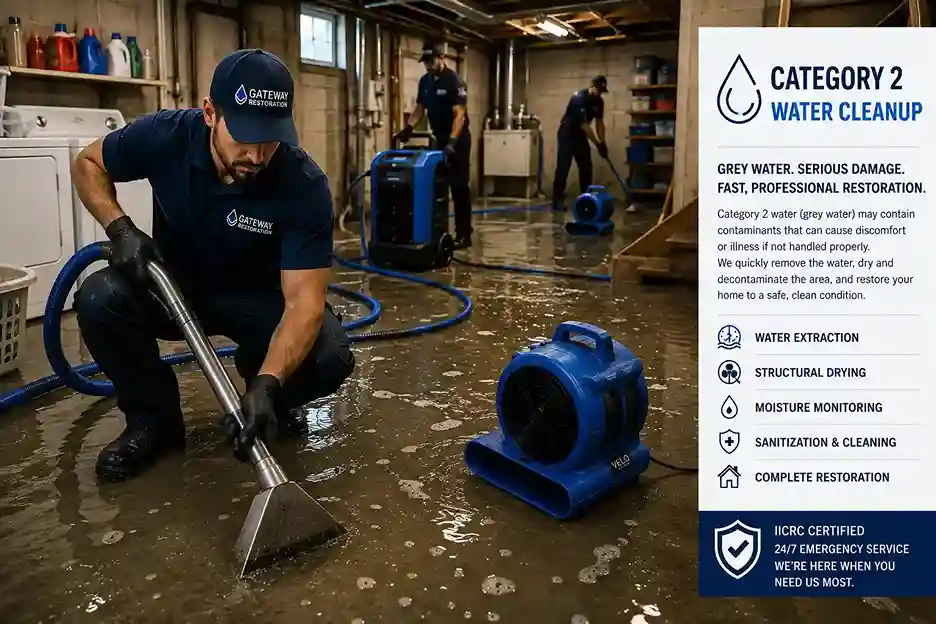
The IICRC — the industry body that sets restoration standards — classifies every water loss into one of three categories based on contamination level. Category 1 is clean water from a source like a supply line, posing little to no health risk. Category 3 is grossly contaminated water, such as sewage or floodwater. Category 2 sits in between, and it's the category most homeowners misunderstand.
Category 2 water is commonly called gray water because it isn't visibly filthy the way sewage is, but it isn't clean either. It contains a significant amount of contamination — bacteria, chemicals, and organic material — capable of causing illness or discomfort if you're exposed to it. A washing machine overflow, for example, can look like ordinary soapy water while still carrying enough bacterial load to require professional handling.
The key difference from Category 1 water is exposure risk. Clean water from a supply line can typically be extracted and dried with standard protocols. Gray water requires antimicrobial treatment, careful handling of anyone in contact with it, and closer evaluation of which materials can be dried in place versus which need to be removed.
Gray water losses show up in predictable places across Chandler households — here's what we respond to most often.
A failed supply line, hose, or overflowing tub sends detergent-laden water across laundry rooms and adjoining flooring.
Leaking gaskets, failed pumps, or overflow events release water carrying food residue and grease into kitchen cabinetry.
Toilet overflow water containing urine but no feces is classified as Category 2, still requiring sanitization, not just a mop.
Slow or clogged drains that back up into sinks, tubs, or floor drains carry contaminants from wastewater already in the line.
A failed sump pump lets collected water and sediment back up into basements, utility rooms, or crawl spaces.
Clean water from a Category 1 event that isn't extracted promptly can absorb contaminants from carpet, subfloor, or building materials and escalate.
AC condensate lines that clog or leak can carry biofilm and organic buildup into ceilings, closets, and wall cavities.
Water heaters, refrigerators, and other appliances that discharge water carrying scale, sediment, or bacterial buildup contribute to gray water losses.
It's worth understanding that Category 2 isn't always where a loss starts. A clean Category 1 leak from a supply line, left unaddressed for even a day or two, can pick up contaminants from carpet fibers, subfloor adhesive, and building materials it sits against — effectively becoming a gray water loss even though the source itself was clean.
It's easy to look at gray water and assume it's just "dirty water" that needs a mop and a fan. In reality, gray water carries a mix of bacteria, organic contaminants, household chemicals, and residual detergents that don't disappear once the water looks like it's gone. Left in carpet padding or behind baseboards, these contaminants continue to break down and can support microbial amplification — rapid bacterial and mold growth — especially in Arizona's warm indoor air.
Direct contact with gray water should be minimized, particularly for children, pets, and anyone with a compromised immune system or respiratory sensitivity. Skin contact can cause irritation, and accidental ingestion, even in small amounts, can cause gastrointestinal illness.
This is also why porous materials — carpet, carpet pad, unsealed drywall, and particleboard — often require more aggressive treatment or outright removal after a Category 2 loss. Unlike hard, non-porous surfaces that can be cleaned and sanitized, porous materials can trap contamination deep inside their structure where surface cleaning can't reach it.
We see it often: a gray water spill looks manageable, so it gets mopped up and forgotten. The real damage is usually happening where you can't see it.
Contamination is still relatively contained. Fast extraction and antimicrobial treatment now prevents most of the damage that follows.
Bacterial growth accelerates in Arizona's warm indoor temperatures. Materials that could have been dried now often need to be removed.
Contamination can reach levels consistent with Category 3 water, mold growth often becomes visible, and insurance documentation becomes more complicated.
Insurance adjusters look closely at how quickly a loss was addressed. A gray water event documented and mitigated within the first day tells a very different story than one left untreated for three days — and category escalation can affect what your policy is willing to cover.
Category 2 jobs require both drying and contamination control working together, not one after the other.
We evaluate the source, spread, and immediate safety concerns as soon as we arrive.
Water is tested and confirmed as Category 2, guiding the protective equipment and treatment protocol used.
Standing water is removed quickly with commercial extraction equipment to limit how far contamination spreads.
Carpet, padding, and other porous materials that can't be safely sanitized are removed and disposed of properly.
Affected surfaces are treated to control bacterial growth before drying equipment goes in.
Commercial air movers and dehumidifiers dry remaining materials according to IICRC calculations.
Moisture readings are logged daily to track drying progress and confirm contamination is under control.
Removed materials like drywall, flooring, and baseboards are rebuilt back to pre-loss condition.
A final walkthrough with moisture readings confirms the space is dry, sanitized, and ready to use.
The general rule: non-porous materials can usually be cleaned and sanitized, while porous materials that absorbed gray water are harder to fully decontaminate and are often more cost-effective to replace than to attempt to save.
Arizona's warm indoor temperatures create close to ideal conditions for mold once moisture is trapped somewhere it can't evaporate on its own. That's exactly what happens after a gray water event that isn't fully extracted: hidden moisture settles into wall cavities, under cabinets, and beneath flooring, creating humidity pockets that stay damp long after the surface appears dry.
Because gray water already carries organic material and bacteria, it can accelerate mold colonization compared to a clean-water loss in the same space. Cabinet voids beneath sinks and around dishwashers are especially prone to this, since they're dark, enclosed, and rarely checked until a smell or visible growth gives it away.
Most Chandler homes are built on slab-on-grade construction, which means gray water from a laundry room or kitchen leak can travel under flooring and stay trapped against the concrete slab, hidden from view until moisture mapping reveals it. This kind of hidden moisture beneath flooring is one of the most common surprises we find during a Category 2 inspection.
Chandler's hard water also plays a role. Mineral buildup accelerates wear on washing machine hoses, dishwasher connections, and supply lines, increasing the odds of a sudden failure. Combine that with aging appliance connections in homes that are 15-plus years old, and gray water events tend to cluster around the same fixtures year after year.
During Chandler's long summer, HVAC condensate issues add another gray water source, especially in attics and closets where a clogged condensate line can leak for days before anyone notices a stain. And during monsoon-season humidity spikes, indoor moisture levels climb even in homes without a direct leak, which slows drying times on any active gray water job and raises mold risk further.
We respond to Category 2 water losses throughout Chandler, Gilbert, Mesa, Tempe, Queen Creek, and Phoenix, including neighborhoods near Downtown Chandler, Ocotillo, Sun Lakes, Cooper Commons, Fox Crossing, and Clemente Ranch.
Because coverage often hinges on whether a loss was sudden or the result of neglect, accurate category documentation from the very first visit matters. A clearly documented Category 2 classification, backed by professional moisture readings, helps your adjuster understand exactly what happened and when.
Every Category 2 job we run includes moisture maps and thermal imaging that show exactly where gray water traveled, not just where it was visible. This objective evidence protects you if a claim is questioned later, and it gives our drying crew a clear target for when a space is actually dry.
We also maintain daily logs, complete insurance records, and detailed drying reports throughout the job. Together, this documentation supports faster claim approval and keeps the entire project transparent — you always know what stage the job is in and why.
Crews positioned throughout the East Valley for fast Category 2 dispatch.
Commercial air movers and dehumidifiers sized to IICRC calculations for your space.
Hidden gray water is found, not guessed at, before drying begins.
Accurate on-site testing so your job is treated — and documented — correctly from day one.
Documentation built the way adjusters expect it, start to finish.
You always know what stage your restoration is in and what happens next.
From extraction through rebuild, one team handles the entire job.
The local crew that answers your call is the same crew that shows up.
"Our dishwasher failed overnight and soaked the kitchen. Gateway had a crew out within two hours and explained why it wasn't just 'dirty water' we could mop up ourselves. Really appreciated the honesty."
"Washing machine overflow turned into a bigger issue than I expected. They found moisture under the flooring I never would have known about with their imaging equipment."
"Professional from start to finish. They documented everything for our insurance claim and it got approved without any back and forth."
We're based near Arizona Avenue and Loop 202, close to landmarks like Chandler Fashion Center, Veterans Oasis Park, Tumbleweed Park, the Intel Ocotillo Campus, and Chandler Municipal Airport — and we respond quickly throughout the East Valley.
Zip codes we cover across Chandler:
Category 2 water, or gray water, contains a significant amount of contamination that can cause illness or discomfort if you come into contact with it. Common sources include washing machine overflows, dishwasher failures, and toilet overflows without feces.
Yes. Gray water can carry bacteria, detergent residue, and organic contaminants that pose a real health risk, especially with prolonged contact or if it's absorbed into porous materials in your home.
Small, contained spills can sometimes be handled with gloves and proper ventilation, but any significant gray water event involving carpet, drywall, or standing water should be handled by trained technicians with proper equipment.
As soon as possible, ideally within hours. The longer it sits, especially in Arizona's warm indoor temperatures, the faster contamination spreads and the more likely the loss is to escalate toward Category 3 conditions.
Yes. Gray water that sits for an extended period, particularly in warm conditions, can develop bacterial growth severe enough to be reclassified as Category 3, requiring more aggressive removal and sanitization.
Sudden, accidental gray water losses like a washing machine overflow or dishwasher failure are typically covered. Damage from neglect or a long-term leak is usually excluded, which is why accurate category documentation matters.
Carpet and carpet padding exposed to gray water, along with saturated drywall and insulation, typically need replacement. Hard surfaces like tile and solid wood can often be cleaned, sanitized, and dried instead.
It can, and quickly. In Arizona's warm indoor environments, mold can begin developing within 24 to 48 hours if contaminated moisture remains trapped in wall cavities, cabinet voids, or under flooring.
Most Category 2 jobs take three to five days for extraction, antimicrobial treatment, and structural drying, though the timeline can extend if materials need to be removed and rebuilt.
Yes, Gateway Restoration provides 24/7 emergency response for Category 2 water damage throughout Chandler, Gilbert, Mesa, Tempe, Queen Creek, and Phoenix.
The longer Category 2 water sits, the more it costs to fix. Our crews are standing by 24/7 across Chandler and the East Valley.
17817 S McQueen Rd, Chandler, AZ 85286
 Gateway Restoration