Fast Cleanup for Washing Machines, Dishwashers, Refrigerators & Water-Using Appliances
Appliance leaks often start slowly and stay hidden for hours or days, quietly damaging flooring, cabinets, drywall, and subfloors long before a puddle ever becomes visible. Gateway Restoration finds it fast and dries it right.
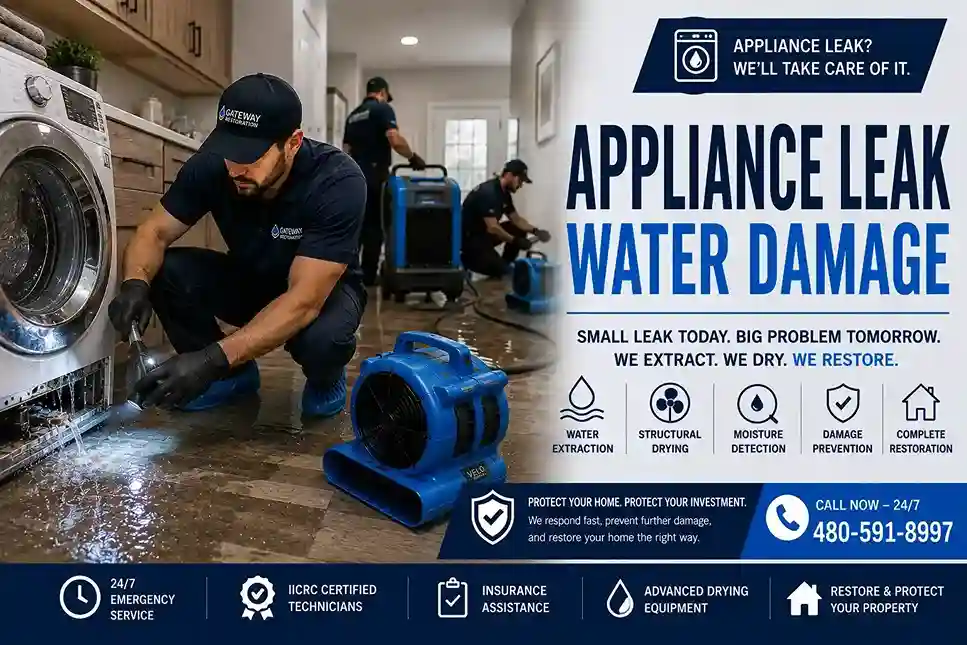
Washing machines, dishwashers, refrigerators, and water filtration systems each fail in different ways — and each requires a different drying strategy depending on where the water travels and what it touches first.
Unlike a burst pipe that sprays water across a room, most appliance leaks are quiet. A cracked ice maker line drips behind a refrigerator no one moves for months. A washing machine hose seeps slowly into a laundry room floor drain that can't keep up. By the time a homeowner notices, the damage is usually well ahead of what's visible.
Supply lines and drain connections run behind appliances and inside enclosed cabinet bases, out of daily view.
A slow drip during an overnight cycle can run for eight hours or more before anyone is awake to notice.
A leak that starts while a home is empty for days can saturate flooring and subfloor completely unchecked.
Water spreads sideways under vinyl, tile, and hardwood far beyond the footprint of the appliance itself.
Plywood and OSB subfloor soak up moisture like a sponge, softening and swelling before the surface shows signs.
Warm, damp cabinet interiors are ideal mold conditions, often developing before any smell reaches the kitchen.
Most homeowners don't discover the full extent of an appliance leak until flooring begins to buckle, cabinet toe kicks swell, or baseboards start separating from the wall — signs that moisture has already been present for an extended period.
Stop the cycle and power down the washing machine, dishwasher, or refrigerator to prevent additional water from entering the space.
Locate the appliance's dedicated shutoff valve, or the home's main water valve if you can't isolate the source quickly.
If the outlet or cord is not standing in water, unplug the appliance at the wall. If it is, leave it and shut off the breaker instead.
Lift rugs, move small furniture, and pull items out of lower cabinets before they absorb additional moisture.
Document the appliance, the water source, and the affected flooring or cabinets before any cleanup begins for insurance purposes.
Towels manage surface water but can't reach moisture that has already traveled under flooring or into cabinet bases.
Call (480) 591-8997 for emergency assessment and extraction before the water spreads further.
Every hour water sits raises the risk of cabinet swelling, flooring damage, and mold growth in Arizona's warm indoor environments.
Every appliance leak job follows a structured, documented process built around IICRC S500 structural drying standards, so nothing is left to guesswork and your insurance claim is backed by objective data.
We identify the appliance, the failure point, and the full extent of water travel before any equipment is placed.
Infrared cameras detect hidden moisture behind cabinets, under flooring, and inside wall cavities near the appliance.
We log baseline readings across the affected area to track drying progress accurately from day one.
Standing water is removed with commercial extraction equipment before it spreads further under flooring.
Specialized drying techniques target cabinet bases, toe kicks, and interior shelving without forcing removal when avoidable.
Air movers and floor mat systems are positioned to pull trapped moisture out from beneath hardwood, tile, and vinyl.
Penetrating moisture meters confirm whether the subfloor itself has absorbed water requiring extended drying time.
Where water has traveled toward baseboards, we check wall cavities for wicking moisture before it reaches drywall.
Commercial dehumidifiers pull ambient moisture from the air so surfaces can release water efficiently.
Strategically placed air movers accelerate evaporation across floors, cabinet interiors, and wall surfaces.
We return daily to log readings and adjust equipment placement until every material reads dry.
Once moisture readings confirm the structure is dry, we complete any needed repairs and issue final documentation.
Not every appliance leak is the same restoration job. Kitchens and laundry rooms use different materials and layouts, which changes how water spreads and how drying needs to be approached.
A kitchen leak often calls for careful cabinet-by-cabinet drying to protect cabinetry and countertops, while a laundry room leak more frequently involves larger open floor areas and a higher chance of water reaching adjoining rooms. Our crews adjust equipment placement and drying timelines to match each scenario.
Certain conditions common across Chandler neighborhoods make appliance leaks more likely and, in some cases, more damaging once they start.
Rubber supply hoses degrade over time and are a leading cause of sudden washing machine and dishwasher failures.
Chandler's hard water accelerates mineral scale inside valves and fittings, shortening the lifespan of appliance connections.
Elevated household water pressure puts extra strain on hoses and fittings, increasing the risk of a sudden burst.
Many Chandler subdivisions use standard builder-grade fittings that are more prone to failure than upgraded components.
Homes left unattended during summer travel or between tenants can go days without anyone noticing a leak has started.
Custom cabinetry and expanded second-floor laundry rooms in newer builds raise the stakes and complexity of drying.
Arizona's mineral-heavy water supply also shortens the practical lifespan of many water-using appliances compared to regions with softer water, which is part of why we recommend proactive hose replacement well before manufacturer end-of-life estimates.
We make salvage-versus-replacement decisions based on moisture readings, material type, and how long the water was present — not assumptions. Our goal is always to save what can reasonably be saved before recommending replacement.
Most Chandler homeowners policies are built to respond to events that happen without warning: a supply hose that bursts, a valve that fails, or an ice maker line that suddenly disconnects. These sudden accidental failures typically fall within standard coverage. What's commonly excluded is long-term seepage — a slow drip behind a refrigerator that ran for months without detection is more likely to be treated as deferred maintenance by an adjuster.
We support your claim with thorough documentation, including moisture logs, photos, and a written description of the failure point, and we work directly with your adjuster throughout the process. Understanding your policy's stance on gradual versus sudden damage before a leak happens can also help set expectations if one occurs.
| Damage Type | Typical Cost Range |
|---|---|
| Minor Cleanup | $900–$2,000 |
| Kitchen Drying | $2,000–$5,000 |
| Cabinet Restoration | $3,500–$8,000 |
| Large Appliance-Related Restoration | $8,000–$18,000+ |
Actual pricing depends on how long the water sat before treatment, the square footage affected, whether cabinets or hardwood flooring are involved, and how far water traveled beneath surfaces. Call for a free, itemized inspection and estimate before any work begins.
Braided supply hoses degrade over time and should be replaced proactively, not just when they show visible cracking.
Check dishwasher and refrigerator supply lines periodically for kinks, cracks, or loose fittings.
Battery-powered water sensors placed near appliances can alert you the moment moisture is detected.
Smart shutoff valves stop water flow automatically when a leak is detected, limiting total water volume.
Inspect ice maker tubing periodically, since it's rarely checked once the refrigerator is installed.
A yearly check of appliance connections and water pressure can catch problems before they become emergencies.
Shut off the water supply to washing machines before extended travel to eliminate leak risk while away.
A pressure regulator reduces strain on hoses and fittings throughout the home, extending appliance lifespan.
We respond to appliance leak water damage throughout Chandler and the surrounding East Valley, including Ocotillo, Downtown Chandler, Sun Lakes, Cooper Commons, Clemente Ranch, and Fox Crossing.
Yes. A dishwasher leak that goes unnoticed for even a day can saturate the cabinet base, toe kick, and subfloor beneath it. In Chandler's warm indoor temperatures, mold can begin colonizing those damp materials within 24 to 48 hours, especially inside the enclosed, poorly ventilated cabinet space directly under and around the unit.
It depends on how long the cabinets sat wet and what they're made of. Solid wood cabinets exposed briefly can often be dried, cleaned, and refinished. Particleboard or MDF cabinet boxes swell and delaminate quickly once saturated and frequently need partial or full replacement, even when the wet time was short.
Most homeowners policies cover sudden appliance failures, such as a burst supply hose or a valve that fails without warning. Damage caused by a hose that was visibly cracked or leaking for weeks before the failure is more likely to be treated as a maintenance issue and excluded, so documentation of when the leak started matters.
A fully burst washing machine supply hose connected to a standard household line can release several hundred gallons per hour under normal water pressure. Left unnoticed overnight or during a vacation, that volume is enough to flood an entire laundry room and travel into adjoining hallways and bedrooms.
Solid hardwood exposed briefly to appliance water can often be saved using controlled drying with air movers, dehumidifiers, and moisture monitoring, provided cupping or warping hasn't set in. Flooring left wet for more than 24 to 48 hours, or engineered wood with a thin veneer, has a much lower chance of full recovery.
That decision is best made by an appliance technician, not a restoration company, since it depends on which component failed. Our focus is drying and restoring the structure around the appliance; we can point you toward trusted local appliance repair contacts if the unit itself needs evaluation.
Most kitchen or laundry room drying projects take three to five days with commercial air movers and dehumidifiers running continuously. Jobs involving swollen cabinets, hardwood flooring, or subfloor saturation can take longer, since those materials release moisture more slowly and require careful daily monitoring.
Yes. Thermal imaging cameras detect temperature differences caused by evaporating moisture inside walls, under cabinets, and beneath flooring, revealing wet areas that aren't visible to the eye. This is especially useful for appliance leaks, since water often travels sideways under flooring, away from the appliance itself.
Yes, refrigerator ice maker and water dispenser lines are among the most common sources of slow, hidden kitchen leaks we respond to in Chandler. The plastic tubing running to the water line is prone to kinking, cracking, or disconnecting behind the unit, often going unnoticed since the fridge blocks the view of the floor beneath it.
Shut off the appliance and its water supply, unplug it if it's safe to reach the outlet without stepping in water, and move nearby rugs, furniture, and belongings away from the wet area. Take photos of the appliance, the water source, and affected flooring or cabinets before anything is moved or cleaned up.
17817 S McQueen Rd, Chandler, AZ 85286
Our crews are standing by 24/7. Call now for immediate dispatch, or request a free moisture inspection.
 Gateway Restoration